CHAPTER 7
Nuclear Electricity And The Citizen's Rights
Every aspect of the determined public relations campaign of the U.S. Atomic Energy Commission, the Joint Committee on Atomic Energy, and the electric utility industry shows an infringement on the rights of U.S. citizens. The misuse of public funds for this purpose should raise the eyebrows of even the most cynical observer.
In the Declaration of Independence are the following historic words:
"We hold these truths to be self-evident: that all men are created equal, that they are endowed by their Creator with certain inalienable Rights, that among these are Life, Liberty, and the Pursuit of Happiness . . ."
It is becoming increasingly clear that our democratic rights to the pursuit of happiness, in the form of a livable environment, are being seriously curtailed.
It is no secret that we face an environmental crisis of deep proportions because technological developments have resulted in massive pollution of our air, our land, our rivers, streams and oceans. It is also no secret that electric power generation is a major offender. Not only does the generation of electricity pollute in a serious and direct way; it also provides the power for a host of additional industries which pollute massively.
Platitudes abound from the electric utility industry and the U.S. Atomic Energy Commission concerning electric power "needs." Facts are curiously lacking.
Instead of a painstaking analysis of how increasing electric power delivery was being used, the dogma was advanced that electricity production must increase 10 percent per year, as it did for several years, far, far into the future. Projections of this, at least to the year 2000, are commonplace. This dogmatic projection, in the total absence of any rational examination, represents a national disgrace.
Cliches such as "power means progress," or "we need more cheap electric power," or "growth is the cornerstone of civilization" are quite shopworn and overtly dangerous for the continued existence of life on earth. But no forum has been opened to consider the issue of optimum electric power production.
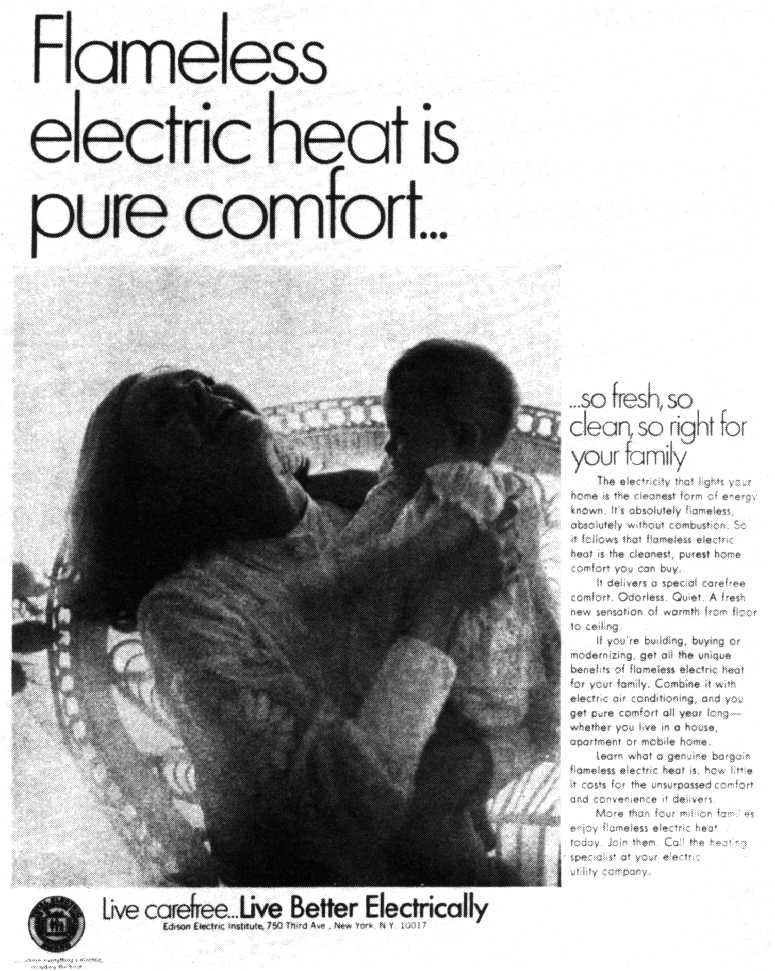
The electric utility industry and the Atomic Energy Commission have been conducting a joint public relations campaign to sell the 10 percent annual growth in electric power production as a magical requirement of existence. And they pay for the campaign with public funds! This misuse of taxpayer funds by AEC is a scandal. The AEC admits doubling its public relations staff from 35 to 70 full-time Public Relations people, to "sell" the atom. Instead, the AEC and the electric utility industry should be sponsoring a serious public forum on the subject of electric power requirements.
Indirectly, the electric utility industry is using tax money to brainwash the public through ads in national magazines, TV spots, etc. What funds the utilities expend are regarded as part of their tax deductible "costs." The public pays for these in addition to the regular charges it pays to provide a profit for the utilities.
So two groups—the U.S. Atomic Energy Commission (and its Congressional Joint Committee patrons) and the electric utility industry—both promote their wares, with an apparent disregard for the public's right to understand, and participate in a meaningful debate and decision concerning electric power requirements. This represents blatant disfranchisement of the public—use of public funds for propaganda without any public participation.
The inalienable rights to life, liberty and pursuit of happiness are even more seriously infringed upon by the development of nuclear electricity in its rash proliferation. Very few citizens are aware of two major ways this comes about.
For many Americans, the purchase of a home is an important step in their pursuit of happiness. And because of the risk to that happiness, inherent in a loss of their home, Americans are accustomed to buying home insurance to protect that crucial investment of life savings. Little known to most Americans is the presence of a "Nuclear Exclusion" clause in their homeowner's insurance policy. A typical set of nuclear exclusion clauses from a Homeowners' policy issued by Hartford Insurance Group (one of the nation's largest and most reliable insurance companies) are as follows:
2. Nuclear Clause—Section 1: The word "fire" in this policy or endorsements attached hereto is not intended to and does not embrace nuclear reaction or nuclear radiation or radioactive contamination, all whether controlled or uncontrolled, and loss by nuclear reaction or nuclear radiation or radioactive contamination is not intended to be and is not insured against by this policy or said endorsements, whether such loss be direct or indirect, proximate or remote, or be in whole or in part caused by, contributed to, or aggravated by "fire" or any other perils insured against by this policy or said endorsements; however, subject to the foregoing and all provisions of this policy, direct loss by "fire" resulting from nuclear reaction or nuclear radiation or radioactive contamination is insured against by this policy.
3. Nuclear Exclusion—Section 1: This policy does not insure against loss by nuclear reaction or nuclear radiation or radioactive contamination, all whether controlled or uncontrolled, or due to any act or condition incident to any of the foregoing, whether such loss be direct or indirect, proximate or remote, or be in part caused by, contributed to, or aggravated by any of the perils insured against by this policy; and nuclear reaction or nuclear radiation or radioactive contamination, all whether controlled or uncontrolled, is not "explosion" or "smoke." This clause applies to all perils insured against hereunder except the perils of fire and lightning, which are otherwise provided for in the nuclear clause contained above.
Many citizens are under the illusion that such exclusion clauses apply to nuclear war. Nothing could be further from the truth. If a nuclear electricity plant (or any of its necessary related activities, transport, fuel cleaning, or waste disposal) results in radioactive contamination of one's home, these nuclear exclusion clauses in homeowners' policies mean the citizen may lose the investment in his home, even though he has taken the wise precaution of buying insurance.
The astounded citizen might ask why the insurance industry sees fit to make a special exclusion of nuclear or radioactivity damage to his home. The insurance industry does not add a premium for coverage against radioactivity or nuclear damage. They just refuse to insure.
What nuclear or radioactivity damage worries the insurance companies? Is it nuclear war? Hardly. For if it were, they could readily so specify in the policy.
Clearly, the insurance industry, known for carefully protecting its profits, has taken very definite notice of the burgeoning nuclear electric power industry. It is obvious that it doesn't like what it sees at all. This lack of confidence in the safety of the nuclear electricity industry is expressed by the Nuclear Exclusion clauses in homeowners' policies. Underwriters refuse to risk dollars on the fail-safe formula developed for the nuclear electricity industry.
Considering the insurance industry's long history as a profit-maker, the public would be well advised to take heed of its extreme skepticism.
The insurance companies saw the nuclear electricity industry as a hazard, and moved quickly to protect themselves. The public is denied a similar opportunity.
The Constitutionally Questionable Price-Anderson Act
In the earliest days of the peaceful atom, there were wildly optimistic projections that electric power would become so inexpensive through nuclear electricity generation that metering the electricity would be hardly worthwhile. Those economic forecasts have proved sadly incorrect. In spite of massive subsidies by the federal government, direct and indirect, nuclear electricity is hardly holding its own against fossil-fueled electricity generation. And, it must be pointed out, the latter receives no federal assistance.
The Atomic Energy Establishment, embarrassed by its great promises and great expenditures, wanted to make some public showing that nuclear electricity generation was moving ahead, as advertised. But the leaders of the electric utility industry were disinclined to invest in nuclear power, lacking insurance coverage against possibly catastrophic nuclear accidents. The private insurance industry, feeling that the risk of accidents was unknown, would no more insure the industry against major nuclear accidents than it would the public.
The AEC sponsored one well-known study of the potential cost of a serious accident in nuclear electricity generation. The published results (Report Wash-740, known as The Brookhaven Report), which considered reactors only 1/5 the size of those currently being developed and planned, still concluded that a serious accident could produce monetary losses up to 7 billion dollars—over and above the injuries and losses of life!
There is no evidence that new reactor-developments have lessened the potential money losses to be faced with a major accident. Engineering developments may have cut the risk of certain accidents, but the larger capacity of the newer plants may have offset this. Indeed, no estimate has been made that excludes an even larger possible loss from the new, highly experimental, nuclear electricity reactors.
So the private insurance companies refused full coverage for nuclear electricity plants, and the electric utility industry would not risk construction and operation of nuclear electricity generating stations without insurance coverage. An impasse had arrived in the development of "the peaceful atom." Sensing that their major promotion was in jeopardy, the Joint Committee on Atomic Energy came forth with a fantastically bold solution.
A bill was proposed, known as the Price-Anderson Act, which simply eliminated individual liability in the event of a major accident in a nuclear electricity plant. Originally this act set 500 million dollars as the maximum liability for a single nuclear plant disaster (more recently extended to 560 million dollars). And, in addition, all but 60 million dollars of the insurance up to this limit was to be provided by the U.S. taxpayer. So if we consider the 7 billion dollar potential loss projected by the Brookhaven report, we note that private insurance carriers, in spite of governmental prodding, refused to cover more than one percent of the potential loss. This probably makes nuclear-electricity generation one of the least attractive insurance risks known.
The key point, over and above the lack of confidence of the insurance industry in nuclear electricity plants, is the utter disregard of personal rights the Price-Anderson Act represents for the average citizen. Since the maximum coverage is 560 million dollars per nuclear electricity accident, and since the damage can run to 7 billion dollars, in a serious accident, the individual might recover only 7 cents out of every dollar lost, assuming he is lucky enough to emerge from such an accident with his life.
The insurance industry will not suffer. The electric utility industry will not suffer. Through the generous manipulations of the U.S. Congress (prodded by the Joint Committee), only the citizen will suffer—in the name of progress.
If the Price-Anderson Act were repealed, as assuredly it should be, it is extremely doubtful that any future nuclear electricity generating plants would be built above ground. Indeed, it is extremely doubtful that any electric utility company would be so foolhardy as to continue operation of nuclear electricity plants already built.
Electric utility propagandists, and atomic energy entrepreneurs, state that the extreme skepticism of the insurance industry shouldn't put anyone off. The insurance industry, they tell us, refuses to underwrite the risk simply because there is no prior "experience" upon which to base an estimate of the risk of major nuclear power plant accidents. Precisely.
But there is much more to it than this simple truth. The industry is saying, in a most persuasive manner, that they (the insurance industry) have no confidence whatever in the hopeful, optimistic safety calculations of nuclear electricity propagandists, certainly not enough confidence to risk dollars.
Another area of disfranchisement of citizens by the nuclear electricity industry must be clearly understood. The Atomic Energy Commission and the electric utility industry are well aware of the public's great skepticism concerning the safety of nuclear electric plants. So they resort to a form of public relations that might easily be construed as bribery.
For a variety of obvious economic reasons, power companies prefer to install their nuclear-electricity-generating plants as close as possible to the heart of major metropolitan centers. Such installations mean minimum transmission costs and losses in delivering power from production site to site of utilization. If they could get away with it, the utilities would place these plants directly in the major metropolitan centers. Indeed, if the nuclear plants were as safe as the propagandists claim, there would be no reason not to do so.
Realizing they are ill-prepared to answer questions that may be raised in such a large community, the utility companies shrewdly avoid these locations. There is little that can make installation of a nuclear-electric power plant look attractive in a major city.
But, in dealing with the small community, located near a major metropolitan center, a workable promotion scheme is available to the electric utility industry, along with the probable absence of the sophisticated knowledge of the real hazards. This promotional scheme deserves careful examination, since it is used repeatedly to take advantage of millions of citizens.
A small community is chosen, generally less than 20,000 population, some 20-40 miles from a major metropolitan population center. Of course, anyone even mildly conversant with nuclear-accident hazards realizes that a major nuclear plant accident, that close, can easily endanger a million or more residents, in a major metropolitan center, through the spread of radioactive poisons.