from rats, to ratical, to rat haus reality
from rats, to ratical, to rat haus reality
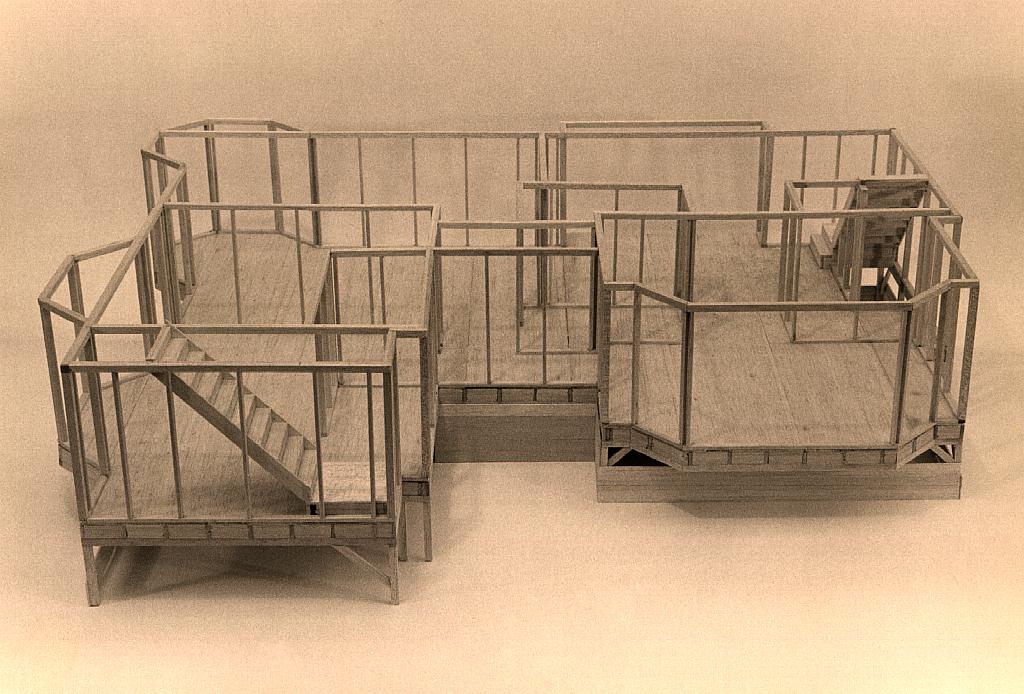
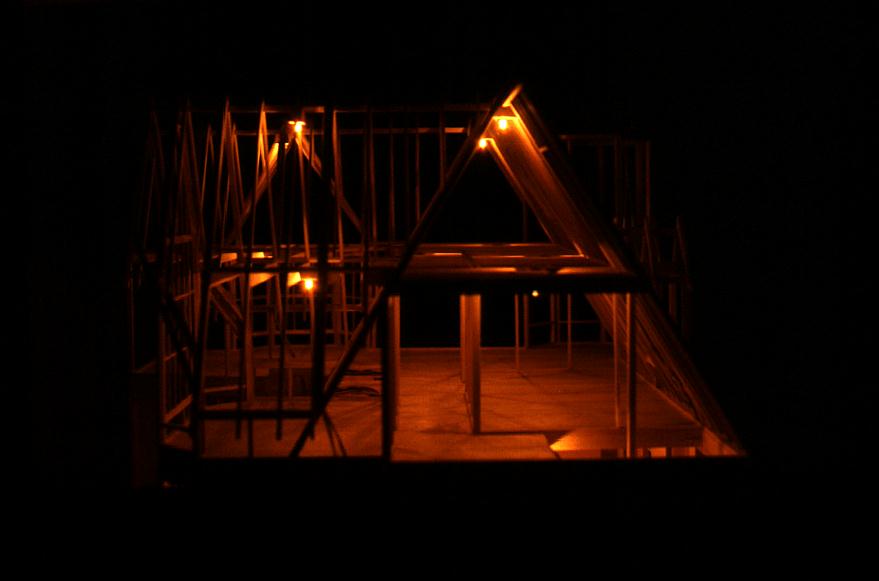
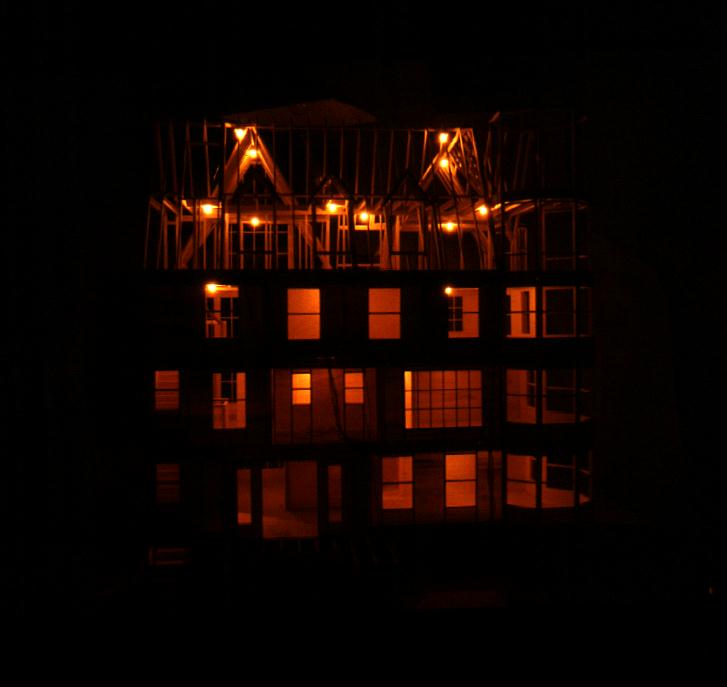
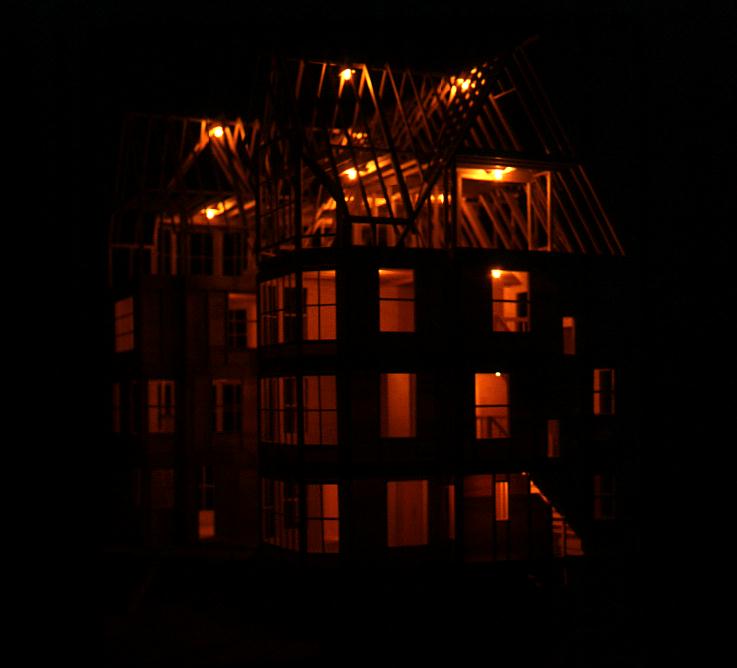
As we near completion of the current Year of the Rat, it feels appropriate to tell a story about how rat appreciation started, how the ratitor came to be, and how the organic unfolding of rat haus reality awareness manifested, first in the building of the balsa wood house itself (preceded by the rat cabin and ancestral rat haus), then in its image scribing, next as a gift-in-photo series, and now as this virtual gathering place for consciousness to further explore, expand, and extend itself.the origin of things rat-full
or
how rats helped shine the way into a ratical world
by david "rat ratman [who can do?] ratmandu[!]" thompson ratcliffe
Sometimes people ask, "so what's with all this stuff about rats?" There is a great deal still to explore regarding the rat archetype and symbology, but for the present, here is a somewhat pedestrian explication of the rat legacy traversed by this one in the journey joined in the company of this human overcoat.
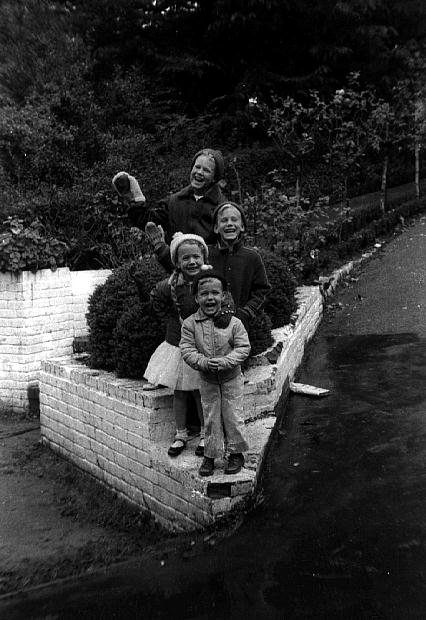
The above is of brother Steve, Bruce, sister Patty and myself when i was 2 and-a-half. Altho Patty is mentioned only briefly in the following, it is not because she does not figure prominently in my own life but simply that the areas alluded to herein did not include as much of her direct participation as happened with Steve and to a lesser extent Bruce. 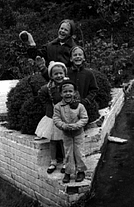
This story became much larger than i had anticipated when writing commenced in December. Originally i simply wanted to share something of the influence of rats and the role they have played in my life. But as it took more shape, i felt it wood be a benefit to also share some of the high water marks i've lived and been blessed by.
This story is dedicated to Sir Laurens van der Post who left this place after turning 90 last December. i have only recently come to be deeply nourished and affected by reading some of the many books he wrote. i offer this tale in the same spirit of what Sir Laurens has re-invigorated within, emphasizing the importance of story telling, an essential element of life that all of our ancestors engaged in.
As i write below about Bobbie Louise Hawkins, "i wood imagine what she does is what everyone knew how to likewise do more than ten thousand years ago when story telling was the means by which one learned about life and the world one lived out one's own within." Sir Laurens long life manifested and expressed this same deep understanding of the fundamental importance of story telling. We are as much nourished by stories as by food and drink. May this story offer something to others akin to all that living it has imparted within and blessed the expression of life i manifest.February 6, 1997
last day of the Year of the Rat, 1996
I Owe You One from Frenchy and Cuban Pete, &
OTHER STORIES by Bobbie Louise Hawkins.
© 1977 by Bobbie Louise Hawkins. Reprinted with permission.
the formative years: A+B=C... Way back in the dim dark past, when i was about 7 years, brother Bruce brought home 2 white rats, A and B. They got along well and soon mama A gave birth to a fam'blee of what i recall to be on the order of 20 little ones. Bruce gave me papa B and two of the kidlings whom i named Asa and Rahmbo. i don't bebember how, but Asa and Rahmbo didn't last long. B however, enjoyed a good long life.
When B, who became "the First", left this place, i was very saddened without his daily company. So began "dave's line"of rat friends including B the Second, B the Third, Trash, Roscoe, Clean & Dirty, and Stripe. This was the lineage up to the time i left home to finish hi skool as a "boarder". Later in college, just plain Rata. Later back east, Manny-Magpie, who's name became Mug-pie-low, and then Pierrot. Somewhere after this the name Fettund came into being as a result of my exposure to feta cheese in Greece and the fact that rata was quite fat and rotund. Tund was a shorthand derivative of Fettund. Later in Bolinas (north of S.F.) it was Rata again, who's name became Lucky-Lata became Latahno became Latanos became Latanios, became Tawno became Tillo became Mr. Tillo. Mr. Tillo's name was some sort of pinacle of rat naming as all the rats i had after him also bore the same moniker (as well as some interchangeably being addressed as Fettund and/or [Mr.] Tund).
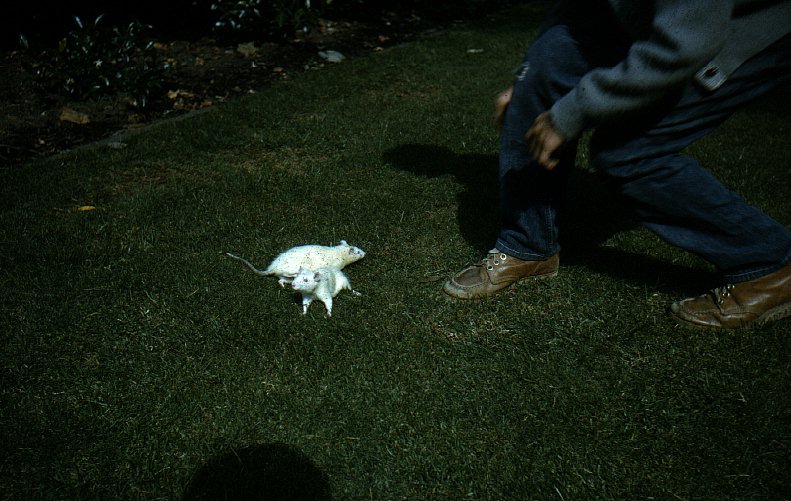
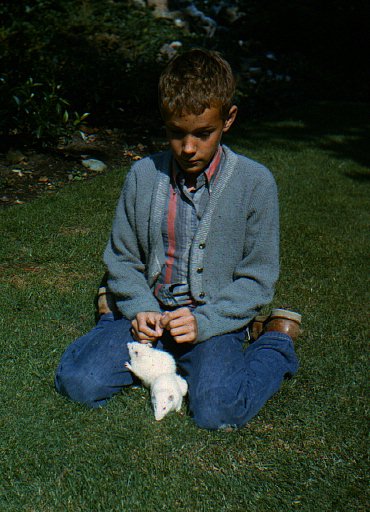
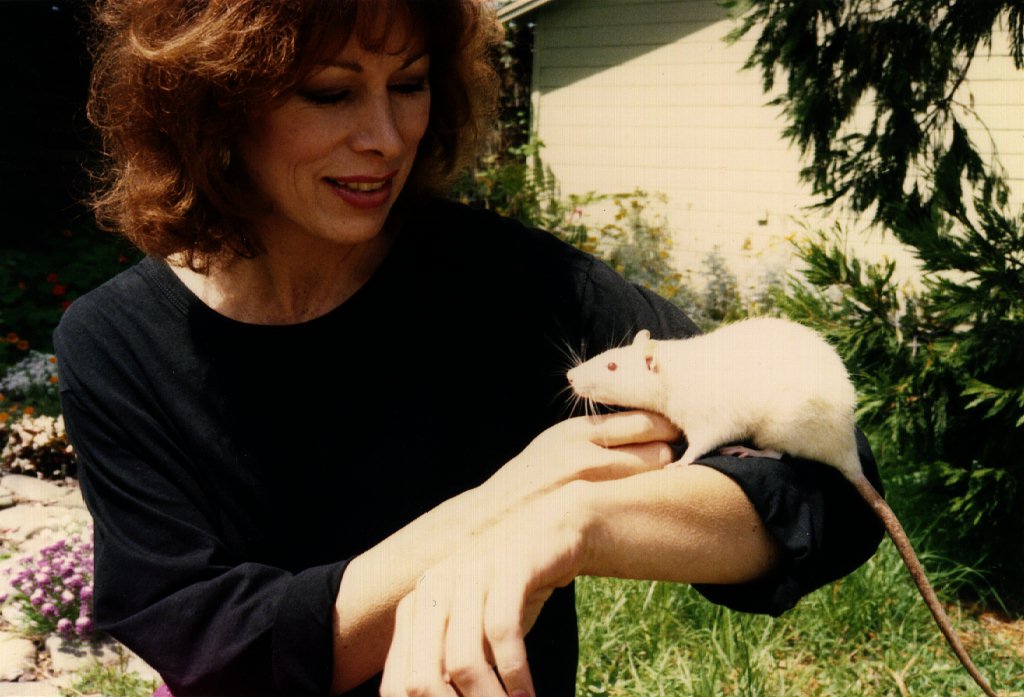
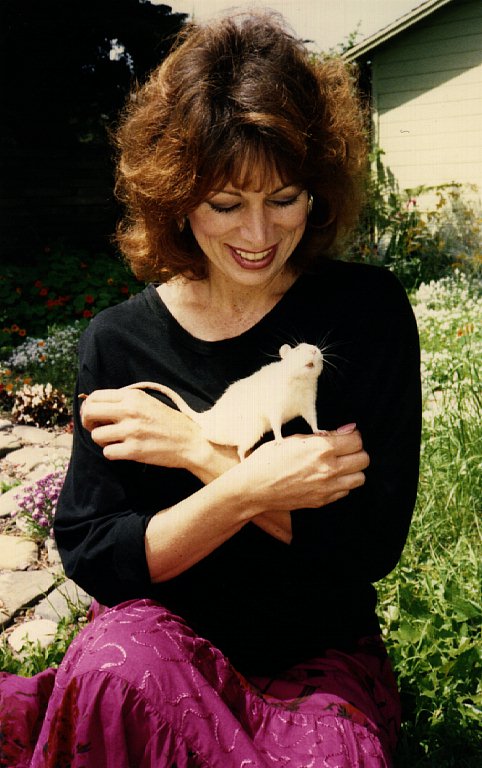
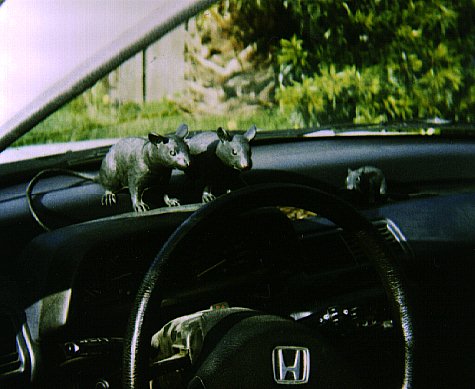
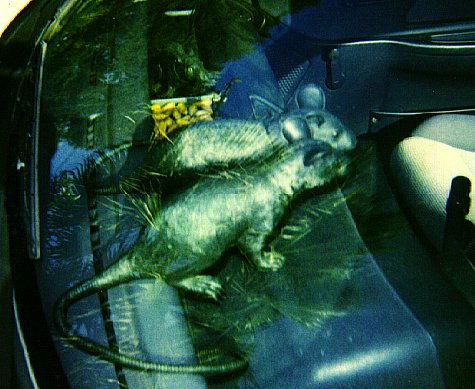
The images here are of Clean and Dirty with me on the front lawn. This my one experience with having two rats at the same time. i think the reason was i was concerned about my rat being lonely and when i went to the pet store to find my next friend i decided these two were chums and wood prefer not being separated. They were so named because a day or so
after i had brought them home, i discovered one was covered with fleas (and that these "hitchhikers" had already populated my room). So altho the flea powder ended the "tarnished" quality of Dirty's coat of fur, the experience left its mark in me mind.
These are the "earliest rat pix" i can still find in my own archives, though i imagine i may find more when i next peruse other's collections. The camera caught me wearing what appears to be a rather "pensive" gaze, although i'm afraid my clenched fingers more accurately convey the mind-space of a boy learning something about the shortcomings of the modern world's nuclear fam'blee paradigm.So many happenings cascade effortlessly back into thought's foreground of life-times enjoyed with these delightful, furry, curious, and without-guile pequito amigos. (Even though i was raised in a culture that attaches an inordinate amount of importance to linear thinking, any such recounting of what follows is doomed in this regard. As with life, many threads make up the tapestry of this story and the manifestation of their "chronology" does not map itself into sequential or "longitudinal" traversal.)
Bruce raised another one of A's babies whose appellation, quite logically, was C. C was taught to do oh-so-many wondrous and astonishingly agile tricks founded on the nawl-edge that if human finger's tapping commenced, it was an Alert, Alert, Report to Base! message, "Base" being wherever the fingers were tapping. Once these coordinates were triangulated upon and arrived at, a Cheerio was tendered as payment for the feat. As Bruce recounted recently, a Cheerio was "just the right size, and quantized more than corn flakes. Right size meaning big enough for me to hold and also big enough for C (aka "Say-la", as term of endearment) to recognize as worth going to all that trouble to get. Also: I once proffered to C a finger with a bit of Crest toothpaste on it. She sniffed, and then BIT my finger! (Only aggressive moment in a long, happy life.)"
From Bruce's knowledge of Spanish, one of the generalizable names people in the fam'blee as a whole wood use when talking about or referring to any one of the rats wood be "rata". In different letters from Dad or Mom to me during the summers when i went off to camp they wood invariably refer to Bruce or whomever "feeding and taking good care of the ratas", or "the ratas are fine and being well fed". At some point i began interchanging "raton" with rata.
i wood make all sorts of rat mazes and castles with a marvelous set of wooden blocks we'd had for a long time. i liked to change my room around and did so quite often as a kid. There were about 10-or-so configurations i especially enjoyed centered upon where i wood position the bed. Much of the time i was in my room, i'd let rata roam free.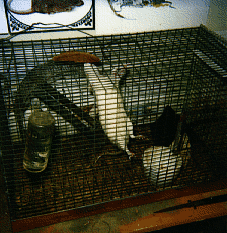
i learned how Bruce had taught Say-la to be hip to the "tapping-chawing delight" relationship, and turned B onto this same pavlovian trick. Over time, i changed the reward to be either a sunflower seed, filbert or even a whole walnut -- all still in their shell. It was enormous fun to "sound the call" and draw rata out of wherever he happened to be hidden or not visible. The easiest place to be called to, as far as B et al was concerned, was tapping on the "drawbridge door" of his cage. Early on i got a nice big squirrel cage with a large wheel in it and a door on one side with its hinge along the bottom edge. Using a length of clothes hangar wire i made a "hook" that held the door horizontal when open. If rata was out rumaging in some cupboard, cabinet, or inside the closet, tapping on the drawbridge was the quickest way to reel him in, and, if hungry he wood very swiftly close the distance between himself and me. (Seen here is Mr. Tillo in the same kind of cage doing "whatever it takes" to get to a piece of dried-out bread.)
At other times i'd start tapping somewhere out in the room. If hungry, he'd find his way quickly unless the room had recently been re-arranged. With each successiveroom-reconfig he wood soon know where everything was again and find the source of tapping with his usual rapidity. In this version of Calling All Rats, Calling All Rats, Alert! Alert!, when the food was found and taken, raton wood either "get down" right then-and-there and chaw merrily away, or in the case of such "rich booty" as a filbert or walnut, triumphantly carry it back home in his mouth. It was utterly delightful to watch him make the heroic and somewhat comical effort walking unsteadily homeward, the walnut in his mouth obscuring the line of sight in front of him. At times this wood make for what looked to be a drunken rat, stumbling but with steadfast determination, to return to his abode.
Rats see "monocularly." That is, each eye looks out from its own side like that of a lizard -- there is no "stereo visual" akin to the sort of optic sensors we enjoy. Such vision hardware is the norm for non-predatory animals (who may become dinner for a predator if they're not able to see 360° around themselves, hence side-seeing eyes). Further, rats are color blind. i came to feel their strongest senses are smell, then hearing, and only then "seeing", where seeing seemed merely to contain the capability of perceiving contrast between light and shadow. i don't think they are able to gather or take in much in the "visual focus" department.
Whenever finger's tapping was first heard, all else was immediately suspended -- even sleep (altho the alacrity with which the "beingness mode" shifted from slumber into triangulation-and-approach varied based on how full or empty tummy was) -- and the source was sought out withgreat vigor. It was endlessly enchanting to watch rata, in the blink of an eye, become a homing device and, especially when tummy was barren, adopt a rather manic persona searching out as rapidly as was physically possible the source of new culinary delights. (Mr. Tillo is seen here engaged in "Knawing Delight" with a Filbert.)
Bruce taught C to become "firewoman C" and both crawl/shimmy up a 1x4 plank, with rug tacked onto it, to the desktop where a morsel of food was waiting, as well as perform the superrat feat of jumping -- in a single, bursting bound -- from the floor up to the desk without any ladder! This was inspired teaching of the most sublime sort, and greatly stimulated my own imaginings of what might be "fitting pursuits" for rat activities in our household.
Often times i'd be lulled to sleep by giving raton a walnut when i went to bed which he turned into a type of "symphony" transporting me off to dreamland. (My how much things change -- these years sleep is SO MUCH lighter than ever was the case in those early years!) Other times he wood be in bed with me and upon awakening in the morning, i'd find him nestled down near the foot of the bed, where the sheets were tucked in underneath the mattress and above the box spring. Cozy'n'warm'n'dark -- "penthouse" living for a rat!first inventions: rat transport systems
At one point i came up with the idea of creating a Rat Tramway. This consisted of making a large loop of shoemaker's twine threaded thru a pulley on a tree in the far corner of our backyard and crossing diagonally up to one of the windows in my second-floor room where it wood lie on a hook. Attached to this was a balsa wood box, fashioned like a tram, onto the lower side of the string and then looped over the upper side so the two lines stayed in close proximity to each other. Then i'd bring an erector set motor with a notched fly wheel to the window sill and, after putting rata into the tram, lift the twine off the hook and onto the flywheel. Rat-in-tram wood travel the long (maybe 100 feet?, maybe more?) way down/across to the tree. Once there, i'd pull the twine off the wheel, rotate the motor 180°, drop the twine back onto the flywheel, and roll rat-in-tram back up to me.
Another "means of travel" was The Rat Raft. This was created after the grass in our backyard became a pool. Replete with sail, there are photogs somewhere of the Rat Mariner sailing/drifting on a chlorinated sea. All things considered, rata was very gracious in putting up with certain activities i thought were grand, but which i know he was not particularly interested in "living out". i learned early on that rats do NOT like to be in bodies of water. The water bottlewas great for quenching thirst (and boooy did he drink a non-stop long tall "glass" after munching down a feast of seeds and nuts!), but not anything like a bowl, tub, pool, etc. In spite of this, i was always fascinated to see how any given rat -- who i know had never been so immersed in their life before then -- when put into the bathtub, flapped, rolled, and immediately began rat-paddling off towards an edge. Ah instinctual intelligence! How wondrous its presence!
There were days in 2nd and 3rd grade when i wood bring rata, cage and all, to skool for show-and-tell. Such days were among the most sublime since regardless what else was happening, i was keenly aware of the presence of my special friend in the back of the classroom. At times, when it was quiet and we were supposed to be studying or reading, rata might be drinking thru his water bottle, running on the wheel, or knawing on the bars if no nuts were lying around.
A rat's front pairs of teeth (top-and-bottom) are just like the cuticles of our finger/toe -nails: they keep on growing. It is for this reason that they, like all rodents, are confirmed knawers -- they instinctually know to constantly file down their front teeth. And what better way than knawing on any sort of hard surface? Thus i came to possess many empty walnut shells after they had been chewed thru to get at the treasure within. Sometimes raton wood start knawing along the seam of the two halves of the shell and split it in fairly quick order. Other times he wood simply chew a hole thru the side and pull out the goods piece by piece with his dextrous fingers.
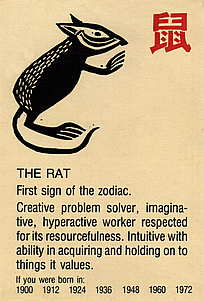
Once i was over playing at my best friend Ok's house and had brought B with me (i think this was B the First). We were outside and B was with us playing in the dirt. In time i realized B had waddled off. We looked and looked but cood not find him. i was despondent when finally i had to go home without B. It felt as if he was already "dead" and that i wood never see him again. Almost a week later Ok's mom Carol was taking some trash out to the garbage cans near the front of the garage and looking down, she saw B next to one of the cans. She brought him back inside with her and i was beside myself with glee to learn that my small furry lost friend had been found. He was in very good shape, including still being fairly pudgy which was some sort of a tribute to his resourcefulness and foraging capabilities (as well as confirmation of the qualities of "The Rat, First Sign of the Zodiac"). i was amazed he had not been killed by a dog, cat, or raccoon, or had not caught pneumonia from being outside for a week of nights.
Starting with B the Second, dave's line came directly from the pet store. A and B were both albinos and i became biased in their favor although i did explore the nature of "hooded" rats -- white with black fur from neck-to-nose and a black "stripe" along the backbone sometimes all the way to the tail -- in the persons of Roscoe, Stripe, and Manny-Magpie.imaginary rat characters and their world
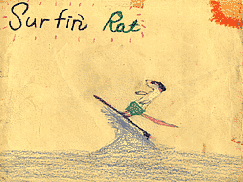
With all the external rat activities i enjoyed with my small, cuddly, forever curious friends, there were also inward rat imaginings manifesting in such series as
- The Sportin' Rats (including any sort of activity, not just athletics)
- News For Rats (precursor to the ratville times (?!) )
- Ratmobiles and Ratjets of the Space Age
- My Rats Inventions (an unfinished work)
- and the story of "Rat Power, and How it Will Succeed," an Original "Tall Tale".
The above five expressions of rat'ness reflect aspects of the imaginary world i inhabited as a kid. Creating the Sportin' Rats was great fun and established a foundation of rat characters employed in News For Rats. Then the interest shifted more to the machines and gadgets that rats wood create and use than any specific personalities. The tale of Rat Power brought things back to a very personal level.
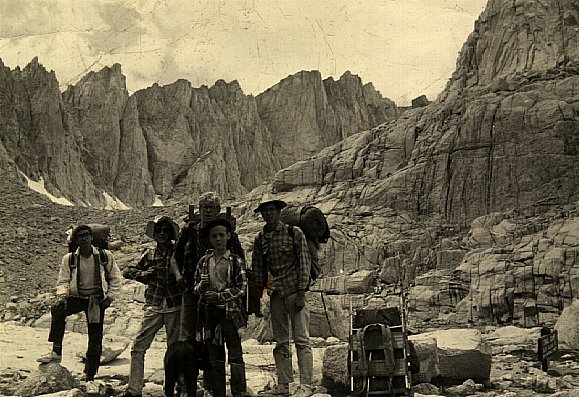
i'm guessing the Original "Tall Tale" of Rat Power was written in the fifth or the sixth grade -- Miss Coyne and Mrs. Goodell respectively, were both caring, supportive, and enthusiastic teachers so either one cood have written the "Excellent -- Especially theillustrations because they fit the story" comment. This was an homage to Trash who was with me in that time-frame. i had climbed Mt. Whitney with my Dad and brothers in the summer of 1964. (July 11, 1964: in the foreground, Steve is directly behind me, Bruce is to my right, and our most precious lab, Pingo, is in front of me.)
Considering i was raised in fairly sheltered middle-class home environs, there's a curious sort of reflection of the world i found myself alive in during that time mixed into this tale: the plight of Native People's of America, dualistic either-or thinking ("try and get them on his side"), people being drunk and off-guard on Christmas Eve (no one in my fam'blee got drunk), and a better world being one where humans other than Indians were moved to Mars and all cities and everything else man-made besides farms destroyed, so Indians, rats and all the other animals of the world cood roam freely.telescoping time: forging a rat-based identity and scaled world
It was in the fifth grade that i gave myself the nickname of Rat. Mem'reh tells me i announced this during an afternoon when i was reveling in sliding down a hillside of brown, dried-up, wild grass on big pieces of cardboard with friends above a playground at skool. i recall this was very meaningful for me at the time as something to let others know just how much i identified with rats and how important they were to me. Looking thru the 7th and 8th grade yearbooks, i see my moniker was fully "in place" as most everyone included "Rat" somewhere in their message-signing. It was somewhere later in hi skool or beyond that Rat turned into ratman. Around 1986, ratman became interchangeable with ratmandu.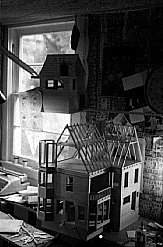
i went off to boarding skool for the last three years of hi skool and didn't have rats during that time. But in freshman and sophmore years in college (University of Oregon) i again did, and in the first half of 1976, during which time i switched from being an english to an architecture major, i built the antecedents to the present-day rat haus, described with a collection of blowups -- all that besides my grey cells, apparently remains of them -- in
Ancestors of the rat haus:
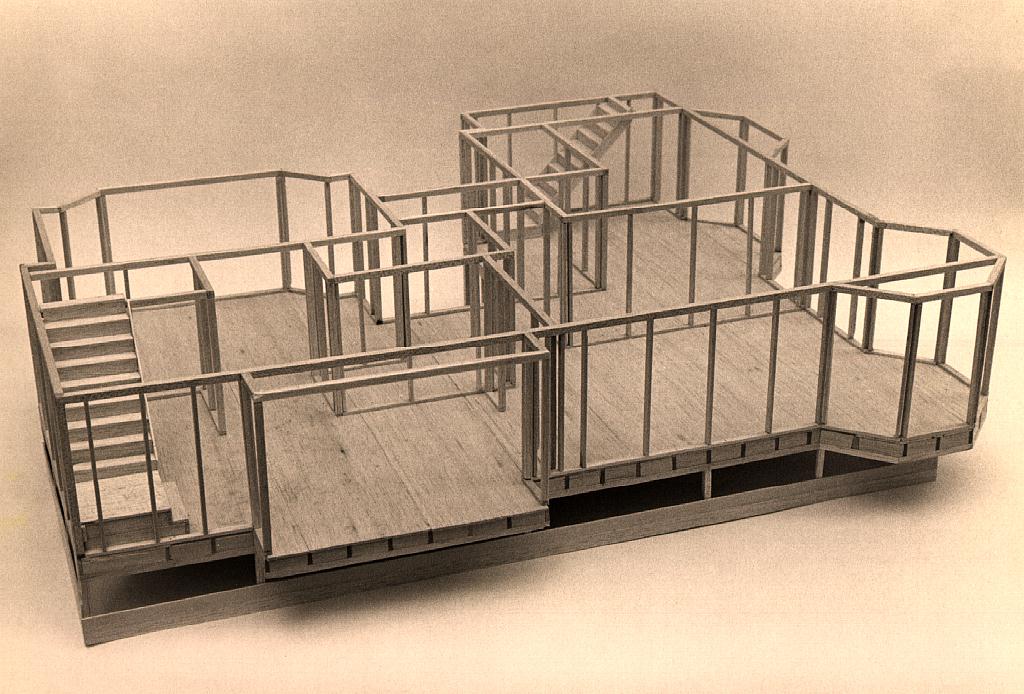
The Rat Cabin and Haus #1, aka the rat victorianThese two precursors of the present-day moniker of this web haus were built during a time of deeply exciting and intensely curious explorations of consciousness and enquiries into timeless questions such as who am i?, what am i?, and what do i want to do with all i have been given?
As alluded to above, i grew up in a pretty sheltered way considering the volcanic releases of conscious energy happening during those years. As the youngest of four, my three older siblings were out-and-about in society in their own ways during the life-bursting open sixties as i was not. i liked to play in the mud, ride bikes back-and-forth to Ok's house a few miles away, and generally make up my own realities that included a lot of rat involvement.living in the modern world: non rites-of-passage childhood's end
By the time i arrived at college (Oregon State University in Corvallis for one term and then transferring south 30 miles to UofO) i had experienced a rather bumpy "paradise lost" phase as innocence had given way to that awkward feeling of being "in between" childhood and, without some rite-of-passage to activate the supreme paradigm shift, adult-being response able for oneself-ness.
I had chosen to go to Corvallis in hi skool because it was supposed to be one of the big agricultural skools. i had come to identify strongly with such "living off the land" by, starting in the summer after eighth grade, going to a ranch in eastern Oregon for four summers and living with the Rod McKays, an eight-kid catholic fam'blee who became a tremendously nourishing substitute for the one in which my parents divorced after nineteen years when i was ten.
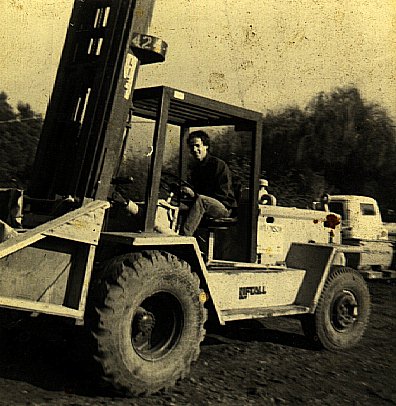
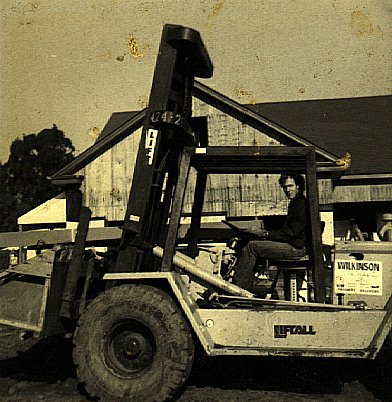
Rod had 400 cattle on the range, 20 Holstein milk cows, a group of horses, 50 sheep, and about 9 alfalfa fields on the west end of the valley where the town of Harper lies along highway 20, 100 miles due west of Boise, Idaho. i worked with them being a part of everything that happened: among other things this included getting up 7 daze a week to milk the cows before breakfast as well as before supper (they called lunch dinner), change the irrigation twice a day in the fields, as well as "haying" the alfalfa two to three times in one summer into loose stacks (instead of bailing it), in preparation for the range cattle coming into the valley during the wintertime. Rod was "tractor man" with a big hydraulic lift that wood fork up the rows of raked alfalfa and build the stacks. i got to drive, work on, and sometime fix an old three-wheel John Deere with a hand clutch; i thought that was the livin' end! They had been taking in kids, primarily from the city, for quite a number of years and i felt i was very much a member of the fam'blee.
There was a great deal i learned from such a different fam'blee dynamic and all of them will always occupy a very special place in this heart. i saw them as literally being children of the earth and of God (independent of their catholicism), in ways i had never experienced or considered before. i know that what they imparted was a feeling that i belonged in and to the world at a time when i was very distraught by a sense of alienation from and discontinuity of life and living. Estranged from the human culture i found myself living amongst but at odds with on a deep, implicit level, and sense of discontinuity from my own fam'blee's disintegration, as well as separation from my suburban "roots" which, of course, themselves were quite rootless but which had been all i'd previously known and had sustained me until childhood's innocency gave way to the sort modern "gawking puberty" where there is no longer any coming-of-age rite-of-passage to usher one into self response able consciousness.
Throughout hi skool years this sense of rootlessness had increased but by 1976, things had mellowed out a bit. i'd already done freshman year as a civil engineer and then english major. The following summer i was playing piano in a very stoned state at Mama's Home Fried Truck Stop, a co-op restaurant. At the end of a ragtime piece, i noticed a man standing by the piano with longish red hair and elfin ears who remarked, "wow man, I really dig the percussion." He introduced himself as Ginger. i appreciated the complement and he invited me over to his table where he was dining with a group of people. i hung out with them all night which included my first taste of dried-out peyote buttons, going out to a bar and playing some ragtime (our contingent dubbed it "maniac piano") while Ginger played on an available conga, sharing a bath with a very nice girl, and leaving my virginity in the before. She told me in the bath that "Ginger" was none other than Ginger Baker. i hung out with him off-and-on for the next week or two before he vanished.
Not having a clue what i wanted to do as far as becoming a corporate citizen thru the college maze was concerned, i skipped a year playing dish-washing ski-bum in Colorado. During that winter i got in a van and did a week's run with others back to the east coast, with each person getting out to spend time in various locales. i stayed with Ok at Yale where he was still taking classes but was feeling as ambivalent about getting a degree in whatever as i was. One evening i had another visit with peyote and was very struck by the presence of Mescalito as teacher just as Carlos Casteneda had articulated. The sense of liberation and "existence potential" was staggering.
Back in Eugene for sophmore year, english was still inspiring but there was more than ever a crushing sense that the prime directive must having making more money than minimum wage as part of its imperative. Based upon the adventures with manifesting the rat haus ancestors, architecture seemed to promise "filling the bill" on all fronts. i had a great spring term diving into some of the ocean of considerations one must cogitate when pondering a structure-to-be in some specific location. However during all this i kept feeling a nagging concern to whit, "i bet i can become a very capable architect and probably really get off on it, but i know i'll always regret it if i don't give music a real `run for the money'...."the history of film -- visual representation of the collective unconscious Starting that fall, a unique, immensely rich thread of experience wound itself thru all three quarters in the guise of a film course called "Great Directors" and taught by William "Bill" Cadbury. He was a tremendously engaging lecturer and person, and he knew worlds about the history of film. Having grown up in the forties, he was a student of film himself from his childhood on and his wealth of personal experience and understanding of the genre was evident in the richly detailed explications he wood regale us with during each class.
The sched for the fall term was: a film wood be shown Monday and Wednesday night, then Cadbury wood "hold forth" the next morning on both Tuesday and Thursday regarding what we'd just taken in; then for those like myself who were extremely engaged by all this, we cood go to the basement of the library on Tuesday and Thursday afternoon to see the same film a second time, right on the heels of taking in all Bill had just expounded upon that morning. Winter term the nights shifted to Tuesday / Thursday with the lecture and re-screening on Wednesday / Friday. Regrettably, i've lost the series ticket from spring quarter so i'll have to rely on the incomplete info in my class notes below.
i take the liberty of listing here the "programs" from those three quarters to convey some sense to similarly-inclined film affecianados of just what we luxuriated in "drinking in" thruout that year:
|
Fall -- September 29 thru December 8, 1975:
Winter -- January 8 thru March 11, 1976
|
Spring -- pieced together from class notes and
alta vista
|
The tickets to the above three Fall-Winter-Spring series were the "books" for the class. For each term the ticket list was titled "Bijou Dream". During the winter quarter Cadbury also put together an "Acme-Bijou" series that ran concurrently on Monday / Wednesday nights and i took the opportunity to see about half of the films from this list.
This class, and Bill's immense scope of nawl-edge about the significance and meaning of what these great directors had created, made a deep, lasting impression upon me. The art of watching a film was awakened within and the films we were introduced to provided an ineffably rich source of imagery and ideas that has enhanced and enriched my own experience and appreciation of humanity and our collective journey of consciousness together on this mote of dust whirling thru space.
One night that spring i bebember lying down on a cot in the driveway looking up into the stars with quite a hempen intoxication in progress. i saw more vividly than i can ever otherwise bebember, the depth between myself and each star -- they were not simply points of light on a dome's surface. i visually apprehended the fact of their floating at varying distances out in front of my self. This was the sort of "incubator" i was exploring the presence of during the time of creation of the rat haus ancestors. It was in this time that i came to the conclusion that once and for all, i had to give the pie'ana thing the real exploration it cried-out for.early stirrings of rat piano & another vestige of innocence ends i had turned 21 that spring and spent an afternoon with Ok on the blower, rapping it down about music. He recommended i go find Keith Jarrett's Facing You and Oscar Peterson's In A Mellow Mood. i succeeded on both counts, and, after getting home put the second side of Mellow Mood's record 1 on, which started with a ten-minute song called "Sandy's Blues". i knew as this song progressed, i'd gotten onto something i'd been looking for for a looooong time. Starting out solo at a slower tempo, Oscar just kept building it up and up, with Sam Jones and Bob Durham joining in. They tore it up, and, eventually softened it all back down again to where Oscar closed it out solo-wise once more.
As a kid my piano playing enthusiasm had been activated by Carol Hills who played boo'ghee, Fats Waller and classical. She has a formidable ear and cood play by ear simply knowing what the toon sounded like, as well as sight-reading on-the-fly. As each of us did in my fam'blee, i had started music lessons when i was about seven. But more than the music teachers, it was Carol's influence that ignited my enthusiasm.
My first lessons were pretty rote kid-scores with a classical focus but then i broke my arm in the fall of the third grade and so got out of having to practice and dropped the ball lessons-wise. The fact was i sure liked the sounds i cood make come out of the piano, but far and away preferred to play in the mud than practice my lessons. A few years later i studied from a popular music teacher which was a little more engaging but it still didn't gel. Then first year at boarding skool on a whim i sat down and played toons like the Pink Panther, Batman theme, and Blue Boogie. i hadn't played for a couple of years, but in that moment i felt an unfamiliar sense of "Oh, this is niiiice! --i like this!" i had finally broken thru into the realization that i wanted to do this for my self, not because i was supposed to or shood do.
i practiced stuff i found interesting thruout the last three years of hi skool including getting heavily into Scott Joplin and learning many toons from the big ragtime book of all his pieces, spurred on by the three Nonesuch albums Joshua Rifkin recorded starting in 1970. Senior year i was the pianist/lead singer in a rock group called the rat band, a name we were dubbed with by default when we played a dance in February being asked at the last minute to fill-in for a band that didn't show. Although i didn't have rats at boarding skool, the rat identity was very solidly established. i was seen as something of a wildman which suited me just fine. As the rat band, all of us encouraged the perception by others of an affect as fuck-ups.
Ok and i were the creators of the rat band and he played lead guitar. With as formidable an ear as his Mom, he had been deeply into Scruggs-style banjo -- as well as guitar inspired by the likes of Chet Atkins, Lenny Breau, and Jerry Reed -- for years spending whole summers sitting up in this room picking out Earl's songs from the record note-by-note. One of the tunes in our repetoire we were most proud of was Ten Years After's "Goin' Home" for which Ok had picked out Alvin Lee's solo from the Woodstock recording. At a show we were part of the day before graduation when all the parents were there, we played Jumpin' Jack Flash and Goin' Home. i can't imagine the adults were necessarily all that interested in our pyrotechnics but we sure had a blast presenting our spectacle.
At the end of that summer which i had been spending in Eugene, i went camping with hi skool friends Dan May and Jon O'Donnell in the area of the Three Sisters mountains. Dan had played rhythm guitar in the rat band and Jon had been a very irreverent source of mirth-towards-life influence. i knew they both liked to smoke pot but up to that point i had not felt interested in the least in finding out what any form of intoxication felt like. It was there by a lake that i felt curious enuff -- and lost enuff from my own eternal center of being brought on by the bumpiness of adolescence commencing after the dissolution of my fam'blee -- to give it a go.
Up to that point, i had felt my own inner psychological structure was fragile and precarious enuff that the prospect of further "earthquaking vibrations" held no appeal. But by this time, the disillusionment of grappling with an increasing sense of being cut off from the eternal source of loving life that flowed effortlessly during childhood reached some sort of critical mass and i was willing to explore strange new worlds -- though not necessarily "boldly going where no one cares to go" . . . After some serious smoking without any shifts, i began to notice my hearing was different. Aural sensations began to have a very strange and curious additional component to their composition the likes of which i hitherto not encountered. And then sunami waves and waves of laughter rolled over and thru our camp. Thus ended another vestige of innocent being.fall, 1973 -- a fundamental high-water mark The first fall term of college was, in hind-sight, a veritable "high water mark" of my life, even though, as the Joni Mitchell song sings, "don't it always go to show that you don't know what you've got til it's gone?" This was in part because for the first time i was truly "on my own" in a place where no one already "knew me". Thus i was able to discover my own self in a way never before imagined. i felt very high thru the whole fall even though i was getting stoned (even tried out "drunk" but didn't find that very interesting at all) less than half the time.
The biggest "waves" i "rode" were taking a Survey of English Literature course by a wonderful teacher, Joseph Crocker, that went from Beowulf to Milton, and being Steve's best man at his wedding to Ashley Perdue. Although he was an older man, Joseph Crocker was very enthusiastic and had an ebullient manner of talking about all the different writers in a way that made them come alive for me as never before. Steve was working on his masters thesis in English at that time and his own interests also inspired mine.
i bebember getting caught up in my English studies so much that, when we had a test about half way thru the term and my marks were good except for one part that showed i was weak in reading comprehension, i started right then to try and read a lot more books to better my comprehension skills. i started with Tolkiens's The Hobbit which i bebembered enjoying so much when Mah'mon read it at bedtime when i was young. i became re-enchanted with this world of Bilbo Baggins. When finished, i immediately got hold of the Lord Of The Rings trilogy and ate it up. i loved letting my imagination run wild thinking about dwarves, ents, wizards and the like.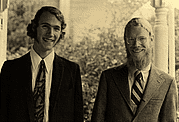
Participation in my oldest brother's wedding on the weekend before Thanksgiving -- as no less than his best man -- was the highest the water rose that fall. Everything except the dinner itself took place in his and Ashley's new home in Bolinas, the Red House. It was a very special afternoon and was crescendo'd that evening downtown at the Gibson house where about 30 of us sat at a long table while the Champagne and wine flowed freely and everyone was very, very enlivened. i felt an overwhelming surgethruout that afternoon and evening that everyone and everything in my uni verse was right and true and complete. A deeply magical time that day and night was.
Up in both Corvallis and then Eugene i found it very engaging inside to get buzzed, and go find a piano in some public place -- a dorm or an eatery like Mama's Home Fried Truckstop -- and hammer out boo'ghee, blues, and some rock'a'du. Piano playing-wise, i'd max'd out with the Beatles, picking out the piano-rich tunes like "Lovely Rita," "Martha My Dear," and "Lady Madonna," and music appreciation-wise had gotten heavily into present-day Frank Zappa thanks to Ok, particularly Roxy and Elsewhere and One Size Fits All. (i'd dug Freak Out when it originally came out, but it was not until this period that i filled in the gaps from then to the high-water mark of the likes of "Village of the Sun," and "Pygmy Twylyte.") But even with that, i still felt a hunger for something with a richer texture and depth.
The day i discovered Oscar Peterson's singing hands ushered me into an apprehension of the uni verse of "jazz" appreciation that has never stopped expanding (altho in the past 3+ years the current pulse is towards a massive exploration of Mozart, Beethoven, Haydn, Brahms, Sibelius, Prokofiev, Chopin, Glenn Gould, Schubert, and Schumann). i found and drank deeply of Duke Ellington's autobiography Music Is My Mistress (And She Plays Second Fiddle To No One) which was a fabulous intro to ALL the people "in the biz" since Duke knew and worked with everyone. His trio and quartet recordings on Pablo, some Horace Silver and Monk all were clearly audible now. My ear had been able to make the jump into aural hyperspace.
Just before i went to Saudi that summer, in his 5-row "chopped" skool bus, George Hutto and i drove out to the LONG sand-spit just south of Florence. We engaged in the "breaking of bread" sacrament with peyote there on the edge of the world. This sentiment was not without a heightened literal facet: as far as one cood see the coast extended north and south in a straight line, the massive "furrow" of dune behind us mirrored the "180° stretching to infinity", a powerful, steady, non-gusting wind blew directly from the west, and the magnificent sky full of clouds and ample spaces between them for SOL to bless us with its radiance. The steady, relentless wind complemented the crashing surf on very fine-grained sand, and we were astonished by Gaia's sand-painting tapestries employing dark (possibly oil-stained) and light sand tones to fashion ineffable manifestations of out-of-time beauty. By evening time, George went inward inside the bus, while i marched up and down amongst the dunes thruout the night examining my existence and sentience at that threshold moment of the journey joined in this human overcoat on the eve of flying to the other side of the world. Among other awarenesses i felt as if i was also simultaneously existent off-world, watching from afar this dune-traversing being, filled and overflowing with the illumination and understanding,This one: so much good in this one; so much to be done with this one.east of west coast journey: from Saudi to Bwoston to New Haven to Durham Bedouin Eyes
i took the opportunity to run-down the dream of being a perfessional musician by going to a music skool in Bwoston for a year. Enroute, as described in the rat cabin & victorian's coda, i had the chance to see my Dad on a visitor's visa where he was working in Khamis Mushyat, Saudi Arabia (400 miles south of Jeddah and 70 miles inland). A practitioner of general surgery in San Mateo, California, he had become disillusioned with the burgeoning malpractice industry in the mid-70s and had always had the desire to pursue further experiences of the kind he had been engaged by onboard the ship Hope for a stint in Indonesia and Bali in the early 60s.
As i kid i had thought i wanted to be a doctor from the experience of going with him on "rounds" to one of the three different hospitals he worked at. We'd walk into the person's room and they wood light up when they saw him. i was very moved by seeing how much my Dad's assistance meant to these people. Nevertheless, as i grew older and realized more specifically just what was involved to become such a perfessional, i lost interest in pursuing such a path.
i had resolved in Eugene that when i was in Saudi i wood tell my father i was going to try to get into a music skool i had heard of in Bwoston called Berklee and finally pursue the exploration of a music source potential for my life. He seemed to have mellowed somewhat. One afternoon i proceeded to lay out for him what i intended to try once i got back to the states. He didn't challenge me as i expected he wood and, among other things, referred to a quote of Winston Churchill who, when asked what one quality he wood wish for another if he cood just pick one replied, "enthusiasm." Dad knew well my great enthusiasm and that it was the a vital attribute of mine. He said he thought what i was going to undertake was much more difficult than what he had done because expressive art was a much more constantly challenging endeavor just to keep the ideas coming than something like surgery.
i went to Saudi Arabia with my step-brother, Dave Whitehead. At that time, the only way one cood travel there was on a visitor's visa as "tourists" were not allowed. We found ourselves in an extremely different cultural milieu that itself was experiencing staggering changes. For thousands of years the desert land had been home to the Bedouin, a nomadic people whose communities were only as large as the desert's "law of scarcity" wood allow. i cood well appreciate what Frank Herbert wrote of in Dune about the Freman and the law of a land without water. The Bedouin were a living manifestation of such a culture.
During the early twentieth century Abdul Aziz Bin Abdul Rahman Al-Saud, known thruout the world as Ibn Saud, had distinguished himself as the person who "forged a modern nation out of a collection of tribes scattered across vast tracts of the Arabian Peninsula". Once the extent of the presence of oil was ascertained after WWII, Saudi Arabia found itself inexorably propelled, in the span of a few short decades, into the alien-to-its-experience consumer-based preoccupations of the impersonal twentieth century "modern world".
While there, i saw a people who previously had never had any awareness or conception of getting things, being bombarded with alien western materialistic images vaunting a consumer's paradise-on-earth, albeit in a muted form because of the existence of Mecca and the Koran which the people in government used for their own purposes of maintaining political and economic control of the society. Outside of the Sea of Cortez in Baja, California, i had never before travelled to a foreign land. i was struck by how, looking into the eyes of people in the souk (sp?) (public market place) i experienced a new sense of not having any idea what they were actually thinking, particularly about me.
It was a very different culture where women never went out in public unless they were accompanied by a male member of the fam'blee (this was not proscribed in the Koran but had been adopted the during the time when the Ottoman Empire invaded and occupied the desert land), where one wore clothes to cover up all but face and hands (in a western "supermarket", every single copy of a "Summer Fun" issue of Time, with a woman wearing a one-piece bathing suit on the cover, had been magic-markered so her arms and legs were not visible), and where if your car was parked and a Saudi driver crashed into it, you were at fault because you were an infidel, one of the great unwashed.
We took one trip down the escarpment (i think the descent was something on the order of five miles over ten miles of driving) to the Red Sea. A sense of timeless eternity was present there. Waking up the first morning and looking around, i felt as if this cood be someplace millions of year before the dawn of homo sapiens. We were at the edge of the Red Sea Basin's great coral reef and snorkled in water that was at least a steady 85 degrees. The different sizes, shapes, and colors of coral, blended with the myriad of marine life, was astonishing. i had never before experienced such a temperate, salten world so removed from any remnants (besides our car) of ever-present industrial world "scaffolding".Berklee, Manny "mug-pie-lo" Magpie, to New Haven
The plane ticket i had was good for a year but i stayed in Khamis for only a month (made some money working in a hospital supply room) and then "city-hopped" back thru Europe (favorite spot was the isle of Santorini in the Aegean and Athens) on my way to New Haven via New York to stay with Ok and make a foray up to Bwoston to apply to Berklee. i have the distinct mem'rhey i got accepted once it was ascertained i cood pay the costs, more than thru my actual musical skills. i anticipated this being a place where people were there with the overriding purpose of developing one's own musical craft and talent, and had high hopes it wood be a very magical musical environment and experience.
There were certainly some invaluable essentials i picked up while living on Gainsborough Street in the back bay section of town. The most important of which was finally learning how to truly sight read music manuscript, largely thru a terrific class where we practiced sight-singing scored melodies while simultaneously conducting the meter with our hand to keep track of where we were in the given measure. Most important of all, i learned how to notate music on manuscript paper from this class. Such skills stood me in good stead in the coming years. i had rented a full-sized upright and, among other songs, was working on Bach's Prelude and Fugue No 2 in C minor from Book II of The Well-Tempered Clavier for my performance class but found practicing for hours on end was not the effortless activity i had expected it wood be. My lower back wood get sore and i began to experience similar hints that my human overcoat was not the indestructibly robust "housing" that i, for the most part, had found it to always provide me with prior to that time.
The rest of my siblings had been born in Frammingham, Massachusetts -- my father elected to start his practice "out west" and moved the fam'blee to San Mateo after my sister was born but before i was a fertilized egg in Mah'mon's womb. Living thru a rather snowy winter in the land of the east, i better appreciated what Mah'mon had told me about how, when people lived in harsher climes where winter was the time to stay indoors, they were inevitably thrown back on their own devices to fill the time inwardly more than they wood otherwise be, continuing activities outdoors thruout the four seasons.
For the first time i found even just the three years difference in age between myself and practically all the people in my classes to be rather vexing. Not being especially out-going myself, and having the bulk of people i came into contact with being straight out of hi skool, i found out quickly there was a large gap between our experience of life and without more people around with whom it felt easy to be with, i withdrew more into my own singular world.
It was in this atmosphere i opted to seek out another rat friend and found a black-and-white hooded character i named Manny-Magpie. i'm not sure that was his first name. There had been Magpies at the McKays and he reminded me visually of them. i greatly appreciated his company and named a composition i wrote for a class after him. At some point "Magpie" phonetically suggested mugpie (strong accent on mug) which in time slid into mug-pie-lo.
i spoke with Dad on the blower while he was back for a visit to California from Saudi. He said he was only going to to carry me with the money i then had (which wood see me thru April) and after that i wood be on my own. i got a job driving a hack for Towne Taxi and started my first nite on New Years eve day working thru to about 3 am. There was a LOT of snow fall that winter but i was able to successfully negotiate my movements around town in the hack tanks. In February i switched to Checker Cab whose office and garage were only 2 blocks away from where i lived. But driving a hack was the same no matter who it was for and i was getting pretty fed up with the low pay (i figured it came out to less than 2 bucks an hour).
During the year i made some trips to New Haven staying with Ok or other members of the Helium Brothers, the band he was with, after taking a leave-of-absence from Yale, playing thruout southern Connecticut. They were 5 players doing drums, bass, fiddle, rhythm guitar and Ok on guitar+banjo, and were very popular playing a mix of rock and a sort of Dan Hick's-flavored jazz. Everyone but Ok wood sing with at least two to three harmonizing in any given song. Kim Oler played bass and he and i became great friends. He'd been doing piano for a long time and we had similar interests in styles. i was very impressed with his transcription of about the first half of Keith Jarrett's "Lalene" from the Facing You album.
At one point during the winter returning from New Haven, i came home to find Manny-Magpie had died of the cold from a friend i let stay in my place who had not closed a window. It was always a terrible loss when such a "before their time" death occurred. The hole left by Mug-pie-low's passing increased my sense of isolation living in Bwoston.
By the spring when classes ended i decided i had had enuff of Berklee and moved to New Haven and into a house with Peter Melien, a good friend of Kim's who was starting out in the lawyering world. Berklee had turned into just another skool in many ways. Instead of the magical musical learning experience where everyone was dedicated to perfecting their craft, all i seemed to find were a lot of kids treating it just like college where they were very conscious of grades and weren't into music for its own beauty and sake. i spent the beginning of summer playing in the practice rooms at Yale by day, and catching the Helium Brothers at night.
Since i had again attended skool that year, i was eligible for another free ticket over to Saudi and flew to Jeddah in June where Dad had moved to. The backyard of his house opened out onto the Red Sea and the reef was much more breath-taking in this location. One had to walk out a ways to get to beyond the shallows, but once past that there began the most incredible array of underwater shape and color. It was 6 to 10 feet for about 50 feet, and then it dropped down to about 40 feet with the "cliff edge" being a huge mass of infinitely diverse and evergrowing coral of all shapes, sizes and colors. The fish were infinite in their numbers and types as well.
This time i flew the return trip straight thru except for a brief stop in Athens. i found a 5 room house at 33 Carmel Street for $125 a month (!) and located a baby grand piano i cood use for as long as i wanted. Soon afterward i got a job working full time at the Grove Street Cemetery in downtown New Haven, where Daniel Webster and Charles Goodyear are buried. Once fall came mowing was supplanted by raking up the leaves and stuffing them into dumpsters. We even dug a few graves.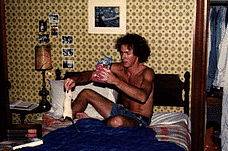
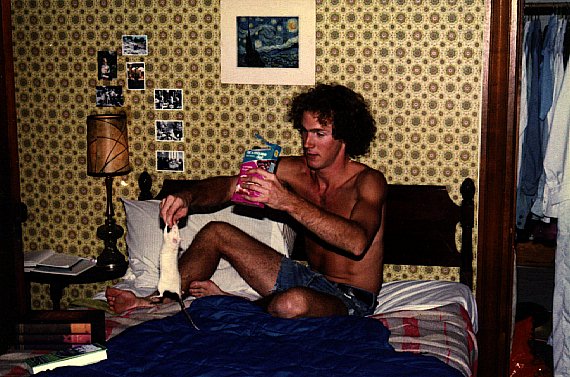
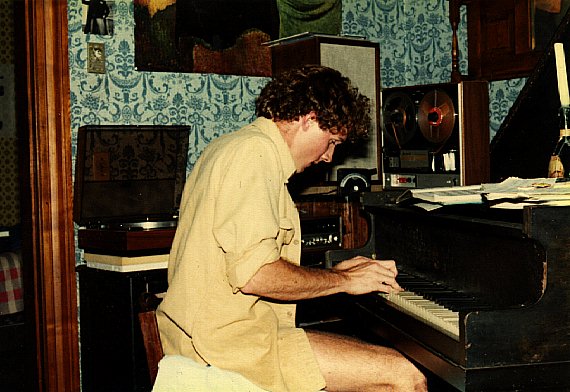
After moving into Carmel Street i found me another rat friend who went by the name of Pierrot (the name's inspiration came from Godard's Pierrot le Fou). He provided a marvelous liveliness to the environs (while i've known some very special cat and dog friends thruout my life, i've never been inclined to have my own as well as the requisite responsibilities). Ok's younger brother Steve who, 5 years later wood be the gifted photog-snapper of a majority of the images in the rat haus reality gallery, came over at one point and "scribed" a roll of film at 33 Carmel Street including "Pierrot not letting go of his rat diet morsel" and the "mr. piano intensity" shots seen here (as well the contrived "Red Star reader" scene below).
i enjoyed greatly having the baby grand and spent my evenings that late summer/fall practicing and transcribing. During this period i picked out Wynton Kelly's solo on "FreddieFreeloader" from Kind Of Blue and scored out the beginnings of Bud Powell's "Un Poco Loco," "Monopoly," "Ornithology," Duke's "See See Rider" (from This One's For Blanton), Monk's "Work", and Bill Evan's "Beautiful Love". As often happened, my initial inspiration with a given song was high-spirited, but flagged once i got to a really tuff part. i knew that even if i were able to, after a fashion write something out, my own technique imposed limitations upon what i cood actually pull off playing.
Kim had turned me on to the four John Mehegan books and from the complete transcription in book four, i learned Bill Evan's "Peri's Scope." Kim also introduced me to the John Coltrane and Johnny Hartman album and, inspired by their rendition of "Lush Life", i worked up a solo piano arrangement of my own tempo and feel that i scored out and then learned.
There was a lot of time spent going to Helium Bros gigs even though i had never found bars or beer halls interesting to any degree. i saw a good amount of what it actually meant to play every night for a living. i bebember a gig playing solo in a pizza parlor in Steamboat and how it was fun at first but the fact i was being paid for what i was doing -- and playing to suit the owner's interests -- changed it from the sort of "show on my own terms" i had enjoyed in dorms or eateries in Eugene to something else not so satisfying.JFK & Rhymes Records
During the fall John Toland's 1300-plus page Hitler came out in paperback. i had been curious about him in junior hi skool and had read a few books about the rise and fall. i became immersed in Toland's incredibly detailed andpieced together account of `der Führer' and his life. At the end of the previous summer i had read Witness to History by Charles Bohlen (ambassador to Russia among other things) that i borrowed from Peter. Along with Toland's book, i also studied Mein Kampf and dabbled in The Communist Manifesto and Red Star Over China.
My grandfather was ordained as a Congregationalist minister from Union Seminary and had been a missionary in China from 1916 into the 1940s. Along with her two older brothers, Mah'mon had grown up in China and i'd always had a sort of personal -- albeit very remote -- identification with the western experience of that far away land and people. With these books, i discovered a new-found interest in what cood be termed "dry historical biography".
Then on November seventh Peter lent me A Thousand Days, John F. Kennedy In The White House by Arthur Schlesinger Jr. This began a very long exploration into aspects of post-WWII American history i had never looked at before. i knew JFK had been quite popular and that my Dad had thought a lot of him (they were two years apart in age). i was sick at home on 11/22/63 and only bebember seeing Dad walking up the stairs to the landing from where i was in bed and saying "Hi Dad". His response was a simply "President Kennedy's been shot" before turning without looking at me and walking into their bedroom.
By the time i finished A Thousand Days i found myself crying deeply about tragedy being the difference between what is and what might have been. i was struck by the fact that he'd been preparing for a meeting with DeGaulle in February 1964 by learning French to better meet and honor the French Prez on his own terms! -- just what sort of person was this who had succeeded in getting into the Oval Office? i got completely wrapped up in reading everything i cood find about him. By Christmas i had begun getting into the different assassination books and was appalled at the mass of inconsistencies regarding what was supposed to have happened on November 22nd, 1963.
The following February with the help of friend Nina, i succeeded in landing a job at Rhymes Records, a co-op store i'd been trying to get hired at for the past six months. Nina worked there and we had gotten to know each other since she loved jazz singers and knew a LOT about the genre. She was the person who had been ordering the jazz section's contents and she taught me a great deal about the biz and the music.
i started out making $125.00/week which was more than i needed to live on so most of it got funneled directly back into the till for records with the additional benefit that i was able to buy them at cost. i had gotten into Bill Evans heavily the previous fall as well as listening to the quintessential Bud Powell Blue Note recordings, and began to greatly expand my knowledge of their work along with that of Art Tatum, Duke, John Coltrane, Willie "The Lion" Smith, Monk, Fats Waller, Billie Holiday, George Shearing, Miles, Art Blakey, and Bobbie Timmons.
Two albums of Bill Evans in particular, the Spring Leaves and Village Vanguard "two-fer" reissues on Milestone with bassist Scott LaFaro, made a new and deeper sort of impression that, up to that time, had not yet been experienced inside. i found the more and more and more i listened to the eight sides of these four records, the more and more i heard and discovered. What astonishingly compelling conversations these two beings engaged in with each other! There was such depth of expression going on which was apprehended within to a degree not previously known. Increasing awareness of and delight with perception of the multiple levels of communication being articulated was very similar to the experience in Bill Cadbury's film class of finding that the more one attended to what was transpiring, the more there was to see, hear, understand, grasp, and be illuminated by.
As mentioned previously i had read about a lot of different people in Music Is My Mistress and one who sounded very intriguing was Mary Lou Williams. There were two albums of hers (ordered by Nina) already in the store (Zoning, 1974, and Live at the Cookery, 1975) when i got there and i took both of them home to check out what she sounded like. As has been the case with practically all the jazz albums i've ever bought, they didn't strike me very deep during the first listen. But pretty soon i began to hear what she was actually playing and began to look for her other records.
At that time, as i was able to find and become familiar with a reasonable cross-section of her recordings -- including The Asch Recordings 1944-1947, Zodiac Suite, 1945, The First Lady of Piano, 1955, Black Christ of the Andes, 1964, From The Heart, 1971, Mary Lou's Mass, 1975 and Free Spirits, 1975 -- i came to feel her really hot albums were all made from 1971 on when she was already 60 years of age. It was not that her earlier albums weren't boss -- they just didn't have as much of the complete breadth and scope of those she recorded in the seventies.i soon was accepted as the hard-core jazz expert of the store only because no one else was into it at all. Pretty soon i was given free reign to order (every week we sent in an order to all the companies) whatever i thought was good to have in our jazz section. i went thru the Schwann catalog and had a field day ordering titles. In many cases i did not know what the given artist sounded like myself, but i knew the names from books like Duke's autobio, and the conversations i'd been having with Kim and Nina and others who knew the score.
It was like Christmas day every time i went thru the record orders to put the albums into the bins: when i came to one i had specifically ordered i found myself putting many of these into my own pile and then immediately marking it's catalog number on our sold-that-day list since i had just "bought it" and now we needed to reorder another. i was a kid in a musical candy store and i LOVED it!
By the fall i had done my homework and there were a lot of people patronizing us who were absolute jazz addicts. i was told more than once by different people that they were coming to feel that Rhymes was offering the best collection of jazz between NYC and Boston. This of course pleased me no end (inadvertently i discovered in the fall that jazz sales in the store had increased by 300% over what they had been before i'd arrived).
i found it to be true that stuff that grew on me more and more -- particularly Mary Lou Williams -- was invariably captivating to others. There were about 7 of us who worked there and at any time at least two wood be present for sales duty. While working, we wood take turns putting on whatever records we wanted to play. On weekend days or whenever there was a larger crowd present and it was my turn to play something, whenever i'd throw Mary Lou Williams or Bill Evans onto the turntable, someone wood invariably come up and want to know who it was. i'd take them over and sing the praises of the person and their music and many wood be interested enuff to take home one of the more highly-recommended-by-me albums. Quite often, they'd be back later for "more fuel."
i was convinced by these encounters that people who have their ears opened at all wood totally dig much of the music i had come to know and love for the first time at that point if only they cood ever hear and be exposed to it! Alack, alas, the commercial slop that passes for music has an increasingly tight stranglehold on the airwaves. Despite this, i don't believe it to be the case that people "don't like jazz." Only that they never get to hear it to any degree to awaken their own aural doors of perception.
Throughout the winter and spring i was getting a fair amount of work done on the piano. i had transcribed an entire song by Mary Lou Williams called "Rosa Mae" and tried to learn how to play it. But there were some very quick runs of notes scattered thruout and i never really got these sections down. i also wrote out and learned the first five verses of "Blues For Nica" by Kenny Drew, and wrote out and slowly began to learn the entire version of a fast-paced number by Horace Silver entitled "Opus de Funk", as well as picking out the first half of his tune, "Ecaroh". i had been learning Prelude No. 5 in D major from The Well Tempered Clavier, and began to work on its accompanying fugue.
Along with the piano and Rhymes, i continued to read a great deal about the assassinations. Even though JFK had been murdered 14 years before, i had never processed until that time what he had been doing while he was in the White House. He became a very potent hero figure, and i wood go in and out of phases thinking about what the world wood be like if he had not been killed. This went on pretty much for almost 2 years. i had purchased and read my first heavy-duty book to come out on the Robert Kennedy Assassination by William Turner and John Christian, as well by Arthur Schlesinger's new book Robert Kennedy and His Times, which was completely absorbing. If RFK had lived i thought he wood have been an even greater president than his brother.
Although i did not apprehend it very consciously at that time, i was vaguely aware of there being a very big parallel between `if only JFK had lived the world wood be so much better today,' and `if only my parents had never had to dissolve their marriage.' i was experiencing a different form of the awesome power psychological projection exerted which i had previously engaged in for years with members of the feminine gender.Mary Lou Williams
In early 1979 a friend at the Rhymes alerted me to the fact that Mary Lou Williams was soon to play in New York City. One Sunday afternoon i went to see and hear her play in the Garden Room Restaurant of Abraham & Strauss (a department store chain). i was the first one in when they opened and recognized Mary Lou sitting over at a table in the corner (it wasn't like a real club where the artist had their own dressing room to hang out in before the show). i went over and introduced myself as an avid fan and started to talk with her, telling how i played a little and how she was my favorite pianist. She was 68 years old at this point and seemed very alert. As soon as she saw me making my way over to her she focused on me completely and talked with me as if she had always known me. i asked her to sign a few of her albums i'd brought and also -- most importantly -- got her address at Duke University in Durham, North Carolina, where she was a full-time professor.
Soon some people came over that obviously were old friends. i slipped away and found myself a table right behind the piano. She played two sets but the piano was noticeably out of tune. i thought it was real funky they hadn't seen fit to tune it properly before her performance. i noticed she had an ace bandage on her left wrist and thought her playing sounded not as strong or driving as on her most recent album, My Mama Pinned A Rose On Me, recorded in December of 1977. Later i discovered she had perfect pitch and that it was very unsettling for her to play a piano not in good tune at concert pitch so i understood better the real reason why she had sounded less than stellar playing that day.
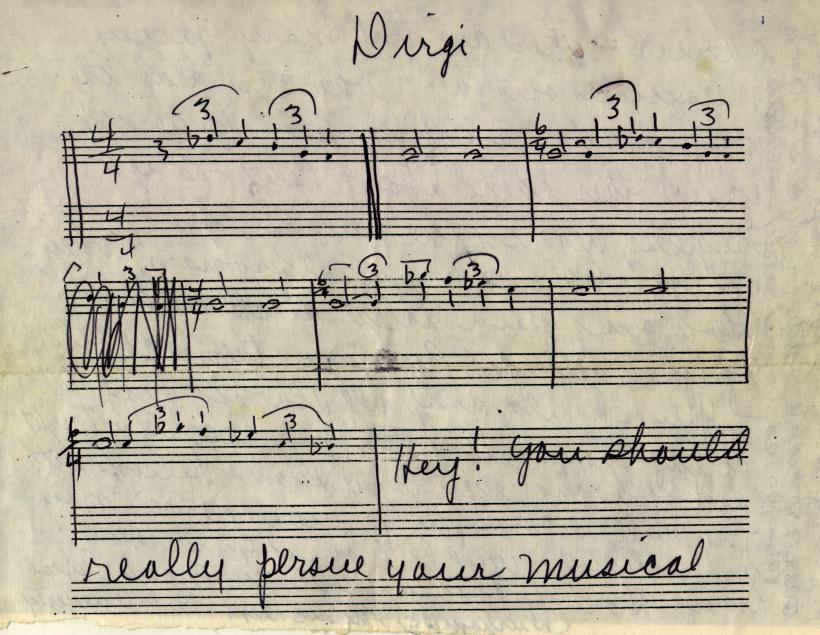
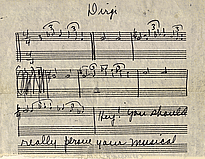
Back in New Haven i was inspired by my exposure to one of America's living treasures to work on some more transcription, as well as to send a letter to Mary Lou telling her how much i had loved seeing her and hearing her play. i also included my transcription of "Rosa Mae." She sent a very encouraging reply on March 8th and closed by saying, "wish it possible for you to extract more of my solos". Being exceedingly excited by this i continued to work on what i had been doing with "Dirge" and the beginning of the title track, "My Mama Pinned A Rose On Me."
Then matters were escalated out of my control when i was fired from Rhymes on March 25, for talking too much. i had been complaining to one of the record company reps about how we just were not able to keep all the records we shood have in stock because of our random, scattered finances and how it was frustrating to have to tell people that we were out whatever-it-was they were looking for but that we did hope to be getting it back later on....
The top brass had told me time and again that Rhymes business was Rhymes business and nobody else had any business knowing that business, so i was out on the street the next day. At the time i was completely in shock because i hadn't been expecting that (of course -- else i wood have finally "gotten the message" and shut up) and didn't have much money. (In time i discovered they were going to give me a pink slip which wood say i had been laid off for lack of work so i cood get unemployment which saved me, but at the time i didn't know this and felt terrible.)
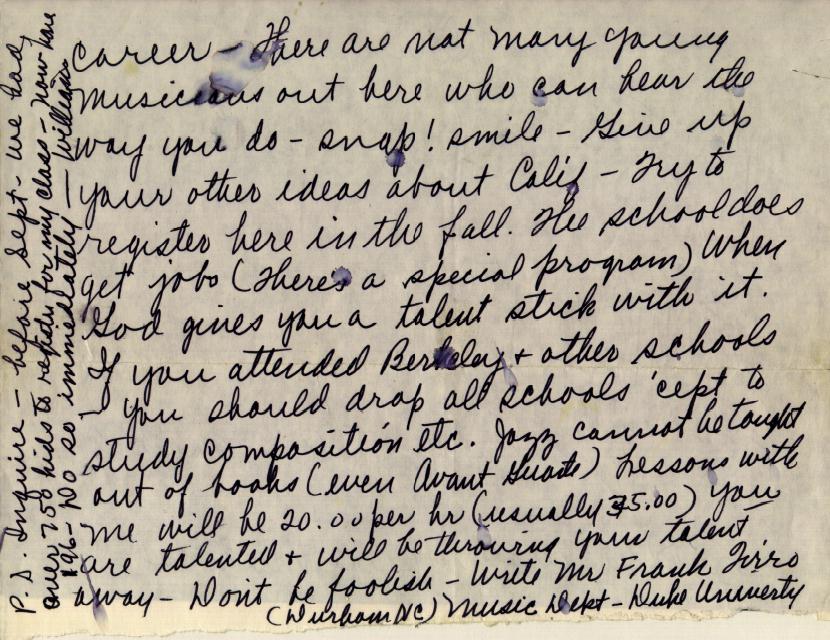
Along with unemployment i worked under-the-table at a kinder care place taking care of children ages five to nine. Being with the kids was a relief in many ways and i began to think of moving back to California. This seemed like a good plan until i received a reply in mid-April to a second letter i had written to Mary Lou in which i had included the beginning of her soulful tune "Dirge Blues". [September 2004: See the transcription excerpt of the song's opening in DavesPianoLessons.com/transcriptions.html]. i had been trying to transcribe it and had included some questions about the meter and tempo as well as telling her about my idea of moving back to the west coast. (Later she told me how she had written this dirge only a few days before JFK was murdered during which time she had felt a deep, deep sadness without knowing why. This ability to sense premonitions of events in the near future was something she experienced more than once and was an indication of an extremely well-developed intuitive self.) It was so overwhelming to me i must include it here in its entirety:
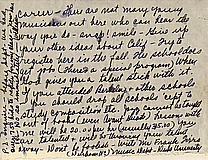 Hey! You should really persue (sic) your musical career -- There are not many young musicians out here who can hear the way you do -- snap! smile -- Give up your other ideas about Calif -- Try to register here in the fall. The school does get jobs (Theres a special program) When God gives you a talent stick with it. If you attended Berkeley (sic) & other schools -- You should drop all schools `cept to study composition etc. Jazz cannot be taught out of books (even Avant Guarde (sic)) Lessons with me will be 20.00 per hr (usually 35.00) You are talented & will be throwing your talent away -- Don't be foolish -- Write Mr. Frank Tirro (Durham NC) Music Dept -- Duke UniversityNeedless to say i was knocked out by her enthusiasm and encouraging words so i altered my plans accordingly to make it to Durham when she returned there in the fall from her pending summer-to-be in New York City.
P.S. Inquire -- before Sept -- We had over 750 kids to register for my class -- now have 196 -- Do so immediately -- Williams
i went back to California for the summer and then flew to the Raleigh/Durham airport on the night of August 31st. Mary Lou had just come home from a being in the hospital at Duke Medical Center and i was able to talk with her by fown as soon as i got to town. With Mark, a poli-sci senior who had been studying with Mary Lou, i found a house to live in two blocks from the corner of campus where the music building was. i also got a part-time job 4 hours in the morning way out on the other side of west campus tending goats, ducks and deer at some sort of animal facility.
i settled into a schedule very soon after that: up first thing to go to work (sometimes going swimming before work), back for lunch and then to the music building for practice (on M, W, F), or for Mary Lou's class (Tu, Th) and then going to practice after class. i took lessons with her every week if she wasn't too busy with other things. After the first one which was in the evening, she invited me back to the kitchen for some watermelon and we had a wonderful conversation about music and the people she'd known (or at least a few of them -- she had known and worked with practically everyone in the jazz world).
The jazz class was good even though there were some kids who signed up simply because it was supposed to be an easy grade and they wood sit up in the back mumbling. i sat in the front row and listened to Father Peter O'Brien (a white Catholic priest who was her manager and pulled a lot of the load for the class) talk about music and play a lot of records illustrating what he was saying for the first half of class. Then Mary Lou wood come in and sit at the piano and play and teach us to sing a lot of her songs (she said the only way to learn about music was to have it come from inside and to sing it out). i loved to listen to her playing as well as singing. It was such an indescribable blessing to drink in such a rich pure dose of her sounds in this manner -- live four feet away from where her fingers were dancing -- twice a week like that, plus invariably getting a little of the same during my piano lessons.
Soon after i arrived i was at her house one evening and we had already worked a little on the piano. Then she brought our a copy of her Solo Recital 1978 Montreux album that had been recently released and we listened to some of the songs. When we got to "Honeysuckle Rose" she was not especially pleased with the way she had played it saying she felt it was too fast and shood have been played more slowly. i was struck by this instance of her own exacting self-standards, of what she did or didn't like in her own performance.
She wood close her eyes much of the time while playing. At one point when we were talking at her house she remarked, "When I close my eyes I'm gone". One of the many staggering-to-me aspects of her playing was that she never looked at her hands -- and they were moving all over the place! It was clear that long ago, she had physically become one with the instrument, and that there was not one iota of energy being siphoned off from her creative expression by any of the technical issues i've always been dogged and constrained by.
Mary Lou's style is steeped thru-and-thru with a fundamental bluesiness as well as a powerful percussive element. Laid on top of this is a gift for improvisational expression unique in the way she arranged and especially composed music. She wood compose complete, fully-developed tunes while playing. The range of style and mood traversed in her own compositions was extraordinarily diverse and rich in its texture, depth, and feeling.
So inspired did i become by exposure to this legendary Giant of Jazz that i began to pick out two complete songs from My Mama Pinned A Rose On Me: "No Title Blues", and "J.B.'s Waltz". i had loved both of these for as long as i'd heard them. But up to that point i hadn't been able to summon the determination to sit down and take as long as necessary to write them out. The difficult part was notating the songs because of the discipline and tenacity required. Learning them afterwards was a great joy since the structure of the recording was now articulated as a written score. By October i was getting in a minimum of 4 hours a day practice. In November i was able to increase this to 5. i had never been able to consistently play that much at anytime in the past and it felt great.
Throughout the fall the time spent with Mary Lou was the radiant center of my world. She lived in a two-story house and had two pianos: a new Yamaha grand in the living room which someone had given her, and a spinet across the front hall in a smaller room which is where we did the lessons. We did practically everything on the spinet; i hardly ever saw her play the Yamaha. Mary Lou wood tend to be somewhat short-tempered at times during the lessons. As Nina (then living in Bwoston) said at one point, "I doubt Mary Lou wood get so riled up if she didn't think you had the potential and were capable of going further."
i did get the message, repeatedly, that she felt i had the goods. Inviting me to come study with her was of course a crystal clear message. Then once there, the time and attention -- and at times exasperation she gave vent to -- during my lessons. She wood also at times make collared greens and hush puppies and we'd eat at her breakfast table while she'd hold forth as a living encyclopedia describing the people who'd created the musical idiom called "jazz". As Duke more accurately put it in Music is My Mistress,You probably heard of the word `jazz.' It's all right if that is the way you understand or prefer it. We stopped using the word in 1943, and we much prefer to call it the American Idiom, or the Music of Freedom of Expression." [p. 309]i looked for ways i cood increase the time being with Mary Lou. The most successful avenue was that i began to clean her house and thus cood spend quite a long bit of a given day with her there. During these extended periods of time i began to see her moods shifting continually and cood better appreciate and understand her tendency to lose her temper with me. She had been thru and endured so much as a black woman in an essentially black man's field but it never deterred her from giving so much of herself to her music and all those she played with and loved so deeply.
Her marvelous 1978 recording on Folkways Records, The History Of Jazz, made in her New York City apartment by herself at the piano with her Tandberg tape recorder, included a rich "conversation" she conducted with you-the-listener about this music and its rich, rich heritage. At the end she obliquely referred to her own personal travails with the words,It was my pleasure to bring you thru the history of Jazz. You may not realize this but you're lucky. On the other hand, to bring this history to you I had to go thru muck and mud.Born Mary Elfrieda Winn in Atlanta, Georgia on May 8, 1910, Mary Lou had grown up in Pittsburgh after her family moved there when she was 5 or 6 and was exposed to all kinds of music. Known around town as "the little piano girl", Mary Lou was often heard at private parties including those of the Mellons and the Olivers, well before she was ten years old. She married twice, first to alto saxophonist John Williams and later to trumpeter Harold (Shorty) Baker. "Yet she says of both husbands and all other encounters, ``I didn't marry men. I married horns. After about two weeks of marriage, I was ready to get up and write some music. I was in love with Ben Webster longer than anybody, and that was about a month!'' " [Ebony, Oct. 1979, p.60]
It was apparent to me that although she never had children herself, she bore something of equal mystery and limitlessness in and thru her music. As with other mothers who have and raise children, hers manifested and contained the depth and richness of an extremely unique consciousness and spirit in an extraordinarily uncommon form and expression.
Mary Lou was very big on teaching people "the history" centering on all the musical eras and styles from the Spirituals and Work Songs sung by the slaves, to Ragtime, Old-Fashioned Slow Blues/Ballad, Fast Blues, Boogie Woogie, the Swing Era, particularly Kansas City Swing, BeBop, Modern, and Avante Garde. She herself was unique in the history of the Music of Freedom of Expression as she was trained to play all styles beginning as a child prodigy at age three on her Mother's lap. She lived thru all the eras and was an unrivaled composer, arranger, and innovator, as well as a top, bar none, pianist and performer.
Like Duke, she knew and worked with all the greats and was one of the few people who lived thru, played, and was part of all the eras of this unique American Idiom form of music. Again, taking a page from Music is My Mistress,Mary Lou Williams is perpetually contemporary. Her writing and performing are and have always been just a little ahead thruout her career. She did one of our most important arrangements on Irving Berlin's "Blue Skies," which we recorded as "Trumpet No End," and it has always been one of our standard high spots. Much of her time is now devoted to work in the religious field, but her music retains -- and maintains -- a standard of quality that is timeless. She is like soul on soul. [p.169]Reading the above the first time in 1976 in Eugene, the sense of her specialness had always stayed with me waiting for the time when opportunity wood present the chance to study with her as i was doing on the cusp of the decade of the eighties.
Up to the beginning of December things had gone exceedingly well. But i switched jobs to a graveyard shift as a radio operator at the Duke Public Safety Office Friday and Saturday nights and, altho this provided enuff money, i had never tried to work those hours before and it tended to mess my up my head. Then skool let out for Christmas vacation and the "town" i had been interacting with became very empty. i went to visit Barbara Crouse, a good friend of the fam'blee, in Indianapolis for five daze. But when i returned, i found that Mary Lou was back in the hospital where tests were being done because she was going to need to have surgery. i visited her a fair amount in her hospital room and we had some long talks. But she was relatively inaccessible and i was at a loss as to how to regain my musical momentum.
i never had the sort of unquenchable drive i felt all the people whom i idolized lived their whole lives expressing. Also i've always found it essential to have others in the locale where i'm living to whom i can share a deep closeness with wholly independent of the sort one has in a physical relationship with another special person. i had not met anyone in Durham with whom i was able to establish such a rapport. i had always been inclined to pour my soul out to such special others and prior to that had been able to find people to share the depth of my interior with. Since arriving in Durham in September, except for the five daze with Barbara, i had never gone that long without having someone around i cood confide in.
With Mary Lou engaged in attending to her own physical needs i found myself lost and coodn't re-ignite my motivation to proceed with my practicing. After her operation Mary Lou was slowly convalescing in the hospital (and wood stay there until the middle of March) so there was no music class and very limited musical exposure to her.
Sometime in the second week of February i "caved in". A block away from home, i was walking down a sidewalk with a very thin covering of snow from the night before on top of some ice, and all of a sudden i started running along and slipped onto my ass slapping both my hands down hard on the ground. The next day at the student health center i learned i had fractured the fourth metacarpel in my right hand's palm and wore a cast on that hand and lower arm for the next four-and-a-half weeks.
i never really got back to any concerted kind of practice schedule. Mary Lou went home later in March and finally was able to make it back to her class by the end of the month. i had a few more lessons with her then and at the beginning of April but she left town to go play in Brazil for a few days and was supposed to be back a week-and-a-half later after she had spent a some time in New York City. It was the last time i ever saw her. i struggled thru April with a job as a laborer for a small contractor guy but he had to let me go at month's end.
At my wits and money's end i called brother Steve. He said it looked as if the writing was on the wall (i had been expecting Mary Lou back for about 3 weeks and had no word of where she was) and that the Bolinas skool was going to have a huge construction project consisting of nine new buildings (virtually an entire new skool) starting in June. He urged me to come back and try to get a job on it. i didn't need much more encouragement and two days later boarded a bus back to California.Despite such a sad-sounding "wind down" for the last four months of my time in Durham, i have all ways felt exceedingly blessed by the gifts imparted during this period with Mary Lou. Duke understood her being like "soul on soul" as well as his apprehension of the fact that she always had a truly timeless standard of quality in her own playing. For those not familiar with her music, i cannot strongly enuff offer my recommendation to find and explore her recordings.
One of the projects on "the list" for 1997 is to create a collection about her on ratical inside http://www.ratical.org/MaryLouWilliams/. For now, i give in to my own ego and include there my greatest claim-to-fame: an article from the December 7, 1979 issue of Books & Arts with its cover story being "Mary Lou Williams: love in jazz", which had, as its one accompanying photo, an image of me watching her showing "how it's supposed to go".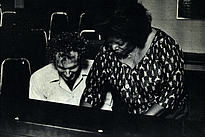
A group of us had stayed after class that day and the photographer for this feature was there snapping away. If i bebember correctly she suggested i play something so i started in with the version of "Roll 'Em" from Live at the Cookery i'd been transcribing at that point. i wasn't thru the 8-bar intro before she came over saying something like, "That's not right. Let me show you how it's supposed to go." As the photo was imaged i was in the midst of loving seeing the "mystery revealed" of every note she was playing, while at the same time trying desperately to commit the mechanics of the aural sequence to photographic mem'rhey -- something i am not good at. i can take a recording of some piano and make a reasonable stab at scoring it out, but simply seeing someone play something right there live in the moment and then being able to recount it to myself afterwards was another matter.
The issue came out in December. Before i ever saw it i was in the music building before or after class one day when Mary came up huffing about how i was always pushing my way into everything. i was mystified but later when i saw the article i realized she had felt somehow taken advantage of. From this, i gained another miniscule glimmer into how challenging her and other musician's professional existence must be and the toll it takes in terms of wearing down one's natural inclination to trust others and trust that uni verse will provide for and take care of all our needs.
Throughout my entire time in Durham i felt the strangest mystery of all was why there were no others like myself who had found their own way there via whatever route, to likewise study with such a true, living legend Jazz Giant as Mary Lou Williams. It always boggled my mind that out of everyone on Earth at that moment, no one else had discovered their own similar path to her door nor was now exploring the possibility of pursuing a musical path with the guidance of such a stellar member of that group of people present during and participating in so much of the creation of the Music of Freedom of Expression.
Mary returned close to the end of May and wrote me. We shared more correspondence thru that fall. One day in March i was visiting her while she was convalescing in the hospital after i'd gotten the cast off my right hand and cood play again. A piano had been rolled into her room and i had played the version of "No Title Blues" i'd transcribed and worked up. She was very pleased, telling someone else there, "Look, he's done the ``No-Name Blues!'' " She wrote me saying i wood make a great music manuscript copyist (transcribing whatever from recordings) and i have kept going with that, although not for my livelihood which she indicated i cood make a reasonable income from.
The last letter i received from her was dated September 4, 1980. She had written, "Practice & do a great piano -- your timing is better. I'll always tell you what's good or bad, Only way to teach it."
Mary Lou died next May from cancer just after her seventy-first birthday. She had been fighting it while i was there and stayed incredibly engaged right up to the end, playing, teaching, sharing, and loving. i don't know what wood have happened if she had returned before i left in May of 1980. It's certainly possible i wood have stuck around with her there. She was a unique teacher for me in so many facets of life and living. i was blessed beyond compare to have had the chance to know Mary Lou and drink at the fountain of life with her. Some aspect of her will always live on inside. Perhaps i will be able to serve as some kind of beacon to emphasize and ignite in others the awareness of and love for the music she created and thru which she expressed her own inimitable experience of being.life in Bolinas: Bobbie Louise Hawkins, laborin',
piano technician, and the rat hausLeaving Durham closed a chapter in life of traveling the path of playing piano perfessionally. Although i do not know what wood have happened if Mary Lou had returned before i left, i came to the conclusion that i simply was not obsessive enuff to want to practice all day every day and go out and play all night every night which is what i felt it wood take to "make it go." i also sensed trying to make money to provide for my material needs by playing piano was not something that wood suit my own nature. Far better it seemed, to keep playing for the fun of it, and find something else to bring home the bacon.
i came out to Bolinas after returning to California, and stayed with Steve and Ashley while i began to scope out the situation with the pending construction project at the skool. A man named Wally Grewe was the big boss and i learned the possible slot for me was as a laborer. i wood need to join the Laborer's and Hodcarrier's Union in San Rafael but that cood be done after Wally hired me. This job was clearly going to be a pretty lucrative one -- as far as a kid in his later twenties was concerned who had never worked for wages significantly above minimum wage -- so i bird-dogged Wally. As is usual, things were getting off to a very slow start and he kept putting me off because he wasn't going to need a second laborer until some of the first buildings, the foundations of which still weren't complete, had their framing begun.
i was also taking wild stabs at ideas of what i cood learn about to make money so i woodn't be condemned to shit-jobs for the rest of my life. In a letter from Dad in Saudi, he suggested piano tuning and told me to look up Sheldon Smith in Berkeley who had a shop and had rebuilt Dad's baby grand. i called him up and he invited me to drop by the following week to talk about things. He said he was getting ready to take on an apprentice in rebuilding. We had a nice visit and he made me feel the idea of becoming a piano craftsman really had some merit to it -- if one stuck at it long enuff to really become good. He asked me if i knew how to tune and i said i didn't. He said he'd call me nonetheless when he made up his mind. i felt i almost might have made it in if i had known how to tune. He never did call back.
On June 27th (a full moon) i went up Overlook Road with Steve to a woman's house to help unload a wood-stove he had picked up for her over the hill. She had already bought it and he was going to do the installation. Her name was Bobbie Louise Hawkins. i had met her very briefly two Christmases before at the Bolinas Community Center after a performance she had been in with Terry Garthwaite and Rosalie Sorrels.
Bobbie was and is a writer. Born in Texas, her ancestors included an Irish man and Cherokee woman at the time when "The Irish came to Texas building the railroads as they came, the cheapest labor available." On stage, the three of them wood trade the limelight each telling their own stories: Terry wood sing a song she'd written accompanying herself on guitar, Bobbie wood read from one of her books, and Rosalie, guitar in hands, wood likewise sing one of her own songs. As they'd go around each one wood tend to leverage off of and further develop the theme of the previous stories. i had been greatly taken by her when i watched and listened to her read that night.
The stories she read were from two of her books, both published in 1977: Frenchy and Cuban Pete, & OTHER STORIES (TOMBOUCTOU), and Back To Texas (BEAR HUG). Her source of inspiration for these stories was her own life growing up in West Texas and the exceedingly rich tapestry of characters that populated her world of those years. She read them with her Texas drawl turned up full creating an irresistible enchantment and transporting one into the world of Uncle Horace, Grandmother Oda Louisa, Aunt Ethel, Beezer and cousin Velma, Aunt Hannah and cousin Billie-Bob, and a host of equally captivating characters.
Enhanced by an impeccable sense of timing, her Texas drawl gave the telling of these stories something i have never encountered before or since. i suppose it is simply that Bobbie Louise knows the timeless, age-old art of story telling better than anyone else i've ever met. i wood imagine what she does is what everyone knew how to likewise do more than ten thousand years ago when story telling was the means by which one learned about life and the world one lived out one's own within. As Reynolds Price observes on the back cover of Back To Texas,If more writers were writing like Bobbie Louise Hawkins -- economically and truly about the only human things that interest us in prose: the past, the family, love, hate, duty, forgiveness -- then maybe a few more thousand Americans wood be reading narrative fiction and nourishing themselves on the oldest of all safe and enduring pleasures: news and fun and consolation. Start with Back To Texas if you're low on any of the above mentioned fuels.One of the stories she told that night in the Community Center (from Frenchy and Cuban Pete), altho not centering around members of her own fam'blee, is one of my all-time favorites for the wisdom its closing sentence imparts:i have never forgotten this and strive to "follow thru" with anything i ever get started on with consistency and perseverance.I OWE YOU ONE
Before it gets lost into the void I want to tell about a letter that got written to the Denver Post years ago. It could have been as long ago as 1947 or 1948.
It was apparently written in answer to a letter that had been written earlier and, judging by this letter, the earlier one seems to have been written by a woman who was complaining that when her husband got drunk he'd knock her around.
The woman who wrote the letter I read said that she had the same problem.
She said she only weighed about a hundred pounds and her husband weighed close to two hundred pounds. She said for years he'd go out on Friday night and Saturday night and get drunk and then he'd come home and beat her up, then he'd fall asleep on the bed with his clothes on.
There came a night when he beat her up and when he had stopped she said, "I owe you one."
When he fell asleep she went outside and brought in a piece of two by four and she started pounding on him with it.
Of course, he woke up right away, and he beat her up again. And she said, "I owe you one."
She said that in no time at all she had him afraid to go to sleep. Then he began to see that it was ok to go to sleep if he hadn't beat her up. So he stopped.
Considering the number of years it had gone on the stopping was really quick.
She said she hoped that her own solution would encourage the other woman to look for a solution because it was not hopeless.
The two principles involved were consistency and perseverance.
So we brought the stove into Bobbie's house and she offered us tea out in the sun on her front porch. She and Steve talked literature and writers. They already had a great rapport thru their common interest. At that time, Steve was engaged in finishing a PhD in English Literature at Berzerkeley and was writing a book as part of this on Thomas Campion and the aesthetics of songs. She invited us to dinner at the Gibson House that night with another couple Steve knew whom she was already slated to meet there. Ashley was in Berkeley for the night and we agreed. Steve got a baby-sitter for their daughter, Oona.
i realized only after we got up there that morning who Bobbie was and felt very drawn to her. Dinner was marvelous and in time we moved into the piano bar room where Michael McQuilkin was playing piano and singing. i had heard about Mike before and had been told by Steve and Ashley more than once that i shood meet him because to them we seemed so much alike. i knew he was a piano technician of sorts and said i'd like to talk to him about that because i wanted to learn how to tune. i stuck close to Bobbie thruout the evening and Steve finally had to go home at 11:30 to relieve the baby-sitter.
We were quite a loud group of people when they kicked us out of the bar at 1am and Bobbie suggested we all go to her house for a little more liveliness. About 10 or 15 people came along and i got to sit in the front passenger seat of Bobbie's VW bug. We stopped at the top of Overlook to drink in the magnificent vista of Luna in full splendor accompanied by her uni verse of stars. Then to Bobbie's house where i played a little piano with 4 guys trying to all play along on acoustic guitars. It was quite cacaphonous and after a point Bobby and i went upstairs to look at some xeroxed-type artwork collage she had done (an instance of which was used on the cover of Frenchy and Cuban Pete) and sat on the floor examining them until, in just a little while, everyone else had left.
We came back downstairs and had tea in the dining room. We talked and talked, each feeling more curiosity about the other. i never went home that night and, although Bobbie expressed some ambiguous feelings about actually being able to live with anyone else (she had been divorced from her second husband for about three-and-a-half years) -- and she continued to feel uncertain for the next week -- i ended up staying with her and moved all my stuff in within about a week's time. Bobbie was twice my age. For a long time i had wanted to be involved with an older woman and now was able to explore what this was like.
Throughout July we spent each day enjoying our mutual company and getting to know more about each other. At the end of July i was hired on at the skool job and began a six-and-a-half month stint as a perfessional laborer. i immensely enjoyed working at this job. There were 12 carpenters and one other laborer named Dell. Dell was 37 or so and had been laboring for 15 years. He was red-neck in some ways but was also a real sweetheart and great to work with. i became very fond of him. This was the first experience since hi skool where i again felt that wonderful sense of comraderie, this time with all my fellow construction workers.
i was the honest-to-gaud grunt on the job site doing the majority of all the shit work. But the sense of belonging and of participation was fabulous and i drank it up. i also got to do intoxicatingly fun stuff like driving the heavy-duty forklift around. Maneuvering with the hydraulic lifts the tremendously weighty "pay loads" up to the second floor or roof of a building was unparalleled in its "control master" excitement mixed with the requirement of being absolutely precise with "positioning" and then "touch down" of whatever needed transporting.
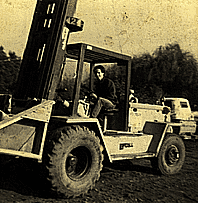
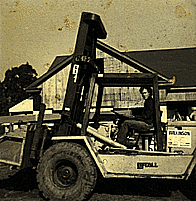
At some point during the fall i almost made my last mistake. i was using a cement grinder to grind down the bottom edges of building walls to a smooth finish where the cement sill adjacent to the slab sidewalk wood be exposed after the wooden walls were added. The grinder was heavy and had a suicide switch which kept the rotor spinning after one turned it on at the trigger. Without the suicide switch, the grinder turned off the way a Skilsaw does once the trigger is released.
i had been warned to make sure my shirt was always tucked into my pants but at one point had failed to keep one of the shirt tails from hanging loose. The next thing i knew the rotor had latched onto the shirt and the grinder twisted on, its sanding edge glancing off the edge of my stomach and the whole unit flying up to hit my chin. In a flash i was locked in mortal combat with this electro-mechanical beast, holding it at bay as it was still trying to spin and close the remaining distance between itself and my chest and head. i think it was Dell who ran up and yanked its plug. i immediately collapsed onto the ground, more from a kind of psychological shock, altho i had just expended an uncommon amount of energy to keep the grinder away until the plug was pulled.
i think i went home for a while but came back during lunchtime and even did some work for the remainder of that day. Later that afternoon i was in the bathtub and it was only then for the first time i began to realize just how intense the experience had been and how fortunate i was to still be alive. As quickly as it happened i cood just as easily have been disemboweled if it had really gotten hold of me along the stomach instead of only glancing off it.
From this and other experiences -- especially from seeing Dell who was not yet 40 years of age but looked as if he cood have easily passed for someone in his later forties (his rugged face has a certain sand-blasted "luster" to it) -- i came to understand that doing construction in general and laboring specifically (as in other trades equally taxing physically), one pays with one's life to an extraordinary degree: years are prematurely added to one's human overcoat.
Throughout the fall i had been trying to learn piano tuning from Michael McQuilkin. He got me a lot of the tools but progress was slow since i was laboring full-time. In December i bought my first vehicle -- a 1963 Dodge half-ton truck with a cab-over camper for fifteen-hundred clams. i got this essentially so Michael and i cood move pianos out to Bolinas from the Bay Area to work on them. We were planning to go into business -- but this never came to pass.
For the first month and a half of 1981 i continued on at the skool but the job as a whole was winding down and on February 19th i was laid off. Steve and Ashley had bought the Blue Lagoon, a building in downtown Bolinas, and later in March Steve and i began to work on it's foundation. We had to redo a lot of the support for the base of the building. Also in March i worked with Michael restringing 2 upright pianos and learned a great deal in the process. As March progressed work at the Blue Lagoon started to consume the entire work week and i had little time for much of anything else.
Bobbie had gone down to teach at U.C. San Diego for the spring term at the end of March. During that time we decided it was better that i find my own place to live. i found a great space on Lauff Ranch Road -- the second floor of a two-car garage building -- and moved in June 1st. i had been working full-time with Steve at the Blue Lagoon and we had enuff to do that i succeeded in talking him into hiring Juan Manuel de Santa Anna, a special friend i met on the skool job who was hired as a carpenter's apprentice. Juan is a descendant of none other than General de Santa Anna. Juan's disposition has always been flowingly mirth-full and his bright energy enhanced every aspect of our joint efforts. We three made the Blue Lagoon into a cherry building that had a restaurant downstairs and a bed-and-breakfast run by Ashley upstairs.
Juan was living with Ane Rovetta who worked at Audubon Canyon Ranch across the Bolinas Lagoon. They have both become life-long friends. i had the honor of playing some piano at their wedding a year or so later. Ane is extremely gifted in the art of live story-telling as well as a being a superb nature illustrator. i've enjoyed many years of her calendars with ink drawings of native wildlife of California and the west. In recent years, she has gotten into doing pastels in a big way with the subject matter being natural setting landscapes. i just attended a show at the Bay Model building in Sausalito where Ane had some of her pastels of the California coast, wine country and Klammath area and Juan had some photographs. They are beings filled with great light.
After moving into Lauff Ranch Road i again found a rata to share my abode with. Originally he wore the tried-and-true moniker of rata but this transposed itself into a string of intermediate names beginning with Lucky-Lata, which shifted to Latahno, which changed again to Latanos, and was extended to Latanios, shortened to Tawno and, with Tom Bombadillo (was he in The Hobbit or The Trilogy?) affectionately bebembered, slurred into Tillo which finally came to rest in the most inspired rat name i have ever discover, Mister Tillo. Mr. Tillo was destined for immortality but he didn't seem to care.
Throughout the spring i had been practicing piano tuning around Bolinas and playing on Bobbie's upright. i transcribed Bobby Timmon's solo from the "Close Your Eyes" tune (off the Art Blakey and the Jazz Messengers' At the Jazz Corner of the World, Volume 2 album which i'd first fallen in love with back in Durham) altho i never succeeded in truly being able to play the score.
In July i got the go-ahead from my friend Kate to fetch her father's grand piano that had been languishing at his wife's sister's house in Fresno for 16 years, move it to Bolinas, and restring and restore its "innards" for him. He paid for the materials, and i did the labor for free which along with restringing, included regulating the action, replacing the dampers, and getting the keytops re-covered (in plastic, not ivory). For doing the work it was agreed i cood have the piano as a "loan" for an indefinite amount of time. "Landing" this grand piano was a great blessing as it is always the case that the richer sounding the instrument one can play on, the more one is inclined to play and play and play.
Starting that summer i had an ideal environment in which to be more and more engaged playing piano and transcribing songs off records. The garage building was far enuff away from where other people lived on the property so i cood play at night or in the morning without worrying about disturbing someone else, an ever-present issue where pianos are concerned. i worked up transcriptions of Willie "The Lion" Smith's "Relaxin'" (from the "Luckey & The Lion": Harlem Piano Solos by Luckey Roberts & Willie "The Lion Smith" album on Good Time Jazz) and Monk's "North of the Sunset," "Monk's Point," and "Dinah," (off Solo Monk on Columbia).
i had become enamoured with an incredible record store in Mill Valley called Village Music. The owner knew worlds about "the biz" and had a tremendous catalog, including a marvelous jazz section. During this period, along with more Duke, Tatum, Monk, Trane, Bill Evans, and Bud Powell, i got heavily into "The Lion", Jaki Byard, Randy Weston, The Modern Jazz Quartet, Tete Montoliu, Little Walter, Lennie Tristano, and Martial Solal. Thanks to my Dad's recommendation, i also fell in love with the three four-record box sets on Seraphim (Capitol's budget label) of Walter Gieseking's immortal 1953-54 recordings of Mozart: The Complete Music for Piano Solo.
Since further elucidation of the rat piano thread ceases beyond this point, we jump ahead to 1986 for a musical coda of the MOST significant recordings i have come across in the last ten years. In 1986 i found a recording by John Lewis (Modern Jazz Quartet pianist, composer, and arranger) called J.S.BACH, PRELUDES AND FUGES, from The Well-Tempered Clavier, BOOK 1. Six Preludes and Fugues (Nos. 1, 2, 6, 7, 21, 22) were included with the preludes being played by him as solo piano and the fugues having as many strings as the number of voices in each -- four was the maximum and included violin, viola, guitar, and bass. In all the pieces, whether solo or as a group, the complete original score is played and extended with an improvisation occuring somewhere inside, always returning back to the score where it left off before concluding.
I've always loved John Lewis. Like Mary Lou Williams, he has the same rich deep love for and apprehension of the blues. His style manifests a genius of simplicity as well as possessing a magnificent grasp of playing just the right notes between the vast empty spaces of silence; no hint ever occurs of feeling cluttered or redundant. His intonation and phrasing is unique amongst the pianists i've become familiar with.
Over the next four years three more albums came out constituting all of the remaining 12 Preludes and Fugues from Book I. This music is the most inspired i have come across in a LONG while. The second volume's subtitle is The Bridge Game. Initially i took this to mean the works were a "musical bridge" between Bach's time and ours where these songs evidenced both a supreme love for Bach's own magnificent creativity as well as that same rich "classical elegance" that is the trademark of the Modern Jazz Quartet in general and John Lewis in particular. In fact, it turns out he loves to play Bridge -- each of the tunes on the second volume have secondary names that are types of bridge hands.
i became so caught up in these recordings i was inspired to learn some of the Preludes from the original manuscripts and then transcribe John's improvs and include those as well. i worked up versions of Prelude Nos 3, 4, 5, 9, 16, and Fugue 10 (one of the only Fugues he plays solo). This music is some of the most sublime i've ever heard and heartily recommend it to anyone who thinks the above sounds at the least intriguing, and at the most, inspired synthesis of the most astonishing kind.After the Blue Lagoon was "ready for business", Steve landed a job rebuilding a house next to the Bolinas lagoon that was owned by Alice Kent. Her husband Roger had been a big supporter of the Democratic Party during Truman's time and i believe their fam'blee had been the namesake for "Kentfield" in Marin County. During this job we began to jokingly see ourselves as "Ratcliffe Brothers Construction". Our "M.O." here was the same as before: rip out the flooring, re-build the foundations, and then put everything back together again pretty.
For the rest of 1981 and thruout 1982 Alice Kent was our benefactor as we "cleaned house" with another building she owned in Bolinas (also re-doing the foundations) and then "graduated" over to Kentfield to work on her own smaller "mansion" house, re-painting the exterior and rebuilding part of the foundations of a large porch with massive wooden columns on its edges. We also re-roofed a neighbor's house that fall. Home-grown construction king-pins were we!
The great flood of '82 began to shift into full gear during the Christmas holidays before New Year's Day. By the start of January things were getting exceedingly wet and there was a lot of time to spend indoors. January was a difficult month as i was re-grouping after a very passionate but short-lived romance that had begun the previous November.
It was sometime in late January or February that i was feeling particularly wistful about the rat cabin and victorian and the poignancy at my having "lost" them. The only thing to do, it seemed -- if i really wanted 'em back that bad -- was to build another one. Once i decided to proceed it seemed only fitting to have this "re-make" be even bigger than the rat victorian as i had felt back in 1976 once it was structurally complete, that there were shortcomings in its scale and the degree (or lack of it) of "rat spaciousness". Thus it seemed that in order to do this one "right," it had to be more ambitious and expansive in its scope and detail to justify the time i knew it wood take.
My second-floor "house" in the garage consisted of two rooms in a 30x26-foot space, divided by a wall with one being the "bedroom / piano room". It had a large window seat sort of 4x8-foot area and i commenced building in this space. My M.O. was again to draw out the to-scale first floor plan on graph paper, modeled after the rat victorian. But this time i was interested in "injecting" more human contrivances into the framework and so included "toilet rooms" (how incongruous the "stand-in" term bathroom is when the room only contains a toilet and a sink!) on each of the three main floors.
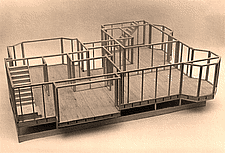
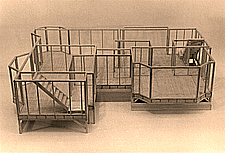
In the above left "front view", the toilet room shares walls (going clockwise) with the front hall, dining room, hallway between it and the kitchen, and living room, with its doorway between the back hallway and the living room. A pantry is off the kitchen across from where the rear stairway begins. i still have the graph paper used for this and bebember very clearly creating the joists and blocking for the first-floor with cardboard underneath the graph-paper, wax paper on top of it, pinning the joists down as i glued them together and feeling very excited that i was actually "on my way" with the descendant of the rat victorian. i knew this one wood be that much more compelling to the eye, but i did not know just how much at the outset.
For the next 10 months i spent a great deal of time engaged in the enormously satisfying process of rat haus construction building it floor-by-floor in the manner outlined previously for the rat victorian. As noted therein, the one addition with this haus was inclusion of lights in every major room or area so that by the time it was structurally complete, there were 32 lights all hooked up on separate switches.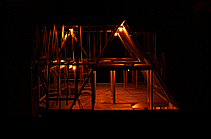
While writing this section i found a forgotten series of slides (what a delightful surprise!) of the rat haus at night illuminated only by its own lighting. Oh SO sweet! Memory of the existence of these has lain fallow for at least ten years (and it has been almost that long since i've hooked the transformer up to the switch grid panel and turned on any of the lights.) It is a truly magical sight to gaze upon this edifice lit only from within. Such illumination of the interior heightens one's sense of its space and achieves the apex manifestation of the desired "miniature replica" effect articulated in the rat victorian's construction. The 32 light switches were laid out in five rows (corresponding to the five floors) on the control panel to provide some sort of intelligence to the mass of switches and where the "end of their lines" switched.
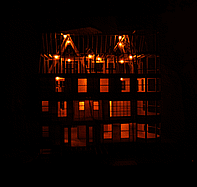

i lived in Bolinas for three years from June of 1980 to September of 1983. It was a very special time in my life since i was able to participate on a daily basis in Steve and Ashley and their daughter Oona's fam'blee life. Ever since my parent's divorce i had grappled with the sadness of feeling i no longer had a fam'blee that was whole that i belonged to. During those three years i embraced the opportunity to be a participant in Steve and Ashley's with a gratefulness that nourished a deep longing within. Oona was five when i arrived and, although we had previously spent time together off-and-on, it was during these next three years that she and i discovered a deep, abiding pleasure in each other's company that has significantly enhanced both our lives from then to now.
As "uncle dave", i wood drop in at their house any time of the day for whatever reason. i joined them for dinner a great deal of the time helping out as the perfessional "pearl diver" i had years of experience with to clean house in the kitchen after desert. i'd baby sit at times, but the real thrill was when Oona came for sleep-overs at my house. We'd have dinner and then perhaps go out on a walk (it was very pastoral there with a creek and fields and woods). Although in the kitchen Ashley is an inspired chef bar none, Oona claimed she thoroughly enjoyed my very basic pork chops or chicken concoctions.
Two of the most enjoyable activities we engaged in when she came over were playing with Mr. Tillo and watching the Three Stooges. Oona loved Mr. Tillo. She wood carry him around and was as entranced with his cuddliness as i had originally been. But her own home was "cat world" of a veryensconced kind. Her Mom had two extraordinary kings -- Bob Tail and Beast -- who had been with her since her prior life living in San Francisco. There were other cats (not as exalted but very essential members of the fam'blee nonetheless) in the mix as well and so it really was out-of-the-question for Oons to have a rata of her own in such a cat-heavy domain -- at least until she was older and cood adequately protect her own furry charge. (Seen here is a shot of the regal Bobby Tail, a very vocal manx of extraordinary bearing who also went by the names of Bobba-luna, Tibby, and Mr. Tibs.)
Along with the cats, another quintessential part of Steve and Ashley's fam'blee were their two Vizsla hounds, Sandor and Sage, father and son, respectively. Sandor had joined the fam'blee as a puppy in 1973 and at some point had been thefather to another litter of which Sage was a member and, when weaned, came to live with his daddy. i loved Sandor as much as Pingo our black Labrador when i was growing up. Vizslas are known for their liveliness and Sandor possessed his own vast amount of such energy and intensity in spades. In the tradition of name-rhyming, the two-syllable original begat many derivatives including Sandor-Landor, Landor-Tandor, Lando-Tando, Lannin-Tannin, Quandor-Landor, Quando-Lando, Quazi-Quando, Quazi-Quandro and from Sage came such variations as Layjro-Tayjro, Quayjro-Tayjro, etc., etc., etc.
Early on Lando-Tando had transferred all his formidable bird instincts into the object of the tennis ball. He was an irrepressible ball-master and when the words "the ball" were spoken, he ceased whatever he had been doing and became intently focused on finding one (if "where's the ball"? was uttered) or staring unblinkingly at it if held up as a prelude to the throw. One summer day i threw a ball out into the surf for quite a long time and Quazi-Quando relentlessly kept bringing it back to me until he actually had exceeded his own limits and looked rather disgusted as heemitted a burst of water out of his butt! He had of course been getting a mouthful of salt water with each ball-grab and it came to be too much even for him. He was quite low-energied for a few daze and i learned that even such a ball-gaud as Lannin-Tannin was truly mortal and needed to be taken care of in a manner consistent with such a status.
Ashley is exceptionally gifted with the camera and has an extensive background of her own in and with the world of photography. One Christmas she gave me a framed 8x10 of Sandor sitting in their VW bus out near RCA beach wearing an Andean knitted hat and looking very stately and pensive. At another point she tooksome pictures with the assistance of Steve and Wilson Burrows (who lived downstairs in the Red House), with Sandor bedecked in a Tuxedo. Some home brew was immortalized with the source of its label being none other than Quandro-Landro's legendary "tuxedo sitting" which Wilson, a master print-maker, concocted at the same time he was engaged in the initial frames of his superlative "MetalMorphosis" series. A proof sheet of these "Red Dog Pale Ale" labels can be found on Wilson's Bolinas Soccer Club page.
Sandor and Sage, though father and son, had distinctly different personalities in a host of areas, one of whichwas the degree to which they wood lose themselves in "the ball". i have no doubt that Sandor was, hands down, the most maniacally engaged ball master ever to manifest on Earth. In comparison, Sage was "interested" but only in a much more circumspect and diffident manner than the focus-every-iota-of-attention transfixed gaze his father wood levy when the ball was held aloft. My own sense was that Sage was into it only because his father was. The images here are represented in a somewhat larger scale in an attempt to convey this difference.
This is most easily displayed in the porch shot where Sandor's single-minded intent is demonstrated by the way his ears wood drop limp, devoting all his perceptive energies into the eyes for maximum tracking capacity. Sage's ears, on the other hand, are perked up, which one might think was an indication of a more heightened attending to the moment. But, in comparison to his Dad's undivided all-consuming gaze, he simply was not as carried away by it all.
The shots below, especially the left, distinguish this degree of carried-awayness in the manner of their facial expressions: Sage is sporting his "mournful interest" eyes he applied in numerous situations in which he knew his father was interested, and therefore so was he. But only on his own terms, and not in any way bringing to bear the beady-eyed and singular-focus his Dad was caught up in. The image on the right shows Sage with his "giving it his very best attention" visage and the increasing years toll on his Dad who looks a little less energized. Yet, even here with Sandor not quite so transfixed, he still is nonetheless on all fours ready to bound while Sage prefers to study the situation in a more relaxed sitting posture.
As has been previously mentioned in The Sportin' Rats as the source of inspiration for Buildin' Rat, i was weaned on The Three Stooges. In the San Francisco Bay Area, Captain Satellite ran 4:30-5:30pm weekdays and included two complete episodes as part of each afternoon's program. As a kid, even though i was the youngest, appreciation of the Three Stooges was a fact for everyone in my household. We wood go over the hills to Half Moon Bay beaches a great deal thruout the year and along the way there was a small out-of-place house we gleefully dubbed "The Three Doodies House." Any such house or structure that had a ramshackle or "inconsistent" air to it elicited associations with "the Men" from all of us. Ok and i used to love to wreck things and our primary source of inspiration in such activities was the Doodies mastery of such theatre of the absurd and ridiculous.
Despite all the condemnation about their "violent `comedy'", "the Men," as Ok and i affectionately came to think of them in our 20s, personified a quality of innocence that is almost completely non-existent in today's cynical-is-cool (as a mask to hide the terror we feel with the sense of "living on the Titanic") postured-world. Richard von Busack has written a marvelous homage to these masters of "velocity without sentiment" on the occasion of their formation 75 years ago, in 1922, and i am grateful for his permission to be reproduce it here on ratical.
von Busack's well understands the reasons for the Stooges' "durability" and ageless allure:Their popular appeal may not justify them as artists, but those oppressed by authority -- children and poor people -- revere them for their anarchic strain. Charlie Chaplin may get all the praise, but currently the Three Stooges get all of the viewers . . .There was a syndicated Stooges show that played every Sunday morning and when Oons slept over on Saturday night, we wood always watch it. For my part, during those years i was big into recording the audio portions of old movies playing in theaters with a portable tape recorder -- as well as off the television -- and extended my library of Stooges tapes from this Sunday time-slot. Oona and i had already been watching some old Star Treks off-and-on at her house that aired on weekday afternoons. She exhibited a very sharp mem'rhey in being able to "call up" all sorts of details from and references to different episodes of boldly going where no one cares to go.
Curly's gift as a comedian was knowing how to get down to the level of an inanimate object, to match wits with it. . .
Is it possible that watching the Stooges, who suffer crazy injuries and survive, is akin to acting out the same part humanity plays when we go to worship? . . .
The Stooges' shorts are often about work, always a touchy subject in the movies. Typically, Moe leads the troupe into a situation in which they're highly unqualified. By the end, the machinery is in wreckage and the Stooges have fled the scene. The usual setup finds them as door-to-door salesmen, mechanics or plumbers (as in their symphony of disaster, the 1940 short "A Plumbing We Will Go").
As "background music," i wood play a LOT of Three Stooges tapes while absorbed in the craft of rat haus construction. Some people are addicted to listening to the radio thruout the day to keep their loneliness at bay. i've had a streak of that thru recent decades but draw upon my own library of recordings rather than the radio bands for company. i'd previously gotten into recording Star Treks on weekday afternoons in Durham after i'd fractured my fourth metacarpel and these augmented the Doodie recordings as well as films such as Casablanca, The Big Sleep, To Have and Have Not, The Maltese Falcon and It Happened One Night.
Building the rat haus was a great outlet for my compulsive energies. The day i was born was a full moon. The presence of a kind of effortless access to some sort of infinite energy source has always been with me. At times a listlessness sets in but this seems more the result of an essential quality of life that inevitably re-asserts a sense of proportion to the tempo of existence.dreams: our most personal letter from and to ourselves By the close of 1982 i felt as if i had "bottomed out" trying to discover a way to make money that somehow was true to my own dearest self and life and did not violate my integrity. i understood all-to-clearly the potential for construction shortening one's life and had had my fill of pounding nails with Steve. Even though the piano technician's path was not physically lethal, i felt i wood be "selling myself down the river" with the sense that tuning and rebuilding wood not nourish me in the longer haul as i knew whatever i did to bring home the bacon had to.
During 1982 i had met a piano technician in San Francisco named Richard Moody and worked for him learning how to rebuild a number of player pianos. Like Bruce, i had always enjoyed understanding the mechanics of the way things worked. Working with Richard, i became very intrigued with the mechanism of the "air system" that worked the miniature bellows for each of the 88 keys. He also owned an Atari and i had my first exposure to PacMan and Missile Command. That was the first and last time i've ever found computer games engaging but during that period, i was very caught up in endless hours of ever higher scores and warhead detonation.
But by the end of December i felt i was slowly heading for the junk pile and was more inclined to be open to possibilities i hadn't previously considered. i had been keeping a dream journal since February and was impressed that the more i wrote them down, the more i remembered when i'd wake up. i had read Jung's posthumous autobiography Memories, Dreams, Reflections when i was twenty and had been exceedingly taken with his own propensity for "self-honesty" -- for being able to see himself free from the self-deception so prevalent in our society. i'd also read the beginning of Man and His Symbols.
From both these books i became quite curious about dreams and their significance. i believe Jung at some point wrote that a dream is the most personal letter we'll ever receive from our self to our self. On January 16, 1983 i had a dream that was integral to my own continued growth and development which i include here in full:going to a place that's 4 or 5 stories where things fade and become other things good & bad and being there with Carol, Ok and Steve H. Up on the 4th floor Carol is telling me about these little creatures called Tazzios that know our names and all about us, and can tell us all sorts of things as well as make all sorts of things seem to happen. I'm with her & Steve & one of these Tazzios and she says go on and take it up to the 5th floor room and ask it anything, you'll see what I mean. So I do, and it does know so much that I can't understand how it can. It also makes me think I'm in a Maharajah's tent (mine?) with an infinitude of blankets/rugs at one point that are in a pile on the side of the room. Then somehow, it seems that I am down on the 2nd floor but that the place has slightly altered. There's some kind of changing of people that's taking place where I go outside and around the building and then am supposed to come back in, but, I think, I stay out too long (we're going around & around the building) and when I finally get back in I am correct in my fear that I now do not have my previous identity (was I some sort of detective?) and am numberless. Because I do not have a # (or name) I don't know where I'm supposed to go and after a short time get pursued by some "regulator". I go back to the 5th floor to try to find a Tazzio to get me back to where Carol & Ok & Steve are. En route I can reach Ok audioly and ask him for help in finding the Tazzio or getting back & he says "Just become expansive" and I'll find the Tazzio and it'll help me alright. I'm somewhat afraid of the inexplainableness of the Tazzios.Throughout my life, Carol has been a fundamental source of love, inspiration, and sense of inner well-being. Of all the people i've ever known, it is from Carol i know the strongest experience of unconditional love. With her eldest and youngest sons present, a quorum of my real-life "adopted fam'blee" is present and participating in this situation. At the time, the dream's theme was fundamentally perceived to focus on the process of transformation. The ineffable and utterly mysterious wisdom of dreams is in full evidence in that it is Carol who introduces me to the Tazzio. i had read some about the "senex", the inner wise old man. i felt the Tazzio was a symbol of this age-old unforgotten wisdom we each contain and carry within, even though we become cut off from it by the conditioning we are subjected to growing up in a culture that has lost its own sense of place in and belonging to uni verse.
The experience alone with the Tazzio amplifies my appreciation of its apprehension of reality. The perception that I can't understand how it can know what it knows emphasizes the importance of irrational events and awareness of things beyond and outside the rational experience and understanding of consciousness. The Maharajah's tent seems to impart the understanding that i possess great wealth of a foreign-to-my-western-sense nature. Blankets enfold us while asleep with a cocoon-like sense of security and warmth, and rugs adorn the floor which i interpreted as symbolizing the essential nature of having a solid foundation underfoot. In an inner context, the message was seen to be that i possess a stable and rich basis within my self -- for one such as i who is so inclined to doubt myself and my own abilities, this was a communique of critical import.
Then i find myself "outside" the domain of the Tazzio where people are changing and i sense being outside too long. Once again inside, i find myself directionless and pursued by an agent or representative of conformity. i attempt to ascend to a higher level of awareness to regain my connection with the centering influence of my adopted fam'blee via the Tazzio's ability to go beyond the rational and in transit i am able to perceive Ok's recommendation to Just become expansive. Those three words became a veritable guiding light for me from that point forward.backing-up into computers, Marta Van Leuven, finishing college
It was during the time of this dream that i felt as if i hit the bottom of something, not in a depressive way but simply coming up empty and more pliable, more malleable than i had felt in a long time. It was in this bottomed-out state that i posed the age-old question: "What makes money? Computers make money, but i woodn't be any good at that -- they're too complicated for me." Nonetheless i drove over to UC Berzerkeley one morning to scope out their computer science program. i found that it was heavily impacted with a lot of people already waiting to get in.
On the way back to Bolinas i stopped at College of Marin in Kentfield to see what i cood pick up. Walking around i fell into conversation with a very vibrant woman who was a computer instructor named Nancy Zamfirescu. She encouraged me to sign up for a class she taught on Fortran that was soon to begin. In comparison to the "off limits" feel of UCB, this situation was pleasantly inviting and i decided to give it a try. It was one of the best decisions i ever made.
From that spring semester thru December, 1985 when i graduated from UC Santa Cruz, Nancy turned out to be one of the most inspired and gifted teachers i ever had learning about the world of computation and logic. She possessed that rare gift of bebembering what it was like not to know the course material or the discipline being taught and truly hear the questions posed by students on the level where the student was at and was coming from. i learned so much in that one course on programming Fortran and it was because of her animated, excited, clear presentations and explications of the subject matter. Initially i was not expecting to necessarily find the field particularly interesting, but within about six weeks i began to feel this stuff was actually fun!
It was in a different class that semester that i met another life-long friend in Marta Van Leuven. Legally blind, she cood still see three degrees out of one eye and was herself setting out to learn about computers at the same time as i. We became very close that spring and summer. By her own living and being Marta has taught me worlds about the tenacity and indomitable nature of the human spirit. She was fully sighted until her mid-teens when she suffered an almost complete loss of sight. In the later eighties her remaining vision dissipated entirely. Despite such unimaginable-by-me challenges she graduated last spring in a masters program at Dominican College in Marin with a degree in counseling psychology as part of her goal of becoming a fully qualified Marriage, Family and Child Counselor. She is now completing the latter half of her 3,000 hours training, racking up the hours needed as an intern therapist to fulfill those prerequisites for her MFCC license.
Marta's living example of pursuing her dreams despite personal adversity is unparalleled amongst all the friends i've met and know. In my teens and twenties i experienced a deep sense of hopelessness about life. Depressed, i felt as if i was backing-up into the future with eyes fixed on the past, unable to let go of the yearning for the sense of paradise that was childhood. This was in large part the result of my not being able to come to terms with the fact of my parents divorce; from that time forward i was determined to not accept what had happened and not participate in the changed psychic as well as physical landscape. Such inward obdurateness extracted a heavy toll.
But during that winter and spring with Marta i witnessed a dimension of melancoly i'd never even imagined prior to that point in my own journey. There was a night that spring when we were lying in bed in the dark and she was expressing such a sense of despair and hopelessness as i have never known inwardly. She was sharing a very painful part of her own journey that had as its recurring motif the message that this affliction was not going to get better or "go away" no matter how much she endeavored to improve her own condition. There was a similarity here with my own challenge of having to come to terms with one's own experience of reality and accept the fact of what is, but the degree and depth of her hardship seemed infinitely more overwhelming than what i was grappling with.
i hold Marta's loving friendship in the highest esteem and regard as one of my own richest life's blessings. She has given me a rare understanding and appreciation of just how much one can change the locality and even the dimensional basis of one's own psychic landscape. Her spirit is a beacon that always serves to re-mind me of and re-align me with my own ineffable gifts of creatively responding to life's teachings and an "urge to health" i have been blessed with since birth.
By springtime i felt i had finally found something i cood actually answer the what shall i do to make money? riddle with and truly apply myself to. i set about tendering applications to Cal State San Francisco and Sacramento. i'd given up on UCB or Davis as they both had very impacted programs. In March Steve suggested i apply to UC Santa Cruz which i hadn't thought of. i was accepted in May and began classes that fall. Time acceleration commenced up to December 1985 when i graduated with a BA in Computer and Information Science.
i had another long conversation with Ok on the blower after my decision to pursue a degree in computers. He was very excited and felt my own musical inclinations wood serve me well in the study of logic and programming. i had found the programming assignments in Nancy's class to be surprisingly engaging. i came to appreciate them as puzzles, the solution for which required an understanding of what operations needed to be performed in order to arrive at "the answer".
Over time i came to see that virtually everything about computers and programming is based on counting (which is also a fundamental ingredient in Music). Whether it's done iteratively or conditionally, the flow of logic is determined by the state of the numerous variables which, in one form or another, possess values that can be manipulated and compared on an ordinal basis.
During the 28 months at UCSC i found people began to respond to me as a person more and more in the way i wanted to be inside my own self as well as the way i wanted to be seen by others. It was a rich time of personal social development in that unique social environment that is [ grade / high / university ] "skool." Such a socially engaging venue rarely is as present or available in any community of people one encounters after "graduation" into the skool of working life. But there is a "skool of life" we are all ways a part of no matter what physical age we are counted as.
During the final year i did a senior thesis on creating a fractal surface generator based on Loren Carpenter's triangle subdivision algorithm. i had found computer graphics, otherwise known as "making pretty pictures", to be the most interesting of my studies. Together with skool mate and friend Giulia Pagallo, we had implemented a 3D software library as part of the intro to graphics class. With Giulia's help i had great fun employing this library to fashion images that had the appearance of naturally occurring landscapes. The title of the thesis paper was Using Fractal Geometry as a Stochastic Terrain Model to Generate Fractal Landscapes. Fractal derives from the latin word fractus meaning rough and broken-up. The generation of the scene's irregular shapes was accomplished with random as well as deterministic data which gave them the appearance of natural terrain.
These daze fractals are much more commonplace than they were eleven years ago. At that time i found the exploration of fractal geometry to be very curious and compelling. Most people finished the CIS program by taking a comprehensive exam. This seemed about as boring a way as i cood imagine to finish skool and the idea of a senior thesis as an alternative to that was something i had wanted to pursue since arriving in September, 1983. i also knew the beauty and distinctiveness of such a graphical thesis wood be very helpful when it came time to find work after i graduated.landing at SGI, the ratitor finds his voice i had been attending a weekly graphics group meeting that fall and in December we had visitors come to demonstrate a new graphics machine by a company called Silicon Graphics, Inc. (SGI) in Mountain View. The main presenter was Norman Miller, a salesperson with some technical background. He was accompanied by Peter Broadwell who had been working in the software engineering part of the company for a couple of years. i was very impressed with the system as it had its own 3D graphics library -- not in software but in hardware as a series of customized chips, configured as a "geometry pipeline" that took 3D data and transformed, scaled, clipped, and projected the 2D results onto the screen in real-time. It had a functional window system, and it ran UNIX, the operating system i'd been working on since College of Marin daze. i bebember thinking, Now there's the kind of company i'd like to work for.
After the presentation, friend Gordon Kio and i engaged Peter in conversation and talked for almost an hour. i asked if they ever hired lowly college grads and he was encouraging in his response. Near the end of our converse i was emboldened enuff by my sense of his friendliness to ask if i cood put his name on my resume as a reference. He said i cood. As i looked around in the coming weeks at what was available in the industry in Silicon Valley i realized just how much i wanted to work at SGI since they were the only ones creating machines that were right up my alley-of-interest with what i'd been doing with the thesis. i was willing to push a broom if it wood get me hired there.
After more than a month i received a call from Beat Poltera who managed SGI's hotline saying he'd like me to come in for an interview. Since talking with Peter i'd intuitively felt that if i cood just land an interview they'd make me an offer. i borrowed Giulia's car to drive over "Death's Head" highway 17 to SGI on the day the Challenger shuttle blew up. It was a strange day to say the least. i cood tell on the way over that something was very wrong since the reports from NASA were not telling what the status of the crew was one way or the other. And then walking around inside the two buildings that was SGI i found myself in a place very different from anything i'd ever imagined a corporate company's culture cood or wood be like. The people i met were animated, intelligent and exceedingly engaged with what they were doing and they imparted a highly pronounced zest for life. i had gone thru the motions of an interview to join a 2D software project at Hewlett Packard some weeks earlier but that environment conveyed the sense of people more asleep than awake and not particularly engaged with what it was they were doing.
i evidently made a positive impression and was given an offer to work on the hotline answering calls from people regarding the software side of the system. My first day of work was February 10, 1986. i am today about to complete my eleventh year at SGI and begin my twelfth. It has been an incredible "extension class" in the skool of life on so many different levels: i've been part of and watched a company that hadn't yet gone public when i joined (i was something like the 340th employee hired) maintain some of its innovative spark and grow to become quite "successful" in technical as well as economic terms; i've met so many fascinating and highly charged people and have had ample access to the same personal growth-inspiring "social environment" touted above as usually only occurring in a skool setting; working in support i've learned worlds about how to communicate with people -- especially those freshly infused with high levels of frustration and anger; and i've watched my own gifts as an information ferret and librarian sprout and flower as they never had prior to 1986.The remainder of this story is composed of various unfinished threads. The primary filaments i want to articulate are items alluded to at the beginning: how the ratitor came to be, how the term "rat haus reality" was arrived at, and how some of the pieces that became rat haus reality, ratical branch took shape.
Before 1985 i never imagined i wood actually commute over the hill from Santa Cruz to the south bay but starting in February i did just that, first by myself rising at 4am and getting there by 5, then leaving at 2:30 in the aft to make it back home before the roads turned into "concrete" during the commute "witching hour". i kept that up until the earthquake in the fall of 1989. Hiway 17 was closed for about a month but during that time cars with two or more passengers were allowed to wind their way thru at certain hours. So Paul Hansen -- friend from UCSC daze who had since found his way to SGI as well -- and i began to carpool during this period. Since then we have pursued a course of "precision commuting" meeting at Pasatiempo at 5:30 on the button, getting into m-view around 6:10 and leaving at 3:30pm to get back home while there's still some afternoon left in the day.
When i began working on the hotline i was one of two people fielding software questions along with two other people who handled the hardware side of the fence. There was no such thing as a "support contract" but we did provide an 800 number which anyone cood call who had an SGI machine serial number. We tracked the calls with little pieces of paper.
For the first three years i maintained this position and came-of-age as one of the veterans of the fown wars. Then for the next 2 years i helped the people who answered the fowns. i had begun to work on creating pro-active resources to answer people's questions before they called us including a "4Dgifts" guest account, shipped on every machine, containing programming examples to learn by. i myself had been greatly helped with such learn-by-example source code "templates" during my classes at UCSC and i endeavored to apply this same methodology as a guideline for adding things into 4Dgifts to address the sort of frequently asked questions we'd get on the fown.
In those "early daze" SGI manifested a truly uncommon corporate culture largely because of the caliber of people who populated its community and because of its relatively small size. Many people there possessed the ever-shrinking ability to actually think for themselves and did so without fear of ostracism or other forms of reprisal. it was a very nourishing environment for me to discover and realize more of my infinite self within.
In January, 1988 i had occasion to find out just how free-spirited the place still was. On January 26th i sent out a short post to the "all" company-wide e-mail alias (there were no SGI-internal newsgroups yet) expressing my outrage at ronnie raygun's astonishingly fantastical statement made during his State of the Union Address the night before that, ""we're spending more on education than on defense". (It was indicative of the time period that i felt comfortable expressing something so "unbusiness-like" on the company-wide alias -- in recounting events of a similar nature people have before and since then said, "but won't they fire you?" SGI was a supremely uncommon place in those years.) As stated in the archive of the "conversation" that mesg engendered, "the careening course this electronic discussion took thruout a relatively ``small'' sgi back in the beginning of 1988, was one of the most exciting and memorable of times".
In deed it was. i was struck by the sense of community, so clearly in evidence thruout the free-for-all that ensued. People were actively engaged in communicating with each other! and the liveliness with which the discourse flowed was intoxicating. Of course, Cliff Thompson's concluding remark (second response) about ronnie that "The man's a shameful and vicious lying dog, and there's no way around that" certainly threw a great deal more haggis into the fledging fire and gave it its full-fledged ignition.
This experience deepened my own sense of belonging and participation in SGI as a whole. In that period a very high percentage of the company was comprised of spirited, lively, free-thinking souls and the collective spark from that population truly lit the world there during those years.
By 1990 newsgroups had come to SGI and on February 14, i posted a message to sgi.general titled "4 year milestone (sgi is 1-of-a-kind)," in which i presented a summary of what those previous four years had meant to me and then proceeded to articulate an incomplete list of 120 people by which i wanted "to acknowledge some of the beings i have encountered while ``hotlining-it'' here who certainly have made a positive difference in my life".
But 14 months later the boom came down when i was finally asked to cease posting political mutterings to the sgi.general newsgroup. i had begun posting articles now and then with a political focus at the end of 1989 to sgi.general starting with the 11/29/89 "Nukes take to the streets" article from the San Francisco Bay Guardian ("The Cypress structure collapse shut down a major artery for transporting nuclear material. Everything from medical waste to nuclear bombs may now be passing over neighborhood streets.")
Not wanting to be consigned to an impersonal sgi.politics venue, i cast about inwardly for another name and hatched the sgi.talk.ratical moniker playing spelling and semantic games with "radical". i posted a "farewell to an era, from the ratfool" mesg to sgi.general and used the occasion to announce the creation of sgi.talk.ratical. This engendered a series of responses which, as i wrote at the bottom of the farewell piece, "in reading back today, 9/5/94, feels almost like looking through a hi skool yearbook." (This was written a few weeks before the launch of rat haus reality when the initial files were being prepared.)
From the end of April, 1991 into the summer of 1994 i spent a great deal of time posting to ratical with materials culled from newsgroups on the net. i also had worked up on-line versions of materials i felt were pertinent including articles from Covert Action Information Bulletin, Columbian Journalism Review, the San Francisco Bay Guardian, FAIR, Harper's, the Village Voice, as well as collections of my own "series" including "the INSLAW case," "The Saigon Solution," (an on-line form of the 19 published articles from Freedom magazine written by Fletcher Prouty and forming the basis of the initial draft his 1992 book, JFK, The CIA, Vietnam, and the Plot to Assassinate John F. Kennedy), the JFK assassination and articles on the CIA, a "series on the nuclear establishment: most deadly addiction of all", and a collection of posts on Krishnamurti.
Looking back in the ratical archives i find the bulk of these 1000+ posts were pumped out between April, '91 and October, '93. The first time the term ratitor appears is in June of '91. As is probably evident to those who've read this far, i enjoy playing with words. Over time, as this vernacular developed, it came to be known as "rat squeek", inspired by the way Orwell constructed the term Newspeak. In rat squeek, "Editor" was much too stuffy and detached a name. Following the tradition of applying the "rat angle" to things, the impersonal "ed" was transformed into its personalized "rat" visage. It was and is also a way to poke fun at myself which i've always found appealing.
In this impersonal modern world of ours there seems to be a lethal tendency for people to take things -- and themselves -- much too seriously --and personally. This was also the reason i preferred writing my own commentaries in lower case. By doing so, i was attempting to de-emphasize the presumption of importance that, to my mind, capitalization conveyed. i have desisted from that here simply because it is difficult to read HTML documents without the capitalized character present to delimit the beginning of sentences, but i have maintained it with regard lowercasing "i".
De-emphasizing our own overblown self importance is, to my way of seeing things, a critical component of transforming our consciousness and thus our world. In doing so, we will be able to once again truly see ourselves as being simply part of the web of life and not separate from and "superior to" it as a great deal of human activity has as its basis at this time. Self-deception is the hottest thing going on the planet today. While i am by no means free from its influence in distorting one's perception of reality, i do find the awareness and exploration of its presence to be an exceedingly relevant enquiry we all can benefit by which thus can restore the Earth, all life, and our children's children's children's future.Renna Beinoris and seeing "rat haus reality" In September 1990 another life-long friend entered the flow of life when i met Renna Beinoris at a dinner party at Bruce and his wife Gloria's house in Fresno. She came with a friend of Bruce's she had recently met but each of us was acutely aware of the other thruout the evening. By the turn of the year the communication had deepened significantly between us, primarily thru fown calls as well as letters. Renna is Lithuanian. She was born in Salzburg where her parents had gone to from their own country after the end of WWII. When she was five they moved to Chicago. i had never before encountered someone quite as engaging or radiant as Renna. The times we've shared together have provided each of us with a great deal of expansive awareness and rich sense of basking in the warmth of the other's company.
In 1990 i had begun to play with scanning in a subset of 8x10s of the images in the rat haus reality gallery and taking advantage of high-quality printers at work to generate my own blowups. In February i wanted to give Renna a set of these i had had mounted on foam-core backing each with a hanging-hook. The set consisted of four images in the following order:As i was deciding how to phrase each title, i also realized the nature of the four as a whole constituted a series and that the series itself needed a title as well.
house cleaning always involves swabbin' the all decks
titled "Dragging My Sponge Home to You"
the recording device snaps mr. suave in fluid motion
"at home with Mr. Suave"
self portrait of the guy i hired to do the labor"self portrait"
listening to the ever-present bird chorus symphony"witness to the approaching UFO"
Some of the people who had seen these images previously had expressed confusion about just exactly what it was they were looking at. The source of this need for clarification was the human house in the background (Steve and Ashley's, built in 1880, and called "Surf Cottage") and how in picture number's one, two, and four, it blended in with the rat house to such a degree as to cause its viewers to question if the rat house wasn't perhaps of "human scale" as well -- but then who or what was this figure that looked like a white rat? . . . . During the creation of the photographs i'd never thought of this "angle" myself, but in later years, when all one cood see was the scene's composition in the image, i began to appreciate just how "co-ink-kee-dink" it was having Surf Cottage in the background where it blended so effectively as an exceptional "realistic backdrop" to the reality of the rat house.
It was at this point of searching for a name to the series to present to my dearest Renna, that appreciation of the riddle of "rat house reality" popped fully into my mind. It was immediately apprehended to be the perfect moniker conveying that same implicit question of just what is "real" and what is not? Since an original intent of building the rat house was to make it be as accurate a miniature representation of a house built to human scale as possible, the extension of such unintended "human-appearing" reality imparted thru these images is just the sort of delightful "double entendre" life overflows with whenever we employ our intuitive and instinctual intelligence to re-cognize such patterns.
It was not until 1994, while preparing the large jpeg and thumbnail gifs and taking dictation from the ethereal and eternal spirit of Mr. Tillo for the text to include the rat haus reality gallery as one of the components of the original web house, that "house" was transfigured into "haus". Friend Anita Schiller had given me a photo some years before while travelling in Germany of a sign pointing to the "Rathaus", the German word for city hall. Applying "rat squeek", to break this apart into its ratical components, i decided that "rat haus reality" carried more multi-dimensional meanings in its subtext than the thru-and-thru plain english of "rat house reality".
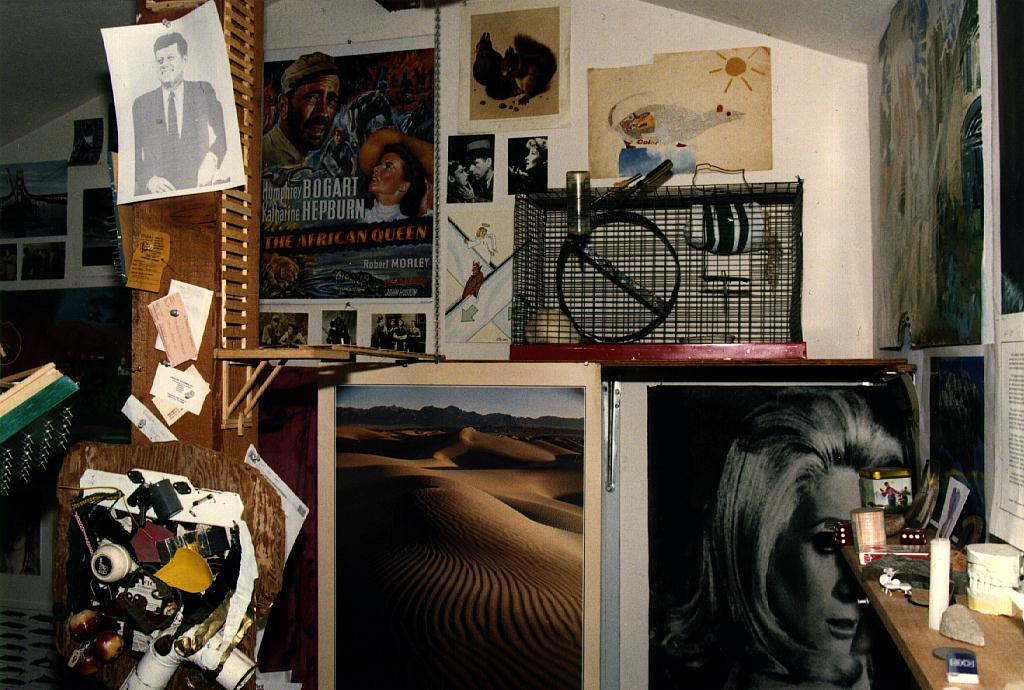
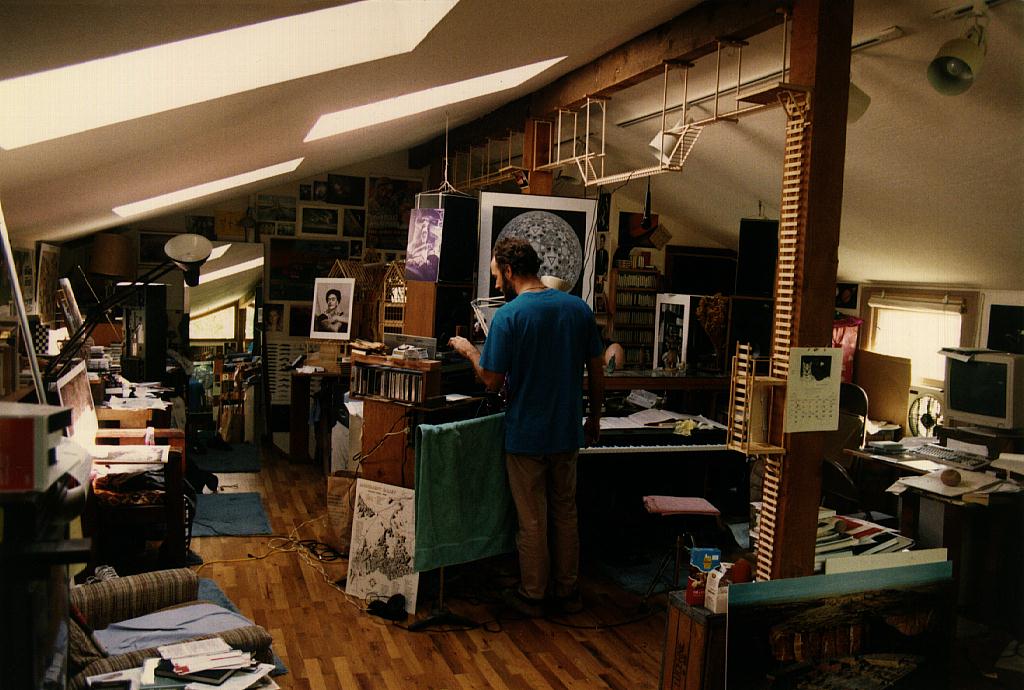
In May, i moved into my present domicile at 567 35th Avenue from where i had been living on Woods Street for four years in a marvelous 20x30 foot 2-story garage building with the second floor consisting of one large room. It was in this setting i constructed the most elaborate ratwalk ever manifested by these hands, seen in the above two shots. At left we see the ratwalk beginning on the shelf of Mr. Tillo's cage (occupant visible in left front corner) and running out to its first landing. From there a ladder ascends to a platform where begins the first of the two spans stretching between the room's interior posts. At right we see a wide-angle view of "the museum" (as a number of people so named the feeling it gave them when they first walked up into it).
In the hi-res image this thumbnail links to is seen the results of one of my most enjoyable construction projects since building the rat haus in 1982. This space was perfect for such a rat skyway to manifest itself. When in his cage, many a giggle and laugh was produced by sounding the calling all rats! --report to base alert at the intermediate 2-level landing visible on the post in the foreground, or, when Tillo was roaming thruout the room and report to base was initiated over on the door of his cage. His ladder climbing, ratwalk galloping, ladder descending drop and sprint across the final span back to "home" was a great source of enjoyment to all who witnessed this performance. (Now if only one of those witnesses had had a vid-camera with them to record this feat.... --i cood include the movie file version!)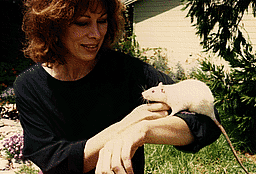
Since moving, the disassembled ratwalk lies in pieces, parked on a shelf in the closet as this domicile does not sport the sort of expansive ceilings they were built in/for. The Mr. Tillo who moved with me was the last rat i ever had. Renna loved Mr. Tillo and at one point we swapped the camera and him between the two of us. Before Renna had met Mr. Tillo she had never known anyone who had rats as pets and so had not yet seen them in such a positive light. But once she met him, she found the same charm, cuddliness, and love-ability i've always had for these sweet friends.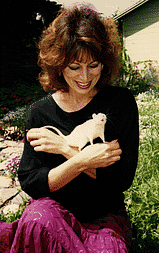
Unfortunately, the last three Tillos i had all developed terminal maladies and had to be put to sleep after about two years of life. i attribute this to two reasons. As a kid, some of the ratas lived for about four years. Today, as with the frogs, i sense they are like the miner's canary in our present-day world where the biosphere continues to be assaulted and, from my own experience, they register their vulnerability to this degradation in a host of forms. The other contributing factor is my sense that the integrity of the gene pool of domesticated rats is becoming more and more compromised as their interbreeding probably occurs more frequently along close fam'blee lines. The last times i went to the pet store i learned that most of the rats sold these daze go for snake food. Oh the sadness!
Luis Oleson, a life-long friend i met while at UCSC (who i think took the shots of the ratwalks -- among other talents he is a veteran photographer) taught me how to put the second-to-last Mr. Tillo to sleep as he had had to do the same thing with unwanted kitties when he was a kid. It was very painful but the experience taught me a new form of what it means to take care of another one is response able for in the only way that is good for them when they are in such pain and only doing the delayed "slow burn" to their final, anguished breathe. Renna was with me when i had to put the last Mr. Tillo to sleep here at 35th ave. The poor darling was visibly not comfortable (it seemed as if he had had a stroke as he no longer was able to walk evenly with his usual assurance) and i finally felt he was no longer wanting to go on with being here.
The death of so special a friend is always very painful. When one has to "take care" of one so afflicted it is doubly hard. i bebember when Dad and Bruce drove away with Pingo at the end of December, 1967 (Magical Mystery Tour had just come out) to put her to sleep because she was older and had kidney stones or something akin to that. The sadness we carry within for those who leave this place in such a manner is our own grief at being left behind. How terribly we miss them! After putting Mr. Tillo to sleep with Renna i felt i cood no longer invite another rata into my life as their collective health seems to have become so tenuous. And the speed with which daze are perceived to pass has increased so geometrically from the way in which i experienced time as a child, that two years at this point feels much too short a span to know friends as dear as the ratas who have shared their lives with me.
At some point around this time i was given a black rubber rat during Halloween by a friend who'd found it in a stationary store. Later my infinitely precious niece Simone (Patty's eldest daughter) gave me a larger one she'd used as a Halloween prop being a witch with her Mom at Mah'mon's 70th birthday party (which happens the day after Halloween). Andlater still i found another like Simone's during my own recognizance in San Francisco with Oona. Some years before that i'd registered the car's license plate as RATMNDU. (i was struck by how many licenses already held the rat moniker or some suitable allusion in a variety of fashions -- there was a whole page that began with "RAT"...! Luckily i had more than just "RATMBLE", "RATCAR", and "RATLIFT" in my list of candidates before i went in. ratmandu is the name i gave my machine at work soon after getting there. i was pleezed with the idea of a take off on the land of Kath[mandu]s.)
Thus it came to pass that while i no longer enjoy the company of a real live rata, i adopted these three "stand-ins"as my own "St. Peter" to watch over me while driving in the ratmandu mobile. They actually saved me from getting a ticket on 17 a few years ago. The CHP had me -- i was doing over 70. But when the guy came up after i'd pulled off he asked "Why do you have plastic rats?" i found out he too liked rats. We talked for a bit and then he turned to go back to his car and said, "Don't drive so fast, the rats'll fall off the dashboard." i azzumed he was going to run my license thru the computer. The next thing i knew he had rolled out and back onto the highway.
a ratical life: manifesting "rat haus reality"
In the summer of 1993 mosaic was something people were beginning to rave about at work. Peter Broadwell had been talking with me and said, "you shood check it out -- it's perfect for you." It took more than just a few months for me to finally understand what he meant and begin to grasp what all it offered for such an information ferret with librarianistic tendencies like myself.
When sgi.talk.ratical begin, i started pumping stuff into it and, by extension into various newsgroups on the net. i had become connected with the two creators of the misc.activism.progressive newsgroup when its antecedent, the activ-l mailing list was born and played a small roll in the formation of map. This was when the fact of U.S. complicity with and support of its proxy death-squad government in El Salvador was assuming more visible proportions in alternative news reports.
Back in UCSC daze (1984 or so) Paul Hansen had turned me on to Mae Brussell and her weekly radio show, "World Watchers". i listened avidly to her every week and was deeply impressed with her formidable grasp of names and the web of relationships between the people she talked about. In 1987 the Christic Institute Case shifted into high gear and i was extremely interested in the links and associations of people that Mae had been talking about for years now coming up in Dan Sheehan's articulation of more of the history of the 20th century covert government of these here United States.
Mae contracted cancer and died in 1988. i had met and come to know life-long friend Tom Davis who had been in the book biz for decades and was Mae's book source, as well as a first first-generation JFK assassination researcher in his own right. Thru Tom i met life-long friend John Judge. John flew out from Washington DC where he was living and he and Tom went to visit Mae in her last daze to determine what to do with her 25 year archive/library collection. It was decided that John wood move out here and set up the Mae Brussell Research Center (MBRC) in Santa Cruz. i tried to help out getting the center launched.
In the fall of '88 i obtained copies from Tom of a series of 19 articles on the CIA and the Vietnam Era from 1945 to 1964, written by Colonel L. Fletcher Prouty from 1985 to 1987, and published in Freedom magazine. Tom loaned me his personal copies for those issues he did not have extras of and i proceeded to cut-and-paste xeroxes of the complete series -- minus the headers, footers and ads -- into a "reader"-type format on 8 1/2 by 11 inch paper. i wanted to make and share copies of this series with people as i felt the author's insights and perspective were extraordinarily significant, given that he himself had taken part in helping to create and operate U.S. Air Force logistical support of U.S. Government clandestine operations world-wide from 1955 to the end of 1963.
John had grown up in DC and had known Fletcher for a long time. At the end of 1988 i met Fletcher myself thru John. John had told him of my just-completed project of making a reader from his articles. After their conversation John recounted how Fletcher had been intrigued that someone was so interested in his articles that they wood spend the time putting them into a cleaned up format. We then began to correspond directly and he agreed to my request to come to Virginia and interview him. We spent five days together at his home in May, 1989. The interview fell out into three distinct parts: Fletcher's 23 years service in the Air Force from 1941 to 1963 (i wanted to get as much context of his own years in the service to provide more background of his own qualifications for the books and articles he'd authored) -- three 90 minute tapes, his 1973 book, The Secret Team, The CIA and its Allies in Control of the United States and the World -- three 90 minute tapes , and the assassination of President Kennedy and the existence of the High Cabal -- one 90 and one 60 minute tape.
i had already become exceedingly familiar with the contents of the Freedom articles. i then spent a significant portion of time in the months prior to our interview meticulously studying The Secret Team and taking copious notes. i wanted to be as well-versed in the intricacies of this book as i felt i already was with the Freedom articles. The time in preparation was exceedingly well-spent. When i was with him we discussed many subjects in preparation to actually turning on the tape recorder and travelling thru the years.
Afterwards i did a first-pass transcription of most of the recordings and was helped with a few of the tapes by a woman who was a long-time World Watchers listener and MBRC volunteer. Fletcher then completed his own hand-edits of all the written transcripts in 1993. In recent months i have finally begun to work on these in preparation for publication thru rat haus reality press as a paperbound book as well to provide the text in its entirety on rat haus reality in the "Topics on the National Security States of America" section. The working title is Understanding Special Operations and Their Impact on the Vietnam Era. Already included in this location are hyperlinked copies of the two complete books and sixteen articles on the JFK assassination and the rise and maturation of elements of the National Security State control apparatus which i pumped out onto talk.ratical and the net in 1992.
In the fall of that year i switched my focus to working up a "Series on the Nuclear Establishment: Deadliest addiction of all" which i began to post in the middle of November. i never finished working up all i had listed in that introductory post, but i did succeed in sending out 48 of the titles, including transcripts of speeches, out-of-print books, articles and testimonies.
i had been concerned about nuclear pollution of the biosphere and the gene pool since hearing tapes of Dr. Rosalie Bertell from The Other Americas Radio. i had come across her book No Immediate Danger, Prognosis for a Radioactive Earth in 1986 and my interest and concern deepened. The murder of the Kennedys and government-by-unaccountability-and-deception was one thing. But i came to see the radioactive contamination of Earth as an even more lethal sort of covert activity. Oliver Stone's JFK movie came out at the end of 1992 and as "Man X", Fletcher's name became much more well-known in the public lexicon.
But in January of 1993 i came across some interviews that changed my own sense of priorities with life. i had ordered two tapes of David Bohm and two of Krishnamurti from the New Dimensions Radio catalog. In 1991 i had read and been very struck with Joseph Chilton Pearce's Evolution's End, Claiming the Potential of Our Intelligence which he had dedicated to David Bohm. Listening to these 4 interviews i found my own previous personal involvement in studying topics like the national security state or even the threat to all life from radioactive contamination was preempted by something that felt far more fundamental -- even though one cood argue that there is nothing more important than averting the possible premature end of all life on Earth.
Yet as i listened more and more to Krishnamurti and David Bohm i came to feel as if i was re-engaging something that had been dormant inside since i was very young. Evolution's End touched upon it but is was only with K and Bohm i felt the fuller impact of a rekindled sense of the infinite and unknown that is one of the hallmarks of being that children have not yet learned how to "turn off" or shut down. i began reading books by K, starting with Freedom From the Known.
In the next five months the strident, vociferous ratitor found his own presumptions falling ever more quickly away and the urge to speak outwardly became a deeper desire to listen inwardly. i wrote five posts only sent on to talk.ratical but not out to the net-at-large. The fifth one, "Krishnamurti on Contradiction," shared the fact that "i now see the anger and rage i channeled into suspicion, then condemnation, and finally rejection of external, impersonal authority embodied in ``the state,'' was actually a ``safer'' means to express my feelings about a much more potent and fearsome authority: my own father."
With this post i had arrived at the end of the era of pumping gobs of stuff out to the net. i spent about a year-and-a-half reading many books and listening to many tapes of Krishnamurti as well as of David Bohm -- particularly the dialogues he facilitated in Ojai from 1986 after K's death until his own in 1992. The recordings of these dialogues have provided a whole new level seeing some of my own inner dynamics of self-deception and how it operates. These recordings, along with K's understanding that The Only Revolution is the revolution within, have provided some of the most illuminating enquiries into the nature of being i have encountered in life.
The single most lasting effect exposure to these two people has provided is the understanding that one has to find out for oneself the nature of one's own being and the world one is alive within and part of. We are raised to look to another to tell us what to do, or how to do whatever. In doing so, we cut ourselves off from the source of inner wisdom we were born with and which is our greatest guide and mentor. No one else can possibly read and understand the book of life each of us is better than our own selves. Learning to re-awaken to and engage this inner source of intelligence is fundamental to our own self actualization.
In every moment we create the reality we experience by choosing how we interpret what we perceive. What we fail to grasp is that we choose the way we interpret what we apprehend. If we think there is no hope, that is our reality. If we sense we are powerless, it is what we are. And if we truly see the fact that we are soley response-able for the way we choose to interpret what we perceive, then we change the world in ways otherwise unimaginable. The only thing we can change is ourselves. In changing oneself, one changes the world. This is the only revolution possible.It was sometime in late 1991 or early 1992 that michele lord (who today goes by the name of rebecca) and i began conversing in e-mail after seeing each other's posts on Gary Trujillo's Native Net mailing list. At some point we began talking on the fown and in 1995 she came and lived here for a period while she was embarking on major life changes and setting out anew on her own. So it was that once i finally understood the implications about what Peter had meant regarding hyper-linked publishing on the net, i had already amassed a large amount of content to put out there for others to consider. rebecca and i slowly but steadily moved into a mutual collaborative endeavor that became rat haus reality, ratical branch.
At this point we are poised to more actively pursue the "business" angle as we need to start making more profit than the expenses i've accrued in initiating this web haus as part of rat haus reality press. We soon will start housing some "clients" who will be laying down their web-stakes in the ratical domain and i hope to have Understanding Special Operations published before the year is out.The life i've been given has been filled with uncountable blessings. This rat-bio is an attempt to articulate some of these gifts, the primary source of which has been my fam'blee and all the friends i've met along the way. i recently enjoyed an evening's dinner with another dear friend, Hiram Clawson, whom i have not seen enuff of in recent years. We met at the time the activ-l mailing list was launched and have paralleled each other in similar journeying formerly without and these years much more within. Hiram has been all over the Earth witnessing and photographing eclipses. That night he showed the slides and photogs of the Lunar Eclipse from last September 26 which i had the very good fortune to tag along with him on up at the foot of Loma Prieta peak where he once more engaged his array of cameras and collected a mass of visuals including the following three.
That evening was my first experience of seeing a lunar eclipse. It was made more special by being in such seasoned company and learning from Hiram a smattering of what he's experienced and seen about these occulations of the earth and the moon by SOL's gaze. To have been born on the day Luna was full seems to have imparted a quality of the energy she embodies. There is a curiosity and source of glow within that lights up this life i have been given. Since 1983 i have found the urge from within to "just become expansive" an exceedingly potent credo. Not a system; rather an understanding of the intelligence of life and the fact of its unknown infinite mystery.i am eternally grateful for all the company of others i've been expanded by and learned from on the journey i've been taking in this human overcoat. Recently the books of Laurens van der Post have enhanced my travels in a way similar to Krishnamurti and David Bohm. i can't recommend strongly enuff the single tale, encompassed by two books -- A Story Like the Wind and its sequel, A Far Off Place -- for anyone who likewise yearns for a re-kindled awareness of our common heritage as children of our Gaian mother, this Earth who spawned us and all life exploring itself thru eons here. It has renewed within something of that rich sense of "being at home anywhere in the universe, by instant right of the fact that one is a child of it and the life it lit on earth." [A Far Off Place, p. 271]