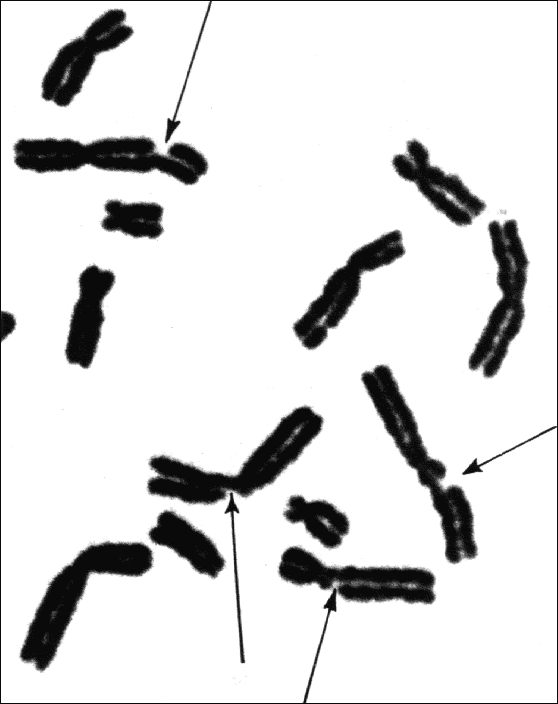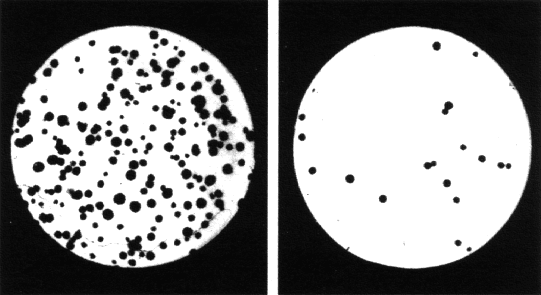
Courtesy of Theodore T. Puck,
Scientific American, April 1960
Scientific American, April 1960
|
CHAPTER 3
How Radiation Produces Disease
To grasp the significance of the physical harm done to human beings by radiation, it is not necessary to understand exactly what happens in body cells which are irradiated. But we will explain, in several sentences, what is known of these events, in case you may need this information for a debate on nuclear power plants. The terminology may be unfamiliar. The various kinds of radiation delivered to human cells (from beta rays, x-rays, gamma rays or alpha particles) are commonly referred to as ionizing radiation, or radiation which separates or changes into ions. The name is appropriate because the high speed electrons (beta rays) passing through living tissue actually rip negatively charged electrons from atoms, leaving positively charged ions. Such electrons in turn ionize other atoms until finally all the initial energy of the high speed electron is dissipated. Such electrons originate in the nucleus of the unstable, radioactive atom. When emitted, they travel with enormous speeds, some having speeds approaching the speed of light. Many such electrons have enough energy to break 100,000 chemical bonds between atoms. X-rays and gamma rays, by one or another mechanism, set electrons in motion in tissue. Once this is done, all the events which occur are similar to those produced by an original beta ray. Alpha particles also ionize atoms in their path, setting electrons in motion which cause further ionization. This disruptive action, producing electrically charged ions, is a major, but not the only, way such radiations injure tissues. Many chemical bonds between atoms are shattered in addition to the ionization produced. This is an important additional damage mechanism. For our purposes, such disruptive actions of ionizing radiation can best be regarded simply as a massive, non-specific disorganization or injury of biological cells and tissues. Biological cells are remarkably organized accumulations of chemical substances, arranged into myriad types of sub-structural entities within the cells. The beauty of such organization can only be marveled at when revealed under the high magnifications of such instruments as the electron microscope or the electron scanning microscope. In stark contrast, there is hardly anything specific or orderly about the ripping of chemical bonds or of electrons out of atoms. Rather, this represents disorganization and disruption. Perhaps a reasonable analogy would be the effect of jagged pieces of shrapnel passing through tissues. One hardly expects nature's architecture to be improved by the disruptive action of shrapnel or ionizing radiation. Instead, we can anticipate varying degrees of damage of the delicate internal cellular architecture. |
|
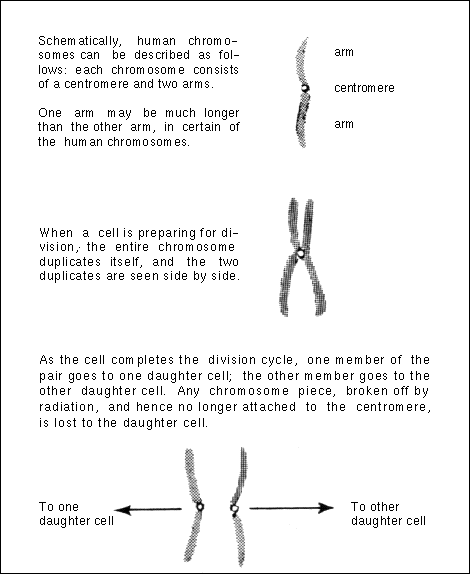
If the damage is catastrophic, the cell which has experienced the radiation injury dies. If less than that, the cell can go on living, though wounded, for a long time. Not only can wounded cells go on living, they can divide, and reproduce new cells. Unfortunately, these new cells might carry the injury sustained by the irradiated cell from which they originate. In many body tissues, the loss of a certain number of cells due to radiation damage can be tolerated because remaining, uninjured cells can divide and still maintain the necessary number of functioning tissue cells. Cells that are not injured too badly can carry on their usual function in the body, perhaps at less than optimum performance. Non-fatal injury to the cells of certain human tissues may be far, far more dangerous to the person than the outright, immediate death of the cell would be. These non-fatal injuries are especially hazardous because, within a period of years, a single cell injured in this way has the potential to initiate a cancer or a leukemia. We still do not know what kind of an injury ionizing radiation induces in the cells that would ultimately lead to a cancer—5, 10, 15, or 20 years later. We do know for certain, that this process does occur. What happens between the initial radiation injury and the ultimate appearance of a cancer or leukemia is still a mystery. But once this process has been initiated by radiation, science knows of no way to stop it. A wide variety (possibly thousands) of types and degrees of injury to cells may occur from ionizing radiation. Perhaps only one or a few of these may be of the kind which can start a cancer which finally destroys its human host. It is important to realize that one gram of cells (about 1/32 of an ounce) from a human organ contains a billion cells, approximately. So, even if only a very rare type of cell injury (among thousands of possible injuries) can start a cell on the path to cancer, it is still possible for thousands, or hundreds of thousands, of cells to be altered by radiation in a way that will eventually lead to a cancer. Do not forget, only one cell with the proper type of radiation-induced disorganization may develop into a fatal cancer. The process in between may be extremely complicated, and many injured cells might not be able to complete all the steps toward production of a cancer. But it takes only one cell to do so. The period between radiation injury and obvious cancer is quite long in the human. Leukemia, often called blood cancer, takes at least four or five years. Other cancers may take as long as 20 years. The intervening period is silent; the person doesn't realize it is going on. If asked about his health, he would, of course, say, "I feel fine." Because of the "silence" during which unknown deadly events are occurring, the time between irradiation and appearance of the cancer has been designated as the latency period. So for leukemia, the latency period is some five years; for thyroid cancer, it is approximately thirteen years. For some other cancers, the latency period is still not accurately known although periods of 20 years or more have been suggested. Once the latency period has passed, a certain type of cancer will continue to appear year after year in a group of humans subjected years before to known ionizing radiation. Acute leukemias due to irradiation continue to appear in apparently undiminished numbers, consistently even 20 years after the Hiroshima-Nagasaki bombing. One form of leukemia, so-called chronic myelogenous leukemia, seems to appear among the exposed population steadily over a period of about 10 years and then to appear less frequently. For most cancers, we do not know whether they will continue to occur throughout life once the latency period is over. New cases may finally stop appearing after 10 or 20 years in irradiated persons. Most public health officials properly assume that such cancers will continue to appear indefinitely in the irradiated groups. For, the assumption of anything else can lead to grave underestimation of the hazard of radiation. We must realize that this major consequence of radiation injury to cells, namely, cancer or leukemia production, does not become evident immediately after irradiation. Sadly, the long delay, or latency period, has proved to be very disarming. The result has been a failure to appreciate and understand the real magnitude of the pernicious effects of ionizing radiation. From radiation and other environmental noxious agents we tend to expect immediate effects. If we don't see them, a false sense of security takes over. The nucleus is generally considered to be the crucial site of cell injury by ionizing radiation. Further, the critical structures injured within the nucleus are the chromosomes. In every normal human cell (except for certain stages of sperm and ova cells) there are 46 such chromosomes. These chromosomes are considered by most biologists to carry all, or almost all, the information in the cell, information which directs the cell in all its activities, including growth, cell division, production of a host of biologically-important chemicals such as proteins, and other metabolic activities. For decades we have known that ionizing radiation can produce microscopically-visible injury to these delicate information-bearing chromosomes. Direct breakage of chromosomes into two or more pieces has been observed to occur after irradiation of cells. There is every reason to believe that the chromosomes suffer much additional radiation injury that is not visible under the microscope. Many authorities suspect that some particular type of chromosome injury, as yet unidentified, is essential if the cell is to go through the sequence of changes that finally convert it into a full-blown cancer cell. Certainly identification of the precise nature of such a chromosomal change represents one of contemporary biology's major challenges. Whatever that chromosome alteration may prove to be, we know that it does occur, all too often, when human cells are exposed to ionizing radiation. When ionizing radiation interacts with one of the chromosomes, there are two major ways in which the information system of the cell can be permanently altered by radiation. Genes are the units of information within the chromosome. They are composed largely of the chemical known popularly as D.N.A. (deoxyribonucleic acid). Radiation can produce a chemical alteration in a part of a single gene, so that the gene functions abnormally thereafter, providing the cell with false directions. When such cells divide, the altered gene may be reproduced in the descendant cells. If a single gene on a chromosome has been chemically altered, so that it provides new directions, a point mutation is said to have occurred. Radiation can also produce a different type of change in the information system of the cell. This change occurs if the chromosome is physically broken. On page 53 is shown a schematic diagram of a human chromosome. It has two arms and a small region between known as the centromere. When a cell divides, the centromere leads the way for the chromosome to go to the daughter cell. When radiation breaks off a piece from one of the arms of the chromosome, this piece no longer has a centromere. As a result, it gets lost from the cell on the very next cell division. A single chromosome has hundreds or thousands of genes within it. Thus, the piece of chromosome broken off may have tens or even hundreds of genes in it. Such genes are lost to the daughter cells when their chromosome piece is lost.[1] Presumably if too many crucial genes are lost thereby, the cell may die. |
|
|
If the mutation occurs in a body cell (meaning a cell other than a reproductive cell ), the potential result, ultimately, is cancer. The kind of chromosome alteration, or mutation, required is not known. However, leading opinion holds that a single radiation event is sufficient to provoke the chromosomal change required in a cell to start it on the path toward being a cancer cell. It is easy to understand from this that as the radiation dose goes up, the risk of future cancer development goes up in direct proportion. This is true because the chance that the "right" kind of single damaging event will occur goes up in direct proportion to the amount of radiation. New evidence, both for experimental animals and humans, makes it quite certain that the incidence of cancer, after irradiation, goes up in direct proportion to the total amount of radiation received. The particular kind of cancer that occurs depends upon which organs received irradiation. Thyroid gland irradiation leads ultimately to thyroid cancer. Mammary gland irradiation leads to breast cancer. Bone marrow irradiation leads to various forms of leukemia. In each case, the numbers of cancers appearing are expected to go up in direct proportion to the amount of radiation received by the particular organ of the body. Adult nerve cells represent a singular exception. They do not divide, hence, cannot become cancerous. Brain cancer, induced by radiation or occurring spontaneously, is really cancer of special connective tissue cells interspersed among the nerve cells. Hereditary Alterations Let us turn now to the effects of radiation-induced mutations in two important remaining cell types, the germinal cells of the testes, source of spermatozoa, the male reproductive cells, and the germinal cells of the ovary, source of ova, the female reproductive cells. Radiation injury to these classes of cells has even more far-reaching consequences than radiation injury which leads other types of cells to leukemia or cancer. Changes in the chromosomes of immature sperm or ova cells may be transmitted to all future generations of humans. The heredity of man, his greatest treasure, is at stake! Once injured, the chromosomes cannot be repaired by any process known to man. (Except in the short space of time described above.) The cells which produce sperm are called spermatogonia. Those which produce ova are called oocytes. Mature spermatozoa have 23 chromosomes. Mature ova have 23 chromosomes. Upon fertilization of the ovum by sperm, we return the number to 46 chromosomes, which characterizes all cells from the fertilized ovum through to the entire adult human. Injury to the sperm or ova chromosomes while in the testis or ovary, either by point mutation or chromosome deletions (see above), can thus be carried forward into every cell of a new human being. Worse yet, since every cell of the new human can carry such a mutation, the sperm or ova of this human can carry them also, so that the original injury persists through successive generations. We are probably fortunate that some of the mutations have such deleterious effects that the sperm or ova bearing the mutation fail to lead to a fertilized ovum, or if this does occur, the unborn baby is miscarried. But all too many serious mutations do permit the development of humans, whose cells bear the mutation, and who suffer serious health consequences as a result. How serious are the health effects upon new generations of humans carrying mutated genes or altered chromosomes? We are only beginning to realize that it may be possible to tolerate only a very small number of additional mutations of genes or chromosomes as a result of technological poisons if humans are to continue to produce new generations of humans. Countless geneticists have repeatedly cautioned society about the danger of allowing any increase in the rate at which any type of mutations are introduced into the general population. They know very well that mutations do occur due to natural sources of radiation and to other causes, many of which are not understood to this date. Some who attempt to make light of the hazards of introducing unnecessary mutations are quick to point out that some mutations are beneficial, and indeed they may be. But prevailing genetic opinion indicates that we cannot hope to improve man by increasing his mutation rate. We can, however, count upon doing a great deal of harm, measured in untold human suffering from physical and mental deformities, and a higher incidence of many serious diseases, if we allow mutation rates to increase. The Nobel Laureate in Genetics, Professor Joshua Lederberg,[2] recently indicated his grave concern about the implications of increasing the existing mutation rate of our genes, and stated that present radiation standards allow for a 10 percent increase in mutation rate. And he says, "I believe that the present standards for population exposure to radiation should and will (at least de facto) be made more stringent, to about one percent of the spontaneous rate, and that this is also a reasonable standard for the maximum tolerable mutagenic (heredity) effect of any environmental chemical." Dr. Lederberg is suggesting that all forms of influence in our environment which can provoke genetic mutation or chromosome injury be one percent of the spontaneous rate, yet he points out the serious situation that we are currently legally permitting 10 percent of the spontaneous rate from radiation alone. Let us quote Professor Lederberg on this: "A ten percent increase in the existing `spontaneous' mutation rate is, in effect, the standard that has been adopted as the `maximum acceptable' level of public exposure to radiation by responsible regulatory bodies." One wonders how it can be that responsible regulatory bodies would allow ten times more genetic injury to the population from radiation alone, when a highly respected geneticist suggests one percent as a maximum for radiation plus chemicals combined. Other geneticists concur. A multitude of unsatisfactory answers to this question has been provided. One is that we cannot afford to impede technological progress by undue restrictions. Thus, atomic energy programs such as nuclear electricity generation, "must" be beneficial to humans in terms of convenience and comfort, so they must be allowed to pollute the environment with radioactive substances that will ultimately produce genetic changes in man. A reasonable question: why must radioactivity be released at such a high level for atomic energy programs to proceed? This question is never asked, but the answer is, of course, economics. It is cheaper to pollute than to take the necessary steps to prevent pollution. Promoters of all technology realize this intuitively and consciously. Hence, they press for the loosest possible standards of pollution or, better yet, no restrictions at all. And the pressure of such promotional interests is staggering. Generally, all they need to do is mention the magic word "economics," and everyone falls into line. If it is not economical to prevent radioactive pollution, then assuredly we must allow the pollution to occur unimpeded. That we may pay an enormous price in the future through deterioration of our genes and chromosomes and, thereby, cause fantastic human misery and suffering, hardly enters this "economic" picture. This is not because the proponents of atomic (or other) technologies are hardhearted, evil individuals, bent upon injury to humans. Far from it. The apparent insensitivity arises from our widespread false definition of the term "economic." We only include short-term considerations in our economic calculations—those concerned with days, weeks, months, or a few years. More ultimate costs to be borne by future society, or future generations, are hard to anticipate (they almost appear "theoretical") and they are routinely avoided in economic considerations. Another common, but unsatisfactory, answer is given for why we would legally permit enough radiation (and radioactivity contamination) to cause a 10 percent increase in mutation rate. We are already being irradiated, they say, from natural sources (cosmic rays, radioactivity of substances in the earth's crust, carbon 14 produced by cosmic rays) in an amount that can also cause about 10 percent of the spontaneous mutation rate. As this specious argument goes, "we can't do much harm if we do to humans only the equal of what nature is already doing." Fallacious as it is in every respect, this argument seems credible to many among the public, the medical, and the scientific communities . They all fail to realize that natural radiation and the genetic and chromosomal mutations caused thereby are doing a great deal of harm. The genetic disorders and deaths caused by natural radiations are no different at all from those caused by man-made radiation. We saw in Chapter II that all these radiations act similarly and the injuries are no different from one source of radiation than from another. All we can say is that, at this moment, we know of no way to turn off the various natural sources of radiation. We, therefore, suffer an enormous toll of disease, debility and death as a result of natural radiation. As a minimum element of common sense, we should refrain, except under the most dire circumstances, from adding to this enormous burden of suffering by adding the injury of man-made radiation. The benefits to society should be required to be enormous and obviously so before permitting any amount of increase in radiation mutations due to man-made sources. When the argument is raised that natural-radiation-induced mutations cannot be harmful since humans have evolved this far in a "sea of radioactivity," this argument should be countered with several cogent points. First, while we have evolved to our present state in spite of radiation, we do have a limited life span and we do have an enormous toll of suffering, disease, and premature death due to genetic disorders. And natural radiation probably accounts for about 5-10 percent of such suffering and disease. We, societally, are at least humane enough to devote a sizeable share of our funds to medical care and medical research in the endeavor to alleviate the suffering and premature deaths caused by genetic, mutation-induced disease, some 5-10 percent of which is due to natural radiation. We must assuredly think very seriously of having to expend 10 percent more on medical care and consider having the massive increase in disease (genetic) that would go with man-made radiation exacting a toll comparable with or higher than the toll exacted by natural radiation. Precisely the same foolish argument concerning natural radiation could have been raised concerning poliomyelitis, cholera, typhoid, tuberculosis, yellow fever, diphtheria, and a host of other infectious diseases. It is entirely likely that the organisms causing such diseases have co-existed on earth, with man and other species, for millions of years. Would anyone argue that typhoid fever didn't exist, or yellow fever, or poliomyelitis, or bubonic plague, or diphtheria, or cholera? Hardly! In some areas of the world, life expectancy has not been the classical three score and ten, precisely because diseases caused by such organisms took a heavy toll leading to life expectancies very much shorter than they are today. Who would have listened to the argument that the tubercle bacillus was harmless just because man survived as a species in spite of the ravages of tuberculosis? Who would have argued that same case for the other serious agents of infectious disease? The situation in regard to radiation injury is actually much worse than the situation in regard to infectious diseases, isn't it? Promoters of nuclear energy are saying, in essence, "Since we already have such-and-such a level of illness from background radiation, it doesn't really matter if we increase this figure to the same level—in other words double it." Applying this same logic to infectious disease, public health officials would say, "Since we have always had 10,000 cases of malaria in this country, it doesn't matter if we increase the number to 20,000." Man has, with great ingenuity, searched carefully in his environment for causes of serious disease. Where possible, he has altered the environment, through sanitation, or by immunization procedures, thereby diminishing the enormous toll of infectious disease. What a shame it would have been if man had given up at the start and said poliomyelitis virus has always been with us, man has evolved in spite of it, and, therefore, no consideration need be given to ravages by polio virus. Precisely how serious are the genetic diseases man suffers from? Extremely serious! This has become increasingly clear to medical authorities from careful studies continuing right up to the present. Before considering the magnitude of the implications of genetically-determined diseases, it is important to point out that new mutations of genes and chromosomes are required to maintain the occurrence of all diseases that are genetically-determined, with rare exceptions. This is so because ordinarily most mutations introduced into a population render the bearer of the mutation slightly or grossly less likely to bear children than are persons with normal, unmutated genes of that specific type. Let us consider the most serious genetic (or chromosomal) mutation—which would be one which renders the person bearing the mutation absolutely sterile. In such a case, if a mutation occurs in the ovary or testis of a parent, the offspring may carry the mutation in all of its cells, will suffer the consequences of carrying the mutation, and will fail to reproduce. Thus, this type of mutation will not be propagated in the species beyond the one generation. But it will cause great suffering to the afflicted individual. If, over centuries and centuries the various spontaneous sources of mutation have remained constant, then this particular type of disease will have remained constant, the new cases always arising by mutations in the immediately preceding generation. If by man-made radiation we increase mutations by 10 percent we can expect an immediate increase of 10 percent (in the very next generation of offspring) in this serious type of disease thereby produced. But because of non-reproduction in such offspring, the effect is not transmitted to additional future generations. So this type of effect of an ill-considered allowance of a 10 percent increase in mutations due to radiation would not continue to persist if we were then to discontinue the radiation. Other genetic mutations do not render the offspring totally sterile but may reduce the average "reproductive fitness" compared to persons with the particular gene in the healthy (unmutated) form. For such mutations introduced by spontaneous sources (radiation or other), there is a build up of such mutations throughout the population until the loss of mutated individuals by lesser reproductive fitness just balances the introduction of new mutations of that particular type. The human species must have reached equilibrium in this sense, since if spontaneous mutations have been going on for millennia, by now the production rate and loss rate are equal. Disease due to such mutated genes is occurring in every generation. If, now, we increase the mutation rate by 10 percent due to man-made radiation and keep on doing this generation after generation, what will happen? Since many people already have that mutation from the previously established equilibrium, we will be adding to that number those due to the increased mutation rate, until after some number of generations (not precisely known, for it depends upon reproductive fitness) the loss of individuals by diminished fertility will balance the increment produced by the radiation. We will have a new equilibrium but now there will finally be 10 percent more individuals in the population bearing the mutation and, hence, there will be 10 percent more of the biological damage produced per generation by this particular defective gene or chromosome. The cost in health per generation can be much more serious than what would be expected just from the 10 percent increase in persons bearing the mutation. We shall see precisely how this can occur as we turn attention to the kinds of diseases caused by defective genes. What Kinds of Genetic Diseases? In recent years in medicine, our horizon has broadened considerably concerning the implications of genetics and mutation for human disease. In the past, genetic diseases were considered to be a relative rarity among the causes of disability and death. Now we realize that this rarity was an illusion, which led to a grave underestimation of the role of genetic mutations in human diseases. Today we recognize that a large proportion of all human afflictions are at least partially determined by heredity, and hence related to genetic mutations. Numerous authorities and authoritative bodies consider that the developing evidence may finally indicate that most, if not all, human disease has a genetic component. The United Nations Scientific Committee on the Effects of Atomic Radiation states:[3] "It is generally accepted that there is a genetic component in much, if not all, illness. This component is frequently too small to be detected; in other instances, the evidence for its presence is unequivocal. Nevertheless, the role of genetic factors in the health of human populations has not in the past been considered seriously in vital and health statistics. As a consequence, data on the prevalence of hereditary diseases and defects are now largely restricted to that collected by geneticists for special purposes in limited populations from a small number of countries. An assessment of the hereditary defects and diseases with which a population is afflicted does not necessarily provide a measure of the imposed burden of suffering and hardship on the individual, the family or society." Professor Lederberg[4] has recently stated the following: "We can calculate that at least 25 percent of our health care burden is of genetic origin. This figure is a very conservative estimate in view of the genetic component of such griefs as schizophrenia, diabetes, and atherosclerosis, mental retardation, early senility, and many congenital malformations. In fact, the genetic factor in disease is bound to increase to an even larger proportion, for as we deal with infectious disease and other environmental insults, the genetic legacy of the species will compete only with traumatic accidents as the major factor in health." Professor Lederberg has stated the problem succinctly and well. In the earlier days of medicine our techniques of sorting out genetically-determined diseases were cruder and tended only to find the diseases that had a simple so-called Mendelian form of inheritance. These are diseases which could be referred to as single-gene diseases. The inheritance patterns expected were known, and hence the genetic basis for the diseases ascertained, relatively easily, by studies of the occurrence of the disease in families and their ancestors. Among the classical cases of such diseases are the well-known phenylketonuria, galactosemia, cystic fibrosis, sicklecell anemia, hemophilia, and others. However, altogether such diseases, numerous as they are, only accounted for less than one percent of deaths. This is very serious, but still is small compared to the now greatly expanded list of genetically-determined diseases, the now well-known multigene diseases. For many years, medical experts realized that a host of the more common and serious diseases of man had a familial pattern, but not one as readily ascertainable as was the case for the single-gene diseases listed above. Dr. C.O. Carter, in a recent compilation of the evidence,[5] has shown that a whole group of important human diseases are indeed genetically-determined, but it appears that these diseases are determined by the interaction of more genes than one, and that this is complicated by further interactions with environmental factors. As a result of such work, we now are forced to consider not only the rarities like hemophilia as genetically determined diseases, but also diabetes mellitus, atherosclerosis (the major form of hardening of the arteries), schizophrenia, and rheumatoid arthritis all as being genetically determined diseases. Hence, they are all subject to increase in occurrence as a result of increase in genetic mutation rates by radiation or any other mutagenic influences. How do such diseases, added to the genetic list, lead Professor Lederberg to say a conservative 25 percent of all diseases are genetic, or lead others to say possibly all diseases (aside from trauma) may have a genetic component? Let us focus our attention on the disorder known as atherosclerosis. This disorder underlies most cases of the most serious form of heart disease in the USA, namely, coronary heart disease. It is coronary heart disease that accounts for the great majority of "heart attacks." And coronary heart disease kills more than twice as many Americans, prematurely, as all forms of cancer plus leukemia combined! What is more, atherosclerosis not only affects the arteries of the heart, but also those of the brain, many internal organs, and the legs. The total disability and death from atherosclerosis are really not fully realized at all, for as a complicating factor in other diseases, its role may have been underestimated—and underestimated seriously. The fact that atherosclerosis and coronary heart disease must now be regarded as genetic in origin, really means that over 50 percent of all disease, at least, is genetic. The implications of genetic mutations are thereby rendered grossly more serious than realized previously, when only single-gene diseases like hemophilia were considered as the genetic disorders of man. It was stated before that a 10 percent increase in genetic mutation rate would ultimately lead to 10 percent more of the biological damage produced per generation by this particular defective gene or chromosome. The cost in health per generation can exceed the 10 percent increase in biological damage. Let us consider atherosclerosis again. While we know that more atherosclerosis will result in a higher frequency of heart attacks, we do not know the precise relationship between degree of atherosclerosis in the arteries of the heart and the occurrence rate of heart attacks. Indeed, the available evidence on this subject suggests that the risk of a premature heart attack may rise much more steeply than simply in proportion to the degree of atherosclerosis. It may well be that an increase of 10 percent in the average degree of coronary artery atherosclerosis may lead to a 50 percent increase in the frequency of heart attacks. We simply don't know this relationship well enough. Similarly, atherosclerosis of the arteries of the brain underlies a fair proportion of "strokes," or cerebrovascular accidents. Again, whether a 10 percent increase in average degree of atherosclerosis of the cerebral arteries will increase strokes by 10 percent, 20 percent, or 50 percent is just not known. As a result, while we can anticipate that a 10 percent increase in mutation rate will ultimately increase the biological damage resulting in major diseases by 10 percent, it is also quite possible that the increased disease incidence may exceed this 10 percent increase in damage (already of grave consequence) by quite a lot. The consequences of genetic mutation, as a result of the new medical concepts of the important role of genetic factors in health and disease, are indeed far, far more serious than were realized 10 short years ago.
Incidentally,
many of the standards for so-called
"allowable" doses of radiation to the public for atomic
energy programs such as nuclear electricity generation
were set before the new implications of human genetic
diseases were appreciated! This fact alone requires a
total re-evaluation of atomic energy programs, nuclear
electricity generation among them.
|