CHAPTER 10
What Can Citizens Do
About Nuclear Electricity?
Recommendation for a Moratorium
On New Nuclear Electricity Plants
It is undoubtedly clear to the reader by now that the authors of this book have grave reservations about the stampede to nuclear electricity being promoted through the AEC, the JCAE, and the electric utility industry. Wholly aside from the views of nuclear critics, a large, and steadily growing, citizen concern has developed. The question is repeatedly asked, "How can this madness be checked?"
Nuclear electricity generation, as it has proceeded up to now, is a classic example of the misuse of science and technology that has brought on our deepening environmental crisis. It is a particularly important case-in-point because of the devastating possible consequences for all men and for all time. Once nuclear pollution has occurred on a large scale—(and nuclear electricity generation gives every promise of causing it) there will be no hope of reversing the pollution for hundreds or thousands of years.
Some gloomy individuals believe we might best let the madness go forward, eliminate the human species, and hope that at some dimly distant time in the future, the biological accident that led to the development of the human species in the first place, might occur again with a better result.
Others believe a solution will come by another route, short of obliteration of the human species. Persons knowledgeable in this field predict that a major accident in nuclear electricity generation will occur as a result of the proliferation of nuclear plants. They believe that before long such an accident will annihilate the inhabitants of a major city, such as New York or Chicago. If such a disaster should happen through a nuclear accident, we would undoubtedly re-assess our "need" for nuclear electricity generation.
It is a horrifying thought:—major calamity as the route back to a rational approach to electric power generation. However, the Atomic Energy Commission and the Joint Committee on Atomic Energy are still pouring taxpayers' millions into sales promotions devoid of realistic safety considerations. Tragedy may indeed be the ultimate resolution the problem finds.
Are there more reasonable solutions? People in a democratic society such as ours have been taught that the government's role is to protect our inalienable rights to life, liberty, and the pursuit of happiness. No wonder they are perplexed when virtually all branches of the national government operate in a way that seems to deepen the environmental crisis, rather than resolve it.
Numerous federal agencies operate in a way that either pollutes and destroys the environment directly, as does the U.S. Atomic Energy Commission, or they indulge the excesses of industrial polluters. Congress may pass laws to protect the public—to protect the consumer. But somehow the very agencies Congress creates to provide the protection almost invariably end up subverting Congressional intent.
Congress put the regulatory and promotional (pollutional, really) agencies together in creating the Atomic Energy Commission. So, in this case, even the semblance of a separate governmental agency to protect the public's interest is non-existent. What can the public hope to accomplish by appealing to the Atomic Energy Commission for curbs on atomic energy?
The AEC allows for the public to be heard. The Commission announces formal public hearings prior to the issuance of construction permits and operating permits for nuclear power reactors. In principle, it is possible, therefore, for the public to intervene, to protest construction or operation of a reactor.
Who hears such protests? The Atomic Safety and Licensing Board, selected from a panel appointed by the AEC. Nuclear power advocates dominate the membership of this panel. The chances for an unbiased hearing for an intervening group are clearly imperiled. It is true that some delays can be introduced into the whole system through such interventions, but, by and large, the delays are minimal. It is safe to say that if the public relies on open hearings in their fight against nuclear power plants, successive interventions on the next 600 nuclear power reactors will be followed by the construction and operation of the 600 reactors.
Nuclear electricity generation has developed under a set of, at best, questionable radiation standards—standards that are right now under sweeping review. Yet the licensing boards refuse to hear any challenge to a particular reactor that is based upon the invalidity and illegality of the radiation standards. The board accepts the standards as sacrosanct. It is up to the intervenor to prove that a proposed reactor will fail to meet the (current) standards. This is a patently ridiculous state of affairs.
This does not mean citizens should avoid such hearings. Certainly the opposing statements made there, reported in local papers, help educate the community on the true facts about nuclear power generation. Consider the effect: 500 people appear at such a hearing, all of them opposed to an impending nuclear power plant; this fact is reported locally. The community at large, and its officials, come to an early understanding of what they are up against, when the hearings produce nothing constructive and plans for the power plant go forward as if there had been no hearing.
Within the democratic process there are other avenues that can be effective. In the order of increasing effectiveness, these are:
- The U.S. Congress
- The State Legislatures
- Direct Public Referendum to Achieve a Moratorium on New Above-Ground Nuclear Power Plants.
Many members of the House of Representatives and the U.S. Senate are thoroughly informed on the true character of atomic energy promotion; if they are incensed, they feel powerless to do anything constructive. Largely the problem centers upon the stranglehold the Joint Committee on Atomic Energy has on the Congress. Suppose a bill were introduced into the Congress calling for a moratorium on construction of new nuclear electricity plants. The parliamentarian would undoubtedly refer it to the Joint Committee on Atomic Energy. There the bill will languish forever. Imagine what the chances are that the super-promotional Joint Committee on Atomic Energy would recommend a halt in such construction.
The early retirement of Congressmen Holifield and Hosmer would be helpful. More important would be action to keep all considerations of electric power generation, including nuclear power, from ever getting into the hands of this Committee. This does not appear imminent. An alternative approach would be to block the annual Appropriations Bill for the Atomic Energy Commission, in an effort to force a reasoned consideration of nuclear electricity generation. All in all, it is difficult to develop much optimism about constructive action at the Congressional level, considering the archaic, obstructionist features of the existing Committee system.
It wouldn't do any harm, however, for a citizen to discuss these expedients with his congressman and senators. They might be willing to try some of the strategies outlined here.
It is extremely important to educate individual Congressmen and Senators concerning nuclear electricity generation and its hazards, not so much for what these men will accomplish in Washington, but for the influence they can have in their own states, where constructive action is definitely possible. And some effective measures might be achieved in the Congress itself, since the public is increasingly aware that politicians' lip-service, without action, only aggravates an already alarming environmental crisis. The early retirement of such Congressmen could change the complexion of the Congress enough to make progress toward a rational nuclear policy possible. But this would take time, possibly a few elections, and be too late to prevent much of the nuclear power plant proliferation currently being promoted.
The Fastest Way to a Moratorium
Individual state legislatures are awakening to the concern of their constituencies, over the nuclear electricity juggernaut, especially where the plans call for nuclear electric stations that will leave almost no region of the state safe from the effects of an accident at one or another nuclear plant. Pennsylvania's state legislature recently responded to citizen pressure by initiation of extensive Hearings on Nuclear Electricity Generation, almost wholly focused on environmental, health and safety aspects of nuclear power.
Such hearings (in striking contrast with those conducted by the AEC) serve the extremely important function of providing the state legislators, and the public, with balanced information and an open-forum education on the less publicized aspects of nuclear electricity generation, such as health and safety. Until recently, the major source of information was the AEC's "gospel of the peaceful atom."
However, it appears that the most likely action of the state legislature will be to initiate interminable studies of the problem. Still, elected officials, when provided with full and honest information on both sides of a question, can aid materially in educating citizens of their own constituency.
To restore rationality to the nuclear electricity generation scene, the most likely avenue to success is a moratorium on new nuclear power plants above-ground for some period like 5 to 7 years. And the fastest way to achieve this is to get direct public vote, by initiative or referendum on the ballot, forbidding planning, constructing, or licensing such plants during the moratorium period.
The citizens of Eugene, Oregon were able to put a referendum on the ballot by citizen petition, which won a moratorium on construction of a nuclear plant that had already been approved. The action in Eugene proves that it is possible to educate the public about the dark side of nuclear electricity generation, in the face of a mountain of well-financed pro-nuclear propaganda.
It is very important for citizens to get involved, as directly as possible, in these major environmental issues. For too long, the public has been excluded from any significant participation in the dialogue, it has been thoroughly bypassed in considerations of what hazards to life and future will be accepted for specified benefits, or ostensible benefits.
This must change in the very early future. It is evident that the public is vitally concerned about the preserving of an environment habitable by humans and other living things. Public dismay at the progressive deterioration of the environment, with an almost total absence of any constructive action by government to alter this ominous trend, is equally evident.
Government agencies are often the chief promoters of pollution activity, aided and excused by huge public relations staffs that grind out reams of one-sided, uninformative press releases. The AEC is just one governmental agency which appears to have little regard for the public interest.
James Turner, a consultant with Ralph Nader's Center for the Study of Responsive Law, describes the incredible situation with respect to food additives thus:
"Over 95 different ingredients and chemicals can be added to bread by the manufacturer, as he desires, without adding them to the label. There are 76 such ingredients in soft drinks. There are 33 in cheese. In fact the whole standard setting procedures of the Food and Drug Administration and the Department of Agriculture are irrational and do not reflect the best interest of the consuming public." (September, 1970)[1]
Michael Wollan[2] pointed out that an analogous situation exists in several other governmental regulating agencies, including the National Science Foundation with respect to weather modification projects, the Federal Aviation Administration with respect to the SST project, and the Public Health Service with respect to fluoridation.
We have shown that the approach, philosophy, and methodology used in developing the radiation standards that govern the nuclear electricity program were erroneous. The electric utility industry has been misled concerning the radiation hazards associated with nuclear electricity. The leading physicist-engineers have been misled. Even the Chairman of the Joint Congressional Committee on Atomic Energy thinks we can safely be exposed to the amount of radiation it would take to produce a major public health disaster for this generation and for all future generations.
All this has been possible, and nuclear electricity generation has developed, as a major industry, through studiously maintained public ignorance of potential risks.
The only hope in this, and other desperately serious environmental problems, is to provide all the information to the public (all sectors of it). A growing segment of the public now realizes the hazards associated with nuclear electricity plants planned for above-ground construction on the very boundaries of major metropolitan centers. The full effects of catastrophic accidents that could occur remain unknown. Yet these gigantic, totally experimental plants are being constructed.
No responsible body of scientists, and no individual scientist, is now willing to minimize the potential radiation hazard to this and future generations. Indeed, when he was Secretary of Health, Education and Welfare, Robert Finch called for a total review of all radiation standards to reassess all the new evidence concerning hazards of ionizing radiation.
Those formulating the review are so concerned that they indicate it will take two years to study the evidence and to arrive at final conclusions as to just how serious these hazards are. Meanwhile, two Nobel Laureates[3] have come forward with their estimates, both even more severe than ours. A third Nobel Laureate[4] has expressed himself as opposed to nuclear power plant construction, simply because the gaps in our knowledge of radiation injury to humans are so large that he believes this alone justifies abandoning the construction of such plants.
There seems little doubt that the public must act directly to stop any further proliferation of this most dangerous, rashly promoted, nuclear electricity industry. The most constructive action seems to be a national moratorium on any further construction of nuclear electricity plants. In such a moratorium period, all the crucial questions can be thoroughly aired, and a rational future assessment planned.
It will be essential to press for action within individual states. In the 28 states for whom a nuclear electricity future has already been planned by those who never consulted the public, citizens groups are now thoroughly alerted and are seeking moratorium action in their own state.
In several states, the initiative is available and is the procedure of choice. Initiative is the procedure by which a specified number of voters may propose a statute, constitutional amendment or ordinance and compel a popular vote on its adoption. This is the highest form of effective participation in the democratic process. An initiative can be put on the ballot in such states to call for a 5-year or 10-year moratorium on nuclear power plant construction. Once passed, such a moratorium invalidates all attempts atomic energy interests might devise to have their way. Certainly where the initiative is available, it is the best course of action toward a moratorium.
The public must be prepared for a massive barrage of propaganda, from the Federal Atomic Energy Agencies and the electric utility industry. They will tell you that, after all, members of these bodies breathe the same air, drink the same water, and live on the same earth as the rest of us. And it is true. So true that if they can forget, for a moment, their immediate, parochial interests, they too might endorse a moratorium on nuclear power plants, at least until we can learn to handle this technology safely.
The ads about your "Good neighbor, nuke" will pour forth in the newspapers, the television, and in the lovely monthly utility company throwaways. Expensive 2-page newspaper ads will remind us that the western White House is located 4400 yards from the 430-megawatt San Onofre Nuclear Plant, and that it has not yet suffered injury. How can the American people, whatever their politics, stand idly by in such perilous times, while their President sojourns often at his Western White House? The region is one where a disaster evacuation plan is required by the AEC to allow operation of the nuclear reactor at all! One of the major accomplishments of a moratorium on nuclear reactors might be to remove the President of the United States from this senseless risk.
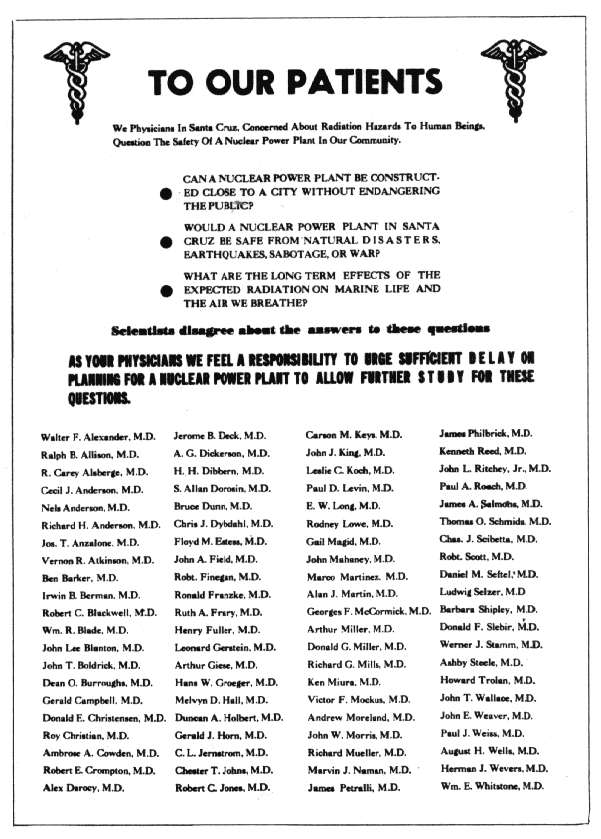
|
| In various parts of the country citizen groups have been formed to fight the construction of nuclear power plants. The above ad appeared in the local newspaper of Santa Cruz, California. |
Whatever the pressure of the pro-nuclear, power-propaganda barrage, it is worth remembering that the American public is not stupid. Given an opportunity to look at the facts, they will surely decide for a moratorium on nuclear electric plants. Fortunately, the press has been reporting the grim prospects associated with radiation hazards fully and honestly, so the public is becoming informed. Further, the public is undoubtedly more interested in self-preservation than in preserving the AEC bureaucracy or the profit margin of the electric utility industry. The public is justifiably skeptical of an industry which proclaims that it must build new electric power plants to meet demands, then proceeds to spend millions for advertisements dedicated to increasing electric power consumption. The polluters' cliches are rapidly becoming appreciated for what they are, a manifestation of total unconcern for the environment.
In the states where the mechanism of the initiative is, regrettably, not available, citizens should work hard to get it established, for the environmental struggle is only beginning. One has only to observe the politicians inaction on environmental matters and the collusion of governmental "regulators" with those they regulate, to realize that traditional approaches will only hasten the deterioration of our environment.
A moratorium petition, signed by tens-of-thousands of constituents, can have a powerful effect in awakening sleepy state legislators and can even activate governors to take a position with the public on such matters. Those who refuse to wake up and bestir themselves may simply have to be retired. Obviously, the more names petitions contain, the more likely it is that state legislators will be shaken from their lethargy.
The informed part of the public, with respect to nuclear hazard, must become active in educating those who are still uninformed, or worse, misinformed. All the logic and all the evidence to counter the empty platitudes of the proponents of nuclear power are available. Proponents who are able to present any logical points to support their position in a debate are rare. Encourage the AEC and the utility representatives to debate in public forums, where any weaknesses and illogic in their arguments are exposed to full view. Man the negative side of the debate with the most knowledgeable combatants available. Each such debate guarantees additional support for the moratorium we are urging.
AEC and the electric utility industry suggest that, unless we go through with the nuclear power plans, the iron lungs in our hospitals will have to shut down for want of electricity. Such assertions can be countered with facts. It is industries that consume most electricity, not iron lungs, not stereo sets, not air-conditioners, and not electric toothbrushes. Recycling aluminum, for example, instead of wastefully using electricity to produce new aluminum, would help to solve our solid waste problem as well as our power problem.
The electric utility industry may one day find itself backing the effort to obtain a moratorium on nuclear electricity-generating plants. This industry is caught in a vice and is currently trying to extricate itself gracefully. Deceived by AEC assurances of cheap, safe sources of additional electric power, they invested prestige and billions of dollars in the nuclear enterprise. The directors of these corporations will realize, sooner or later, that they have made a disastrous mistake and decide not to throw good money after bad. The time will have come to cancel the "Good neighbor, nuke" propaganda line.
A moratorium on the building of above-ground nuclear electric plants can give us breathing space for some rational considerations of the power supply problem. If we make our determination to have it widely and firmly enough known, the research and development funds of the nation will go to those areas needed, to supply necessary, safe, clean electric power.
-
San Francisco Sunday Examiner & Chronicle.
-
"Controlling the Potential Hazards of Government Sponsored
Technology." Michael Wollan, George Washington Law Review,
Vol. 36, No. 5, pages 1105-1137, July 1968.
-
Professor Linus Pauling and Professor Joshua Lederberg
(cited earlier [LP,
JL])
- Professor James D. Watson (cited earlier)