|
|
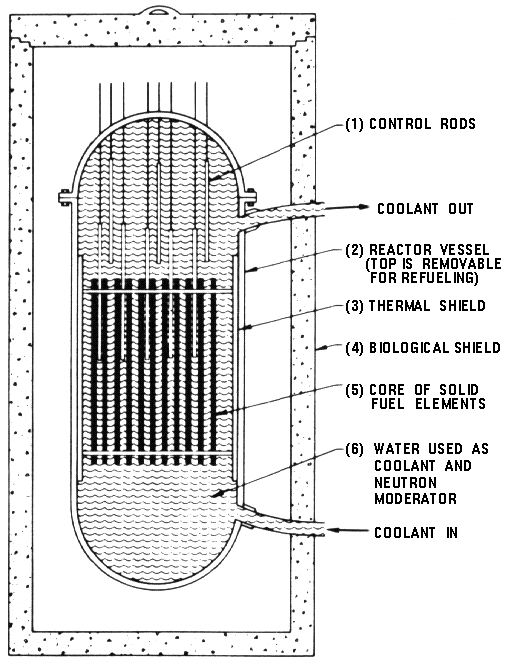
| Vertical cross-section of a pressurized-water nuclear reactor. |
|
Once a reactor core is assembled, it has the critical mass of uranium in an appropriate volume. That is precisely why the reactor works. But in addition to the critical mass of uranium, the reactor has control rods. These rods when inserted into the reactor core are able to absorb neutrons. When they are all inserted into the core, they absorb so many neutrons that not enough are available to sustain the chain reaction. As the rods are gradually withdrawn the power level of the reactor increases. The above explanation of controlling a nuclear reactor sounds simple. In principle it is simple. But between that simple explanation and the design of a truly safe reactor lies a great deal of engineering sophistication. We shall go into this further in Chapter 4. Besides safety, there is a collateral aspect of nuclear power plants—i.e. reliability. Because of the serious hazard associated with the radioactivity accumulated in the core of a reactor, the safe operational limits of the reactor relate to its reliability. A nuclear power station may be required to shut down simply because it is releasing, or may potentially release, too much radioactivity to the environment. One of the questions that we explore in this book is—if adequate (more restrictive) regulations were imposed on the present nuclear power reactors would they be allowed to operate at all? |
|
|
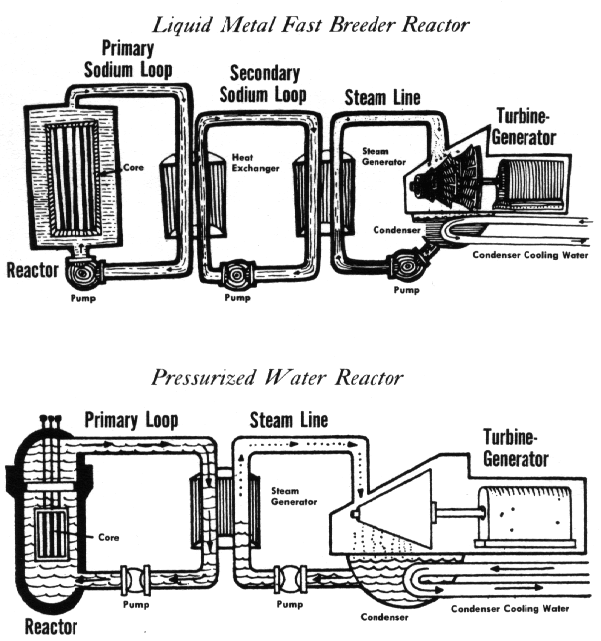
Breeder Reactors The fissionable material in the present water- moderated reactors is uranium-235 (U-235). Uranium-235 represents only about 1 percent of the natural uranium (0.71 percent). The rest is composed of the heavier isotope U-238. Uranium-238 can not be made to undergo fission except by high energy neutrons which are not created when U-235 undergoes fission. However, U-238 can be converted into a fissionable material, plutonium-239 (Pu-239) when it absorbs a neutron. The present-day nuclear reactors discussed above are moderated by water. By moderated it is meant that the neutrons which the U-235 releases upon undergoing fission are slowed down (reduced in energy) by the water. The present nuclear reactors also contain U-238 and when the U-238 captures a neutron it is converted to Pu-239. In the present reactors, because the neutrons are moderated or slowed by the water in the reactor, the U-235 emits fewer neutrons than it would if it underwent fission as a result of absorbing faster neutrons. As a consequence, less Pu-239 is made in the present reactors than U-235 that is burned. There is a net consumption of fissionable material; considerably more fissionable material is consumed than is produced. In the fast-breeder reactors, however, the water moderator is removed and the neutrons which are captured in this case by the U-235 are faster, or higher energy, neutrons. The net result of this is that the U-235, when it undergoes fast neutron fission, produces more neutrons than it would when it undergoes fission as a result of the absorption of a slow neutron. This production of additional neutrons results in a net increase in the production of plutonium over the amount of U-235 that is consumed. That is why these reactors are called breeders. The operation of the fast-breeder reactor, therefore, is anticipated to produce large quantities of fuel to operate reactors fueled by Plutonium-239 (Pu-239) rather than the present uranium- fueled reactors. But the requirement for higher energy neutrons in order to produce a breeder reactor means that the reactor will necessarily have to operate at a higher temperature. The neutron moderator, the water, is therefore not used in these reactors and the reactors are cooled with the liquid sodium. Sodium is a highly reactive metal and liquid sodium will explode upon contact with water or air. Moreover, the fast breeders, in order to increase their breeding capacity, have to be made more compact than the present generation of reactors. Therefore, they will contain much more fissionable material in a smaller volume. The breeder reactor, therefore, concentrates the fissionable material into a smaller volume and operates at a significantly higher temperature. These two specifications for a fast-breeder reactor represent the most serious engineering complications for these systems. The major concern with these reactors is an accident that might result in the concentration of fissionable materials into small volumes wherein the chain reaction can proceed in an unmoderated fashion. Such an event could result in an extreme increase in temperature and a possible explosion. These explosions are not as tremendous as those which result from atomic bombs which are designed for this particular purpose, but nevertheless it is these potential explosions which represent the grave concern of nuclear-reactor designers. Consequently, the fast-breeder reactor places the most stringent requirements upon the control of the process to prevent over-heating and melting of the fuel materials. Very small melts can result in the accumulation of critical masses. Again it may be asked: why proceed with the fast-breeder reactor if it is potentially dangerous? One reason is that the present-day water-moderated reactor will rapidly consume all of the U-235, and nuclear reactors would disappear. The breeder is an answer to this. It will produce more fissionable material in the form of Pu-239 than it uses. The other reason for developing the breeder is that it was envisioned as a source of very cheap power. However, as we shall show later, this vision is becoming quite blurred. There is considerable reason to suggest that the Atomic Energy Commission made a serious mistake some 15 years ago when it began to press for the rapid development of a nuclear power industry. The first chairman of the AEC, David Lilienthal, has recently stated:[1] "Once a bright hope, shared by all mankind, including myself, the rash proliferation of atomic power plants has become one of the ugliest clouds overhanging America." We share Mr. Lilienthal's apprehension and much of this book explains the basis for our concern. The last three chapters discuss the methods available and the means required to rectify this mistake which the AEC seems bent on perpetuating. Suggested Reading A more complete description of nuclear power plants, together with pictures and drawings, can be obtained in three booklets published by the Atomic Energy Commission in its "Understanding the Atom" series:
Nuclear Reactors
These three booklets may be obtained free by writing to USAEC, P.O. Box 62, Oak Ridge, Tennessee 37830.
|