DESIGN: Lorenzo Mollicone
Finding my way in 1989 to meet and interview L. Fletcher Prouty was yet another gift realized along the journey. Mae Brussell, Tom Davis, John Judge were the connections that allowed me to reach Fletcher. At the time, my only intent was to speak with him and record our conversation given my understanding that here was someone who had worked on the inside of the U.S. government’s subterranean system that took shape in the post-WWII world. Only after our meeting did I begin to think of making a book from the recordings to document Fletcher’s experiential knowledge and understanding of the U.S. National Security State’s expanding development.
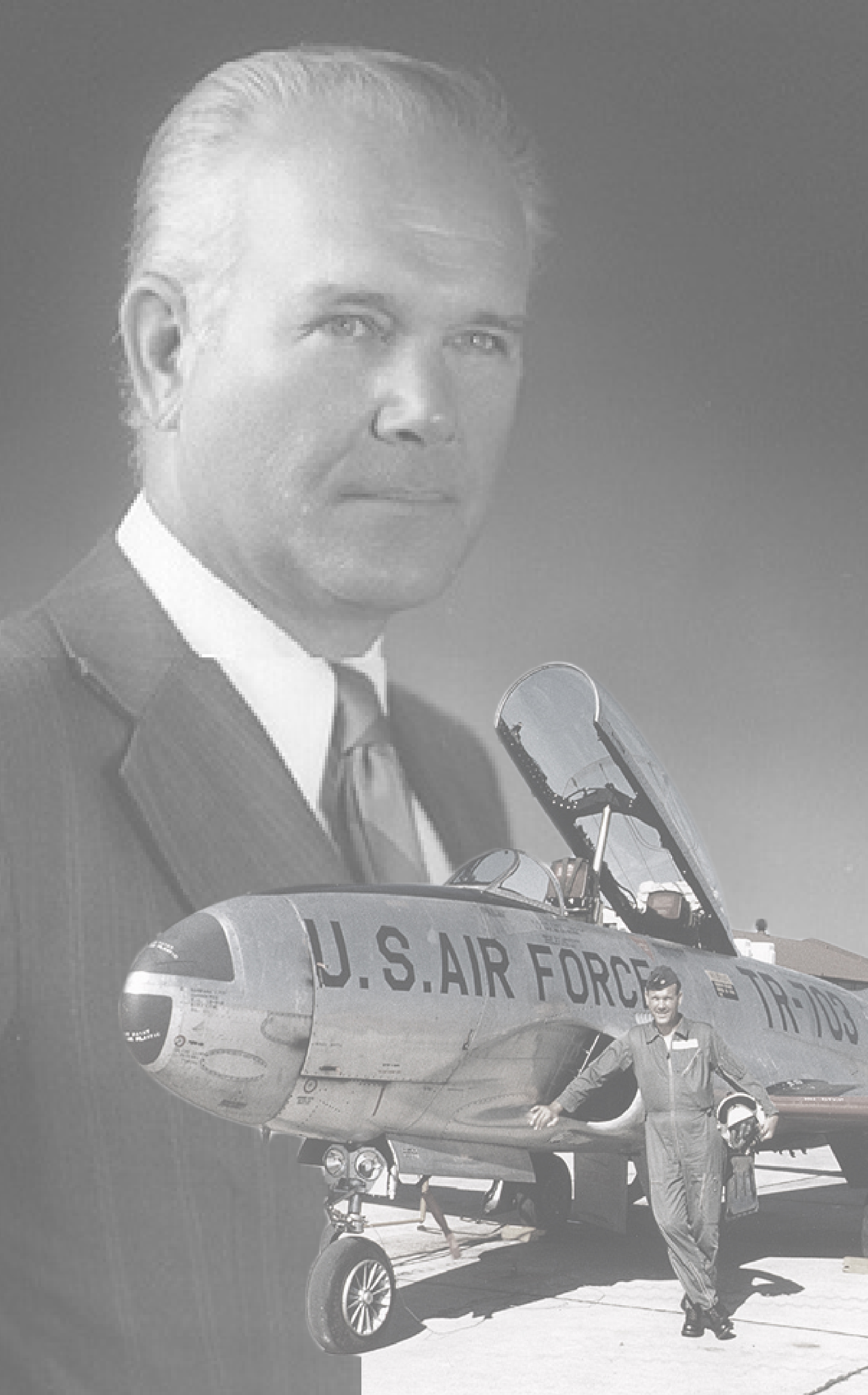
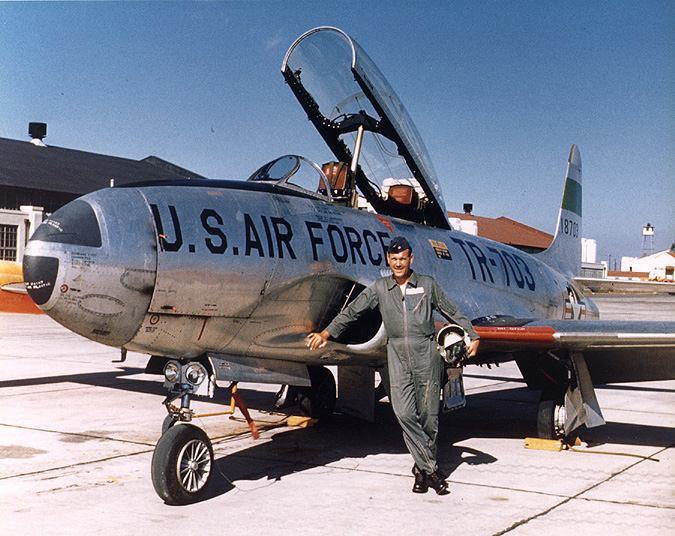
The back cover of the 2025 Second Edition includes two images of Fletcher. The large portrait was taken in the early 1990s in the period of his association with Oliver Stone. The smaller portion at the bottom is Fletcher standing in front of a T-33 trainer jet, date unknown. These images highlight specific areas of Fletcher’s life experience.
The following segments, taken mostly from Fletcher’s writings, present a depth of perspective and understanding gained from a significant period of his life in the U.S. military and the decades following.
Lieutenant Colonel George Kraigher said ”Lieutenant, we are going to use you now for a VIP pilot.”... I was notified that I was going to pick up...Major General Omar Bradley.... We flew him into the battle-zone areas of North Africa.... he’d look down out of the plane...and he’d tell me all the action that had taken place below. He’d say, “Now, see those three tanks over there? Those are German tanks. We knocked them out last week. Now look over here...” It was a terrific briefing of exactly how General Bradley was operating this campaign in North Africa. Chp 1, Pt I: 6, 7.
Early in November 1943, President Roosevelt directed that an American “Geological Survey Team” headed by General Cyrus R. “C.R.” Smith, founder and president of American Airlines, be sent to Africa and thence on to Dhahran not only to investigate the oil fields and their immediate potential; but to bolster the moral of that small stand-by group of oil-men who were riding out the war by holding that franchise at Ras Tanura.
This author was directed to fly General Smith’s party, in a special V.I.P. Lockheed Lodestar of the Air Transport Command, from Casablanca, on Nov. 10, 1943 and flew to Teheran via Tunis and Cairo. We arrived on the island of Bahrain on Nov. 16, 1943.
Because of Saudi Arabia’s “neutrality”, Gen. Smith had made special, secret arrangements for our flight from Bahrain to Dhahran. We arrived at 11:05 AM on the 17th and were met by Floyd Ohliger, an oil engineer and three other CASOC people. The Middle East Cauldron: 9-10.
[T]hey very kindly took the whole crew, as well as the general’s party, and drove us over to an area where there were some oil pipes, that I would say were 10-inch pipes, sticking out of the ground maybe a foot, with caps on them. They’d unlock a cap, spin it off, and oil would just bubble out of the ground by itself—no pump, no nothing. All they said was, “General, come and get it; you can have all you want. There’s oil here for years.” Now remember, this was 1943. And they’ve been pumping that oil ever since....
But that’s the first clandestine exercise I was ever involved in. We went in as though we were civilians, just by painting the plane. Chp 1, Pt I: 12.
Special Operations is a name given in most cases, but not always, to any clandestine, covert, undercover, or secret operations by the government or by someone, U.S. citizen or a foreign national ... even in special cases a stateless professional, or U.S. or foreign activity or organization. It is usually secret and highly classified. Prouty 1973: vii.
[I]n getting this work done [in the Office of Special Operations], I did a lot of work with our general counsel in the Air Force. In other words, we needed a lot of legal help. Because for clandestine work, in order to be effective, the bills have to be paid without leaving a trail. You can’t go to Congress and say, “We need $10 million because we’re going to run some covert operation.” You have to have the money available all the time. It has to be ready and we have to know how to use it. Or, if we used twenty airplanes in some covert work and we lost three of them, we have to account for the loss. Just like you’d have to account any loss you had in a business or in the military—and on and on. Chp 1, Pt II: 43.
This philosophy of reimbursement is very important in covert operations because it keeps bills from appearing in public that would stir up questions about why this money spent was spent when it wasn’t spent for the line items in the budget. Thus when we created the Tab-6 system we worked this reimbursement system in throughout so that you never saw the spending of any money. The Air Force never spent any money on the CIA operations, technically. The money was immediately transferred through a comptroller’s office arrangement up in the office of the Comptroller of the Secretary of Defense. And that expenditure was, actually, Agency money.
Within a few years, the Agency was able to point out to Congress that a lot of money was flowing in that channel because, effectively, they were paying for the utilization of very high-cost equipment: aircraft, submarines, even aircraft carriers in a few places. Very expensive things to operate on a reimbursable basis. So based on that, the agency began to get a much larger budget.
Then when they went into the U-2 and the space programs that budget grew considerably. And it was a completely classified budget and almost non-accountable as the DCI has the authority to spend that money simply on his signature. He doesn’t have to account for it. It’s a rare thing in the budget process, but the Congress goes along with that, for the CIA. Chp 2, Pt II: 131-132.
There was no planning shop. In fact, I’ve always thought—and I worked very closely with them—that one of the strangest devices they used was to call their covert operations the Deputy Director Plans, because there were no plans. I worked with them intimately for nine years. I never saw a single plan come out of the Deputy Director Plans. They would simply smile and say, ‘Well, that’s just our euphemism for covert operations.’ They could have used some other word than “plan.”
But this is how Dulles worked. He was very effective. He had a lot of experience with OSS; and the other side of it is that his brother was the Secretary of State and the dominant vote in the National Security Council. I don’t think this would have been the same if he had been an individual with some neutral or objective Secretary of State. It made quite a bit of difference under the Eisenhower era to have the two Dulles working together in the development of covert operations. Chp 2, Pt I: 105.
The term “special operations” means “military services providing support to the clandestine activities of the United States Government.” The term is a euphemism for overthrowing governments, sabotage, murder, contrived wars, espionage, torture and assassination. These and other similarly indefensible acts are all justified with equally euphemistic masks such as “in the interests of national security,” “defending our way of life,” “the American Way,” “the promotion of democracy,” and, “national sovereignty.” Ratcliffe: Intro: xiii.
As the world’s military strategists noted those developments [US & USSR hydrogen bombs] they knew all too well that “Conventional” warfare in any form that had been known before was no longer the final solution to international conflicts of any size. At the same time they were beginning to realize that these great “Fission-Fusion-Fission” hydrogen weapons would not resolve international disputes effectively either....
[T]he above is an outline of the thinking of World Leaders of the Mid-Fifties era. It may be noted that the alternative to that “War Planning” stalemate was first stated by the Dulles brothers team. They saw a future for “Covert Operations” as a potential alternative. This led to NSC’s approval of CIA’s Saigon Military Mission and to the most important document of those decades, NSC Directive #5412 of March 15, 1994 that became the official recognition and sanctioning of covert operations in Indochina and throughout the world....
[D[uring this age of thermonuclear weapons, the United States would utilize covert operations under the control of the CIA. From that date on the CIA became: 1. This nation’s “Secret Team,” and 2. The “Make-War” power-center of this country. Appendix A, 1998 Preface: 276, 277.
The Dulles philosophy was to control the focal point area. This then led to the creation of focal point offices everywhere. As I established this “Tab-6” organization, as we called it, in every major staff area within the Air Force (because that was my jurisdiction at the time), I would “clear” people—another focal point, you might say a sub-focal point—a person I could go to who had been given, ahead of time, the authority to do whatever it was that he was authorized to do.We stressed this was only for "authorized" business—he would have to be sure he had orders, either from my office or directly up to the Chief of Staff, and that we knew what we were doing for CIA.
This leads to another step, of what you might call “breeding". We had to work with various agencies of the government, not just the Defense Department. We had to have contact points in the State Department, in the FAA, in the Customs Service, in the Treasury, in the FBI and all around through the government—up in the White House. Gradually we wove a network of people who understood the symbols and the code names and the activities we were doing, and how we handled money which was the most important part. Then we began to assign people there who, those agencies thought, were from the Defense Department. But they actually were people that we put there from the CIA.
This led to the creation of a system of powerful individuals—people whose jobs were quite dominant in some of these other agencies. Especially after they’d been there two or three years, because we put them in there by talking to the top man, the cabinet officer or the head of the agency. We would say, “This man is being placed here so that he can facilitate covert activities and so that he can retain the secrecy that’s required and he will keep you informed at all times.” Well, in the over-all U.S. bureaucracy, the top people tend to move from one job to another faster than anybody else, not the career people who are there for a lifetime. So the man we had explained the “Focal Point” structure to, perhaps a year-and-a-half earlier, would be transferred or leave the government. But our trained and fully cleared “Focal Point” man was still there. So after one or two cycles of this, that agency might not even know that employee was our man and not actually theirs because they would have no record of his special assignment, of what his origins were. They would think he was just another one of their own employees.
As a result, he became extremely effective.... These people became very, very adept. Chp 2, Pt I: 123-124.
By the same token, people that were bona fide employees of CIA (agents), were assigned even into the office of the Secretary of Defense. We had certain people there who were CIA employees—Ed Lansdale worked for CIA all his adult career. A person named Frank Hand worked there. But the people in the Pentagon thought they were ordinary military employees. They didn’t realize they were CIA....
Frank Hand had been there for years in the same way. Frank was a civilian of outstanding ability. I always wrote that he was the most important agent that the agency had because he was operating daily and effectively as a member of the office of the Secretary of Defense. You can just imagine the things that a person in that capacity can do when his home base is really CIA. Although people rarely believe this when they first hear it, there are assignments like that in the White House; there are assignments like that in the State Department. For instance, it’s hard to tell the difference, between Bill Bundy who was a long-time CIA employee and his brother McGeorge Bundy who was in the White House with Kennedy. The two brothers certainly are going to act side-by-side-they have the same goals and the same intentions. There were many instances that duplicated like that.
It wasn’t long—I’d say by the end of the fifties or early sixties—before we had spread through the government what I called a Secret Team, a group of people who really knew how to operate the CIA business through the boundless maze of the United States government. Chp 2, Pt I: 124, 125.
Few concepts during this half century have been as important, as controversial, as misunderstood, and as misinterpreted as secrecy in Government. No idea during this period has had a greater impact upon Americans and upon the American way of life than that of the containment of Communism. Both are inseparably intertwined and have nurtured each other in a blind Pavlovian way. Understanding their relationship is a matter of fundamental importance....
[T]here have been some excellent books in this broad area ... But many of these books suffer from various effects of the dread disease of secrecy and from its equally severe corollary illness called “cover” (the CIA’s official euphemism for not telling the truth). Appendix A, 1973 Preface: 260, 261.
[I]t must be asked if we can remove cultural value from one part of our lives without destroying it also in the other parts. Can we justify secrecy, lying, and burglary in our so-called intelligence organizations and yet preserve openness, honesty, and devotion to principle in the rest of our government? Can we subsidize mayhem in the military establishment and yet have peace, order, and respect for human life in the city streets? Can we degrade all forms of essential work and yet expect arts and graces to flourish on weekends? And can we ignore all questions of value on the farm and yet have them answered affirmatively in the grocery store and the household?
The answer is that, though such distinctions can be made theoretically, they cannot be preserved in practice. Values may be corrupted or abolished in only one discipline at the start, but the damage must sooner or later spread to all; it can no more be confined than air pollution. If we corrupt agriculture we corrupt culture, for in nature and within certain invariable social necessities we are one body, and what afflicts the hand will afflict the brain. Berry 1977: 91.